
Car-Optional: Minneapolis And Miami Top The Best Walk & Ride Cities As U.S. Urban Living Gets Reimagined

- Minneapolis, Miami, and Pittsburgh earn top marks for walkable, live-work-play environments where dependence on cars for daily activities is significantly reduced.
- Regionally, the Northeast & Midwest lead with the largest cluster of car-optional, walkable cities.
- Minneapolis and Portland continue to uphold their reputations as the nation’s biking capitals.
- New York City ranks first for public transit, while San Francisco takes the lead for walkability.
- A surprise contender, Miami lands at No. 2 overall thanks to its dense neighborhoods and expanding transit corridors.
- Bucking their own state trends, Honolulu and Tempe also stand out as walk-and-ride hubs in regions otherwise defined by car dependency.
Today, the most valuable commodity is time, and many U.S. cities are striving to deliver. After decades when sprawling suburbs reigned supreme and downtowns were seen mainly as business districts or tourist stops, urban life is being redefined. Increasingly, convenience means proximity – being close to the essentials that make daily life livable – without relying on a car.
The pandemic gave this shift visible momentum, and cities have only built on it since. Across the country, hundreds of miles of bike lanes have been added, light rail systems expanded, and mixed-use multifamily projects have reshaped urban cores. These changes reflect a growing demand for a more comfortable lifestyle—one where errands, work, and leisure are all within easy reach by foot, bike, or transit.
This transformation has also spilled over into the way people use space. As more Americans embrace urban living in walk-and-ride cities, demand for self storage has grown. Smaller apartments and active, car-light lifestyles mean residents often turn to storage facilities as an extension of their homes – a place for vehicles, bikes, sports gear, or seasonal items that don’t fit in compact urban spaces. In many ways, storage has become part of the infrastructure that supports the convenience-driven, car-optional lifestyle these cities are championing.
Interestingly, the shift toward walk-and-ride living also changes how urban residents treat their cars,” says Emilia Man, senior analyst at StorageCafe. “In many of these cities, vehicles are no longer daily necessities but rather weekend companions for longer trips. Some households choose to place their cars in secure storage facilities, while others turn to self storage to free up garage space — allowing the car to stay at home instead of competing with holiday decorations, bikes, and sports gear. In both cases, self storage emerges as a quiet enabler of the car-optional lifestyle.”
While widely supported, the path to car-optional environments looks different across the nation. To identify the cities advancing fastest, we evaluated 180 urban areas using a Car-Free Friendliness Index. This considered walk, transit, and bike scores; commute times; access to jobs and essential services without a car; and traffic safety for pedestrians and cyclists.
The results reveal the best walk-and-ride cities in the U.S. – places where jobs, schools, and entertainment are easily accessible without owning a car, and where the future of American urban living is already taking shape.
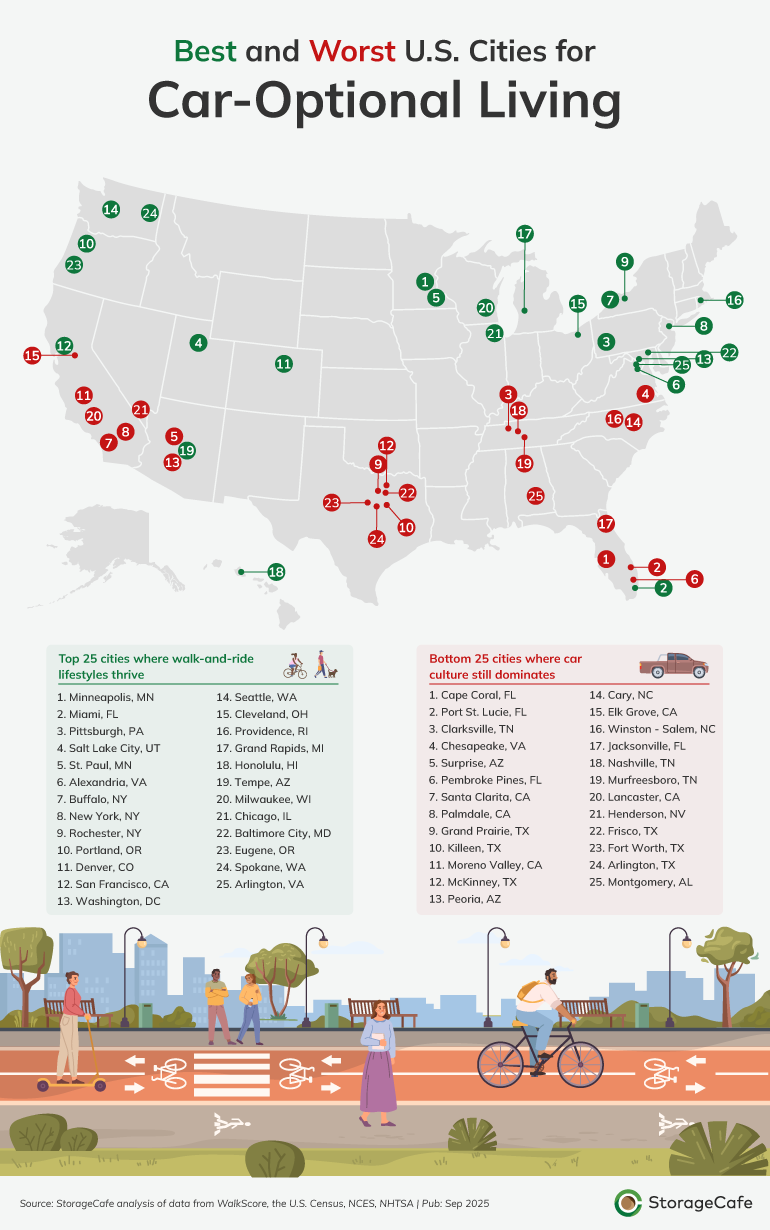
The Northeast and the Midwest concentrate the largest cluster of walk & ride cities — each with six of the nation’s top 25 hotspots — anchored by strongholds like New York City, Minneapolis and Pittsburgh. These metros build on a long legacy of transit-rich, dense urban cores, as well as industrial-era neighborhoods clustered around factories and rail lines, where walking and public transportation remain central to daily life.
Out West, another hotspot of car-optional cities is taking shape. Eight cities are in top 25, with Salt Lake City and Portland at the forefront. Both have embraced ambitious strategies to cut car dependency and expand biking and transit infrastructure, reshaping how residents move through the city.
At the other end of the spectrum, large Sunbelt metros – particularly in Texas, Arizona, and much of Florida outside Miami – remain firmly tied to car culture. Sprawling urban design and auto-oriented infrastructure continue to define cities like Las Vegas and Phoenix, where daily life without a car is still a challenge.
If you’re looking for a walkable live-work-play area to call home, we’re highlighting the 10 best cities that can help jumpstart your car-optional lifestyle. While naturally diverse, they all share one key trait: each offers a distinct model of how walkability, transit, and biking culture can transform urban life — together forming a blueprint for how Americans may live in the decades ahead.
1. Minneapolis, MN

Downtown Minneapolis, MN
Minneapolis tops the list as the nation’s best walk-and-ride city – a distinction that reflects both its forward-thinking policies and its determination to reimagine urban life in a region long shaped by sprawl and a deeply ingrained car culture. The city has taken deliberate steps to make its streets safer and more inviting for pedestrians and cyclists, lowering speed limits on most residential roads to 20 miles per hour – a change that not only improves safety but also discourages unnecessary car use.
For cyclists, Minneapolis is nothing short of a haven. It boasts the highest bike score among large U.S. cities – an impressive 83 out of 100 – supported by nearly 100 miles of dedicated bike lanes and another 100 miles of off-street bikeways and trails. During the pandemic, the city launched an ambitious open-streets experiment, closing more than 18 miles of roads to car traffic — the second-largest such initiative worldwide. Far from being a temporary measure, this effort has inspired long-term planning aimed at cutting car dependency even further.
Minneapolis’s achievements in walkability and bike infrastructure show how a city can chart a new course toward a safer, more sustainable, and more people-centered urban environment — and why it deserves recognition as the nation’s best walk-and-ride city.
2. Miami, FL
Miami might seem like a surprising frontrunner in the ranking of the best walk & ride cities, but the reality is that it’s making huge strides when it comes to walkability and reducing its dependence on cars. Besides banking on relatively high walk, transit, and bike scores, this Floridian hotspot boasts a dense network of amenities like retail, restaurants, schools, and healthcare centers, which facilitate access to all of it by public transportation, bike, or simply by walking. Miami’s self storage sector, that delivered 43% of its inventory over the past decade, further supports the car-optional lifestyle, ensuring vehicle storage options for residents.
The city of Miami continues its work toward transit-oriented development, with initiatives like the Underline, a 10-mile green belt starting in the downtown area and dedicated to walking and biking, bringing even more substance to the vision of an easy-to-navigate city.
3. Pittsburgh, PA
This Mid-Atlantic city has a strong legacy of dense neighborhoods that are walkable, while its public transit system is ranked 16th among the country’s top 180 largest cities. Almost a quarter of workers commute without using a car.
But Pittsburgh also has a well-developed network of retail and services, which means that locals can easily go shopping, dining out, or taking their kids to school without getting behind the wheel. The city is doubling down in policies meant to ensure safety for pedestrians and cyclists, lowering speed limits on numerous streets and installing raised crosswalks within pedestrian-heavy areas. Events like OpenStreetsPGH, held multiple times each year, regularly draw tens of thousands of residents and help them imagine an even more walkable environment.
4. Salt Lake City, UT
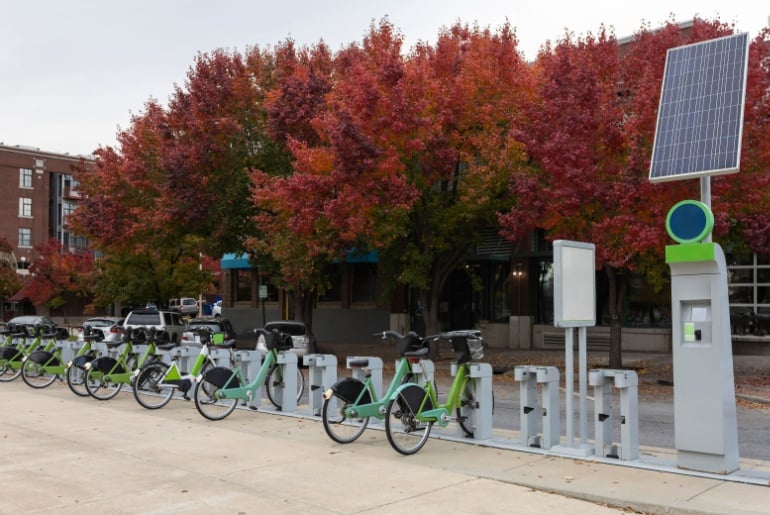
Electric bicycles near Pioneer Park in Salt Lake City, Utah
Salt Lake City embodies the benefits of transit-oriented development and biking culture. Not only is it one of the country’s friendliest cities for cyclists, but it is also actively working on initiatives meant to implement pedestrian-only streets in the downtown area. Its public transportation system recorded close to 14 million boardings in 2024 alone, with new expansions of the transit services planned for 2025.
Another factor boosting Salt Lake City’s standing as a walk & ride friendly place is the elevated density of stores, restaurants, schools and healthcare facilities integrated into its urban fabric, a key determinant in whether you can live without a car in a city.
5. St. Paul, MN
The other half of the Twin Cities lands fifth nationally for walk & ride prowess, with decent walk, transit and bike scores, though still lower than Minneapolis’s. One thing that St. Paul does better than its counterpart is the safety of pedestrians and cyclists – there are only 0.66 fatalities per 100K residents, compared to 2.12 in Minneapolis. On top of that, St. Paul, as well as its twin Minneapolis, built around half of their self storage inventories over the past decade, which provides residents easy access to the service, including to vehicle storage for those who are relegating their cars to occasional use.
In 2022, St. Paul took a major step by adopting a new Comprehensive Bike Plan and “Capital City Bikeway” network, which includes protected lanes that also benefit pedestrians by creating buffers from traffic. The city has also piloted pedestrian-only street events, like shutting down parts of downtown for winter carnival festivities and summer music festivals, giving residents a taste of car-free streets.
The momentum continues: St. Paul is now working closely with Minneapolis and other regional partners on the Rethinking I-94 project, which could replace an aging highway that divides the Twin Cities with a boulevard and new land bridges, reconnecting neighborhoods with walkable spaces.
6. Alexandria, VA
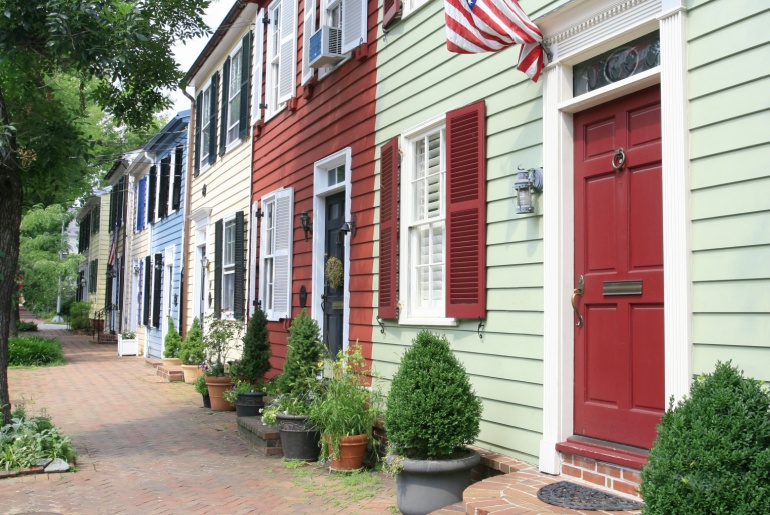
Downtown Alexandria, VA
The smallest city in our top 10, Alexandria, VA boasts a public transit score that places it 16th nationally while also showing decent walk and bike scores. Its public transit bus system is fare-free, a move aimed at enhancing accessibility and encouraging ridership. Moreover, all buses include bicycle racks and further connect to the regional Metrobus, Metrorail and Metroway stations. Where Alexandria truly shines, however, is safety, being part of a very exclusive club of cities that registered no pedestrian and cyclist fatalities in recent years.
On top of that, its charming Old Town district is seeing more and more pedestrian zones that allow outdoor dining and strolling. Alexandria’s embrace of car-free streets has drawn widespread praise as a boon to local businesses and quality of life.
7. Buffalo, NY
Buffalo scores well across the board, featuring relatively good walk, transit and bike scores, along with a density of stores and restaurants that make it possible to shop and go out without using a car. Local initiatives are pressing the local authorities to make the city even more bike-friendly, while a smart streetscape pilot program currently underway creates the framework for better urban mobility.
Buffalo’s public transportation, comprising of buses and a light-rail line, logged over 16 million rides in 2024, with expansion plans being proposed and under consideration.
8. New York City, NY
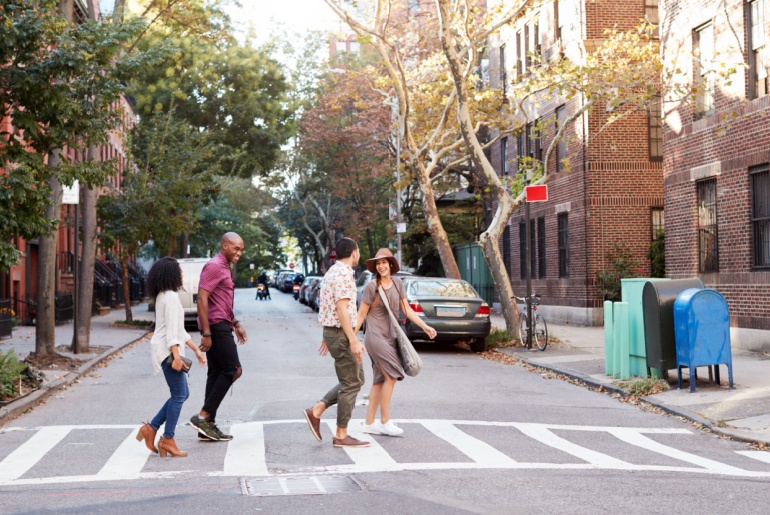
New York City neighborhood
New York City stands out as one of the most walkable and transit-friendly cities in the U.S., ranking first nationally for transit score and second for walk score. Over half of local employees commute without relying on a car, a remarkable figure that shows how deeply embedded walking, subways, and buses are in daily life. The city’s dense transit network and pedestrian-friendly streets make it one of the rare places in America where living car-free is not only possible but often more convenient.
Yet, despite these advantages, New York’s challenge lies in its sheer scale: with five boroughs spread over more than 300 square miles, the average commute exceeds 40 minutes. In addition, while the city is rich in cultural and commercial destinations, its retail, restaurants, schools, and healthcare services per capita are not as concentrated as in smaller cities. This means that, although you can reach almost anywhere by foot or public transit, access to daily needs might not be as convenient as in other cities.
9. Rochester, NY
Rochester is the third New York State city in a row to crack the top 10, highlighting the state’s strong showing when it comes to walkable, bikeable, and transit-friendly living. The city posts solid scores across all three categories, backed by a well-rounded network of amenities and services. For many residents, this means everyday errands, whether it’s a quick grocery run or walking kids to school, can be managed without ever needing a car.
In recent years, Rochester has taken deliberate steps to strengthen its active transportation network. The Rochester Active Transportation Plan, recently completed, aims to make streets safer and more accessible for people traveling on foot, by bike, or by bus. The city has focused on practical, people-first improvements: closing sidewalk gaps, installing high-visibility crosswalks, and re-timing traffic signals to prioritize pedestrian crossings. Combined with its compact urban layout and growing investment in multimodal infrastructure, Rochester continues to build on its reputation as a city where moving around without a car is not just possible but increasingly convenient.
10. Portland, OR
Portland has long been at the forefront of pedestrian-friendly urban planning, and it reinforced that reputation in the past few years. With a bike score of 83, equaling Minneapolis’s performance, Portland rounds up the top 10 of the country’s best walk & ride cities. Local initiatives like “Better Naito” provide a safe, car-free path for walkers and cyclists connecting event spaces and waterfront attractions. Portland also lowered speed limits on key pedestrian streets (downtown speed limit dropped to 20 mph) and added leading pedestrian intervals at many traffic signals to give walkers a head-start crossing before cars get a green light.
The city continues to pursue policies to make car-lite lifestyles easy: it eliminated minimum parking requirements for new housing near transit (a state-wide policy), invested in safer pedestrian crossings on high-crash corridors and it’s even exploring “road diets” on wide streets to add sidewalks and tree buffers.
From Denver to Milwaukee, a second tier of walk & ride friendly cities is reshaping how urban Americans live
Beyond the top contenders, other cities are proving that walkability and car-optional living can flourish in very different corners of the country. In the West, Denver has reinvented itself from a car-centric hub into a showcase for modern mobility. Once known for suburban sprawl and highway dependence, the city has doubled down on its FasTracks light rail system, and a wave of transit-oriented neighborhoods clustered around new stations. Its bike score now ranks 7th among the nation’s major cities, reflecting a strong cycling culture supported by trails that weave directly into downtown.
San Francisco, CA consistently ranks among the nation’s most walkable cities, boasting strong walk, transit, and bike scores, with more than a third of workers commuting without a car. Its dense core and legacy streetcar system makes getting around on foot or by transit second nature. Yet, access to everyday amenities and services is more strained here than in many peer cities, a factor that keeps San Francisco from climbing higher in our rankings. Up the coast, Seattle, WA pairs a nationally recognized biking culture with dense, transit-oriented growth along its waterfront and tech-driven districts. Investments in light rail and protected bike lanes continue to push the city to the forefront of urban mobility.
On the East Coast, Washington, DC and Providence, RI lean on their historic cores and compact neighborhoods, where walking and transit remain the backbone of daily life.
The Midwest brings its own surprises. Milwaukee and Cleveland, once synonymous with industrial decline, are reactivating historic grids with bike lanes, arts districts, and downtown housing. In fact, Cleveland has embarked on an ambitious effort to turn itself into a more walkable “15-minute city”, with Cleveland’s City Council passing a Complete and Green Streets Ordinance, mandating that all street projects must “expand opportunities for walking, biking, and transit” by design. Grand Rapids, a mid-sized Michigan city, also shows how walkability can thrive without the overwhelming scale of a major metro, offering residents a balance of accessibility and affordability.
Honolulu, HI is a walk & ride friendly city by necessity. Wedged between the mountains and the Pacific, it simply doesn’t have the land to sprawl, and that geographic constraint has concentrated housing, jobs, and services in a compact core. The city is also expanding its options with the new Skyline rail system, designed to ease congestion and connect outlying neighborhoods.
In the desert, Tempe, AZ stands apart in car-heavy Arizona, where Arizona State University and a growing light rail corridor sustain one of the Southwest’s most walkable communities. In fact, Tempe is leading the nation for car-free communities. In 2022, Culdesac Tempe, a new 17-acre neighborhood designed entirely without parking, welcomed its first residents. Billed as “the first car-free neighborhood in America,” its tenants agree not to keep cars on site. Instead, they are provided with perks like free light-rail transit passes, on-site carshare services, abundant bike parking, and walking access to amenities like a market, coffee shop, and gym.
Midwestern, Northeastern walk-and-ride hotspots also bring affordability to the table
Living car-free has long been recognized as a healthier approach to daily life. But can you afford to live in the car-lite capitals of the U.S.? We looked at home prices across the top 50 walk-and-ride cities in our ranking to find out where you can walk the walk and own the home.
While walkability and high prices often go hand in hand in coastal hubs like Seattle and San Francisco, metros in the Midwest and Northeast combine the convenience of walkability and transit with housing costs that remain within reach.
No city makes the case more clearly than Cleveland, OH. With median home values of just $118K — barely one-third of the national benchmark of $364K — Cleveland ranks as the most affordable walk-and-ride city in the country. Its mortgage-to-income ratio is just 18%, the lowest of all 50 cities analyzed.
Close behind are Pittsburgh, PA ($243K) and Philadelphia, PA ($235K), demonstrating that even larger metros can deliver walkability without crushing housing costs.
The story is far different on the coasts, though. In New York City, the median home price pushes nearly $798K, and in San Francisco, it soars past $1.27M. Yet even here, there’s a twist: upstate New York offers dramatically cheaper alternatives. Both Rochester ($240K) and Buffalo ($245K) deliver walk-and-ride living at roughly one-third the cost of New York City.
Between the bargains and the big-ticket coasts lies a middle tier. Chicago, IL ($316K) and Minneapolis, MN ($335K) remain below the national average while offering density, transit access, and a strong neighborhood fabric. For buyers, they strike an appealing balance: urban convenience without the extreme price tags of coastal markets.
Self storage and the car-optional city
Car-optional living changes how people use space and self storage becomes part of that equation. In dense, walkable neighborhoods where homes run smaller and parking is scarce (or intentionally limited), many residents don’t need their car every day, which makes self storage a practical solution for vehicle storage.
Over the past decade, developers have responded with more self storage facilities located near transit and mixed-use corridors. Across the top 20 best walk & ride cities, 16 added at least 25% of their self storage inventory since 2015, a build-out that mirrors the shift toward compact housing and car-light lifestyles.
Several standouts illustrate the pattern. Minneapolis has paired bike-first planning with a wave of infill self storage, building 47% of it total inventory oved the past decade alone to serve apartment-rich neighborhoods where residents trade private garages for shared mobility. Providence added a very significant 63% of its self storage inventory, much of it through adaptive reuse and mid-scale urban facilities that fit into historic blocks without disrupting street life. In the Midwest, Grand Rapids —with 54% of the local inventory delivered in the past 10 years — shows how a mid-sized market can support walkable living and still meet demand for off-site storage, from outdoor gear to seldom-used vehicles.
Here’s how self storage stacks up across the cities included in our Walk and Ride Index rankings:
How Much New Self Storage Was Built in the Last Decade - and What It Costs
| Rank | City | Share of Inventory Built in Last 10 Years (%) | Total Inventory (sq. ft.) | Self Storage Street Rate |
|---|---|---|---|---|
| 1 | Minneapolis, MN | 47% | 1,832,866 | $126 |
| 2 | Miami, FL | 43% | 9,157,900 | $181 |
| 3 | Pittsburgh, PA | 31% | 3,168,889 | $133 |
| 4 | Salt Lake City, UT | 15% | 2,466,912 | $135 |
| 5 | St. Paul, MN | 45% | 1,723,790 | $124 |
| 6 | Alexandria, VA | 36% | 1,808,575 | $217 |
| 7 | Buffalo, NY | 45% | 825,818 | $138 |
| 8 | New York, NY | 28% | 24,137,519 | $212 |
| 9 | Rochester, NY | 38% | 1,848,611 | $142 |
| 10 | Portland, OR | 40% | 4,624,356 | $152 |
| 11 | Denver, CO | 26% | 4,929,077 | $138 |
| 12 | San Francisco, CA | 5% | 2,096,940 | $247 |
| 13 | Washington, DC | 59% | 2,012,250 | $173 |
| 14 | Seattle, WA | 29% | 3,938,426 | $190 |
| 15 | Cleveland, OH | 26% | 1,882,589 | $118 |
| 16 | Providence, RI | 63% | 737,099 | $150 |
| 17 | Grand Rapids, MI | 54% | 1,579,563 | $118 |
| 18 | Honolulu, HI | 23% | 1,353,329 | $297 |
| 19 | Tempe, AZ | 19% | 2,027,780 | $126 |
| 20 | Milwaukee, WI | 37% | 3,207,605 | $106 |
| 21 | Chicago, IL | 20% | 12,207,157 | $143 |
| 22 | Baltimore City, MD | 27% | 4,612,708 | $128 |
| 23 | Eugene, OR | 16% | 1,713,875 | $134 |
| 24 | Spokane, WA | 25% | 2,899,152 | $129 |
| 25 | Arlington, VA | 14% | 717,225 | $260 |
| 26 | Cincinnati, OH | 36% | 4,094,638 | $102 |
| 27 | Jersey City, NJ | 27% | 1,033,734 | $189 |
| 28 | Tucson, AZ | 22% | 7,216,652 | $111 |
| 29 | New Orleans, LA | 40% | 2,611,618 | $136 |
| 30 | Paterson, NJ | 30% | 338,018 | $134 |
| 31 | Saint Louis | 19% | 4,594,730 | $123 |
| 32 | Oakland, CA | 19% | 1,599,150 | $204 |
| 33 | Sacramento, CA | 15% | 6,106,207 | $147 |
| 34 | Madison, WI | 39% | 1,566,999 | $132 |
| 35 | Philadelphia, PA | 42% | 6,946,927 | $148 |
| 36 | Boston, MA | 0% | 643,067 | $250 |
| 37 | Newark, NJ | 58% | 798,881 | $126 |
| 38 | Salem, OR | 26% | 2,194,792 | $126 |
| 39 | Vancouver, WA | 34% | 3,171,704 | $136 |
| 40 | Atlanta, GA | 40% | 5,683,567 | $153 |
| 41 | Tampa, FL | 27% | 6,903,794 | $138 |
| 42 | Hollywood, FL | 30% | 1,054,606 | $182 |
| 43 | Richmond, VA | 23% | 4,098,056 | $127 |
| 44 | Fort Collins, CO | 34% | 1,428,395 | $142 |
| 45 | Fort Lauderdale, FL | 15% | 2,601,423 | $151 |
| 46 | Las Vegas, NV | 22% | 14,450,184 | $131 |
| 47 | Orlando, FL | 40% | 9,340,897 | $130 |
| 48 | Glendale, CA | 33% | 668,624 | $309 |
| 49 | Houston, TX | 19% | 27,834,684 | $127 |
| 50 | Long Beach, CA | 1% | 2,143,939 | $214 |
| 51 | Bellevue, WA | 24% | 1,097,018 | $220 |
| 52 | Hayward, CA | 16% | 1,065,688 | $207 |
| 53 | Santa Rosa, CA | 10% | 2,197,459 | $177 |
| 54 | Sunnyvale, CA | 4% | 834,498 | $211 |
| 55 | Norfolk, VA | 3% | 1,985,891 | $124 |
| 56 | Tacoma, WA | 21% | 2,555,745 | $146 |
| 57 | Austin, TX | 33% | 9,984,167 | $133 |
| 58 | Springfield, MA | 70% | 707,458 | $126 |
| 59 | Santa Ana, CA | 0% | 1,227,235 | $201 |
| 60 | Yonkers, NY | 30% | 1,002,661 | $198 |
| 61 | Los Angeles, CA | 22% | 7,384,378 | $269 |
| 62 | Detroit, MI | 18% | 896,714 | $148 |
| 63 | Akron, OH | 25% | 1,828,574 | $100 |
| 64 | Garden Grove, CA | 40% | 281,269 | $140 |
| 65 | Reno, NV | 20% | 5,019,377 | $133 |
| 66 | Boise City, ID | 30% | 4,383,234 | $118 |
| 67 | St. Petersburg, FL | 39% | 2,412,372 | $164 |
| 68 | Albuquerque, NM | 20% | 5,309,409 | $119 |
| 69 | Lincoln, NE | 20% | 1,986,292 | $120 |
| 70 | Dallas, TX | 19% | 10,045,582 | $136 |
| 70 | Springfield, MO | 27% | 3,075,881 | $114 |
| 72 | Irvine, CA | 55% | 3,227,465 | $185 |
| 73 | San Jose, CA | 21% | 4,691,961 | $190 |
| 74 | Charleston, SC | 26% | 1,844,202 | $167 |
| 75 | Hialeah, FL | 24% | 1,167,770 | $175 |
| 76 | Huntington Beach, CA | 0% | 1,069,726 | $215 |
| 77 | Baton Rouge, LA | 18% | 4,788,446 | $123 |
| 78 | Fresno, CA | 6% | 4,847,015 | $131 |
| 79 | San Diego, CA | 20% | 6,725,785 | $185 |
| 80 | Fremont, CA | 5% | 1,054,315 | $180 |
| 81 | Tallahassee, FL | 30% | 2,892,726 | $145 |
| 82 | Modesto, CA | 13% | 2,160,861 | $128 |
| 83 | Anaheim, CA | 6% | 1,521,255 | $184 |
| 84 | Omaha, NE | 27% | 4,936,304 | $98 |
| 85 | Glendale, AZ | 24% | 2,538,051 | $111 |
| 86 | Salinas, CA | 21% | 1,088,592 | $200 |
| 87 | Aurora, CO | 26% | 2,977,081 | $126 |
| 88 | Worcester, MA | 63% | 878,134 | $144 |
| 89 | Columbus, OH | 19% | 5,430,074 | $105 |
| 90 | Lexington, KY | 37% | 2,579,983 | $144 |
| 91 | Aurora, IL | 10% | 749,239 | $116 |
| 92 | Knoxville, TN | 37% | 4,561,410 | $131 |
| 93 | Naperville, IL | 37% | 922,002 | $129 |
| 94 | Toledo, OH | 37% | 1,796,168 | $104 |
| 95 | Scottsdale, AZ | 43% | 3,226,743 | $195 |
| 96 | Riverside, CA | 5% | 3,581,638 | $139 |
| 97 | San Antonio, TX | 28% | 17,779,090 | $122 |
| 98 | Phoenix, AZ | 35% | 10,997,241 | $124 |
| 99 | Plano, TX | 29% | 3,727,672 | $122 |
| 100 | Birmingham, AL | 24% | 3,984,158 | $120 |
| 101 | Des Moines, IA | 45% | 1,506,925 | $103 |
| 102 | Oxnard, CA | 9% | 1,469,042 | $173 |
| 103 | Louisville, KY | 35% | 6,169,621 | $109 |
| 104 | Colorado Springs, CO | 29% | 6,899,752 | $115 |
| 105 | Lubbock, TX | 28% | 4,620,078 | $109 |
| 106 | Roseville, CA | 44% | 2,271,745 | $132 |
| 107 | Mesa, AZ | 26% | 5,150,704 | $110 |
| 108 | Anchorage, AK | 7% | 1,416,176 | $227 |
| 109 | Sioux Falls, SD | 36% | 1,607,662 | $108 |
| 110 | Chula Vista, CA | 24% | 1,970,438 | $181 |
| 111 | Fayetteville, NC | 17% | 3,336,259 | $109 |
| 112 | Tulsa, OK | 28% | 4,969,618 | $104 |
| 113 | Newport News, VA | 25% | 1,618,449 | $122 |
| 114 | Stockton, CA | 13% | 2,670,561 | $119 |
| 115 | San Bernardino, CA | 11% | 1,547,635 | $105 |
| 116 | El Paso, TX | 19% | 4,843,267 | $116 |
| 117 | Corpus Christi, TX | 20% | 3,717,430 | $116 |
| 118 | Fort Wayne, IN | 34% | 2,377,904 | $99 |
| 119 | Kansas City, MO | 38% | 3,007,740 | $124 |
| 120 | Denton, TX | 40% | 1,895,631 | $121 |
| 121 | Raleigh, NC | 25% | 4,723,112 | $117 |
| 122 | Little Rock, AR | 24% | 3,222,983 | $108 |
| 123 | Amarillo, TX | 21% | 3,128,049 | $83 |
| 124 | Chandler, AZ | 37% | 2,428,298 | $118 |
| 125 | Indianapolis, IN | 26% | 7,881,027 | $99 |
| 126 | Irving, TX | 17% | 1,904,628 | $114 |
| 127 | Durham, NC | 44% | 3,353,590 | $116 |
| 128 | Ontario, CA | 0% | 818,307 | $139 |
| 129 | Bakersfield, CA | 12% | 5,440,326 | $101 |
| 130 | Garland, TX | 40% | 2,383,109 | $116 |
| 131 | Greensboro, NC | 29% | 3,849,611 | $97 |
| 132 | Chattanooga, TN | 39% | 2,383,240 | $96 |
| 133 | Memphis, TN | 24% | 6,211,478 | $88 |
| 134 | Shreveport, LA | 17% | 2,965,836 | $89 |
| 135 | Oceanside, CA | 0% | 820,219 | $177 |
| 136 | Wichita, KS | 27% | 3,058,470 | $112 |
| 137 | Virginia Beach, VA | 12% | 5,917,870 | $126 |
| 138 | Laredo, TX | - | - | - |
| 139 | Mobile, AL | 29% | 3,125,857 | $102 |
| 140 | North Las Vegas, NV | 50% | 2,698,966 | $133 |
| 141 | Overland Park, KS | 43% | 1,243,349 | $124 |
| 142 | Rancho Cucamonga, CA | 2% | 1,622,245 | $170 |
| 143 | Macon, GA | 28% | 1,596,215 | $106 |
| 144 | Brownsville, TX | 38% | 996,219 | $108 |
| 145 | Charlotte, NC | 38% | 7,889,577 | $125 |
| 146 | Gilbert, AZ | 39% | 2,410,099 | $120 |
| 147 | Oklahoma City, OK | 21% | 7,869,770 | $88 |
| 148 | Columbus, GA | 19% | 2,512,325 | $103 |
| 149 | Fontana, CA | 0% | 1,365,938 | $143 |
| 150 | Corona, CA | 8% | 1,481,934 | $152 |
| 151 | Augusta, GA | 35% | 2,370,131 | $98 |
| 152 | Huntsville, AL | 46% | 3,337,366 | $99 |
| 152 | Montgomery, AL | 32% | 3,234,806 | $78 |
| 154 | Arlington, TX | 21% | 3,810,729 | $104 |
| 155 | Fort Worth, TX | 34% | 9,677,888 | $106 |
| 156 | Frisco, TX | 39% | 1,782,085 | $132 |
| 157 | Henderson, NV | 34% | 3,555,181 | $137 |
| 158 | Lancaster, CA | 18% | 1,426,585 | $135 |
| 159 | Murfreesboro, TN | 33% | 2,263,185 | $120 |
| 160 | Nashville, TN | 37% | 3,994,864 | $153 |
| 161 | Jacksonville, FL | 25% | 9,996,444 | $134 |
| 162 | Winston Salem | 27% | 2,310,605 | $107 |
| 163 | Elk Grove, CA | 31% | 1,582,082 | $135 |
| 164 | Cary, NC | 31% | 1,266,262 | $109 |
| 165 | Peoria, AZ | 24% | 1,886,627 | $111 |
| 166 | McKinney, TX | 33% | 3,123,130 | $120 |
| 167 | Moreno Valley, CA | 8% | 1,187,427 | $142 |
| 168 | Killeen, TX | 10% | 1,824,765 | $97 |
| 169 | Grand Prairie, TX | 7% | 1,437,079 | $114 |
| 170 | Palmdale, CA | 9% | 925,409 | $137 |
| 171 | Santa Clarita, CA | 41% | 1,134,245 | $176 |
| 172 | Pembroke Pines, FL | 32% | 979,881 | $178 |
| 173 | Surprise, AZ | 62% | 1,982,434 | $123 |
| 174 | Chesapeake, VA | 19% | 2,739,428 | $114 |
| 175 | Clarksville, TN | 37% | 2,469,936 | $112 |
| 176 | Port St. Lucie, FL | 32% | 1,582,987 | $139 |
| 177 | Cape Coral, FL | 47% | 1,836,322 | $163 |
America’s best walk & ride cities prove there’s no single blueprint for car-optional living. From legacy grids in the Northeast to reinvented Rust Belt hubs, public transit oriented Western metros, and even outliers like Miami, Tempe, and Honolulu, walkability is taking root in every corner of the country. Together, they show that the future of urban life in the U.S. may not be car-free, but it will increasingly be car-optional.
Check out how the country’s largest urban areas fare in terms of car-optional living:
Expert Opinions
To learn more about the car-optional lifestyle and how it impacts the lives of Americans, we discussed with experts in this field.
Jacob A Wegmann, The University of Texas at Austin, Community and Regional Planning, Faculty Member
What are the biggest benefits of living in a car-optional city — for residents, families, and communities as a whole?
There are so many, but to me the two that are slam-dunks are physical health (because walking is really good for your body; we weren’t met to be sitting almost all of the time) and environmental sustainability. All else equal, you will contribute to fewer emissions if you live in a walkable place, because you will drive less than the typical American, and you will likely live in a smaller housing unit than if you lived in a less walkable place.
I will bring up two others but with more caveats. One is mental health and social connectedness. It seems obvious that being in a walkable place can lead to a lot of meaningful interactions, which might help a person’s mental health and feeling of well-being. I’m cautious on this one, though, because you can find examples of people who live in walkable places who are socially isolated, and people who live in car-dependent suburbs who are highly social. Still, on the margins, walkability may help in this area.
The other one is savings in your pocketbook. If you move from a car-dependent place to a walkable place and manage to not spend more on your housing costs, then you may save money on transportation costs, especially if your household reduces car ownership (e.g., goes from two cars to just one, or from one to zero). Even if you keep the same number of cars, and even if you don’t take public transit you’ll likely still spend less on gasoline and maintenance, because you’ll drive less distance. The trouble with this one is that walkable places in the US often command a premium for rent or house prices, because we don’t have enough of them relative to the demand for them. If we built more walkable places, that would start to change.
What are the biggest barriers U.S. cities face in reducing car dependency, and what practical steps could help overcome them?
There are so many barriers, it’s hard to pick only several. Car dependency has been baked into every nook and cranny of our society for well over a century at this point. In essentially every part of America except for portions of New York City, car ownership and daily usage is taken for granted as something that is an essential element of daily life – if not, then you are often viewed as though something is wrong with you.
But off the top of my head: walking is much more dangerous than it should be, because our government (local, state, and federal) doesn’t take safety seriously. As a result, our traffic fatality and injury rates (both for those inside and outside of cars, though drivers are causing almost all of the mayhem) are several times higher than in our peer countries (even compared to Canada, which is also a country where most people live in houses rather than apartments and drive cars every day). People won’t do something if it doesn’t feel safe.
Top of my list for turning this situation around:
- Re-engineer streets so that they don’t encourage people to drive 20-30 mph above the speed limit.
- Reform zoning and other land use and building code regulations so that more housing and shops and other necessities of life can be built in walkable places.
- Start building transit lines that are so useful, that save so much time for their passengers, that they entice people out of cars. Most of our new transit lines are so compromised that they don’t offer any advantage over driving in terms of time saved or convenience. A rare positive example here is Seattle’s light rail – it connects the University of Washington campus to downtown faster than just about anyone could possibly drive to cover the same distance. As a result, it has strong ridership. We don’t do enough of that.
How do walkability and access to reliable public transit affect housing demand, affordability, and neighborhood growth?
Unfortunately, we have created a situation where it is very contentious, expensive, and difficult to add housing to existing walkable places, and very easy to build housing in places and in such a way that the new communities will be locked in to total car dependency, because by their design walking will never be useful for anything other than exercise or walking a dog.
Ralph Buehler, PhD, MCRS, MA, Professor, Urban and Environmental Policy & Planning, School of Public and International Affairs, Virginia Tech Research Center

What are the biggest benefits of living in a car-optional city — for residents, families, and communities as a whole?
There are several important benefits. First, and that’s mainly important in the USA, car-optional places provide residents with a choice of mode of transport. Individuals can walk, ride a bike, take public transport or drive. In most areas of the USA, there is no choice in mode of transport. Those settlements were built with the car in mind — and the car is the only viable option.
Second, car-optional areas provide those without a driver’s license or those who cannot drive with transport options. Children and teenagers can get places without relying on their parents from chauffeuring. Older adults who can no longer drive can reach coffee shops, libraries, gyms, doctors’ offices, shops, and other destinations on their own without relying on others for a ride.
Third, traffic safety is likely greater in car-optional areas because they provide well-lit and safe networks of sidewalks and crosswalks (often not provided at all in suburban areas) as well as safe networks of bikeways. In addition, less driving is related to greater traffic safety, as crashes with cars are more likely to be severe due to the cars’ mass and speed. Fourth, more walking, cycling and public transport use creates more opportunities for individuals to meet, chat, mingle and build a strong community.
What are the biggest barriers U.S. cities face in reducing car dependency, and what practical steps could help overcome them?
There are several barriers. First, many rules, laws, and regulations require or facilitate car-oriented development. For example, zoning codes may prohibit mixed land uses, disallowing even non-intrusive activities like doctor’s offices, day care centers, small cafes, etc. in residential areas. The separation of land uses increases trip distances, making walking and cycling less feasible. In addition, limitations on population density make public transport less viable.
Similarly, local regulations often require a minimum number of new parking spaces to be built for each residence or business. The rates chosen are often based on car-dependent suburban areas. Thus, we are building a lot of parking, making driving convenient and cheap. Free parking is a key subsidy to driving. Second, many transport planning processes focus on moving more cars quickly and neglect the needs of pedestrians and cyclists. By focusing on moving cars, planners and engineers forget about non-drivers needs and we forget about the need to get places. We just focus on movement, as if movement were the goal and not getting places. With these requirements on the books it is hard to create non-car-dependent places. Changes of these rules show that communities can develop in a different way. All it takes for government to take away these requirements and allow residents and planners more choice.
How do walkability and access to reliable public transit affect housing demand, affordability, and the way neighborhoods grow?
In the USA, walkable neighborhoods with good access to public transport increase the demand for housing. These areas are very popular. Unfortunately, because there are not enough of those places, this can lead to problems of housing affordability. Given the popularity of walkable places with good public transport access, we should allow the construction of more of these neighborhoods. Greater supply of neighborhoods that are walkable and have good public transport access will increase affordability of such neighborhoods. Unfortunately, many places still do not allow construction of this type of neighborhood.
Robert B. Cervero, Professor Emeritus, University of California, Berkeley, City and Regional Planning Faculty
What are the biggest benefits of living in a car-optional city — for residents, families, and communities as a whole?
Healthy lifestyle, partly from “active mobility” (i.e., walking/cycling more), healthier cities (e.g., cleaner air, fewer car injuries), more equality of access, partly from more resources channeled away from roads and into public transport, cycleways, pedestrian infrastructure, etc.
How do walkability and access to reliable public transit affect housing demand, affordability, and the way neighborhoods grow?
Pro-auto interests (oil, car manufacturers, AAA, etc.) and entrenched habits and lifestyles.
How do walkability and access to reliable public transit affect housing demand, affordability, and the way neighborhoods grow?
Generally, they increase housing prices since for most settings, these are desirable attributes.
Doug Ressler, Business Intelligence Manager at Yardi Matrix

What factors drive the success of walk-and-ride developments in urban planning?
Walk-and-ride developments, also known as Transit-Oriented Developments (TODs), are governed by both density and cost considerations, which are intricately linked. Density is the primary characteristic that enables walk-and-ride developments to be successful, while cost is the key economic factor for both developers and residents.
How do higher-density, mixed-use communities promote affordability and lifestyle benefits?
Higher-density, mixed-use communities are explicitly designed to provide alternatives to driving. This includes not only public transit but also infrastructure for walking and cycling. In addition, the also provide economical savings by elimination of car dependency. Housing costs in TODs may be higher due to demand for walkable, transit-accessible locations, the total cost of living is often lower. This is because residents can spend significantly less on transportation by owning fewer cars and driving less.
Higher density concentrates housing, jobs, and retail around transit, which makes the location more valuable and can attract a diverse and economically mobile demographic.
How do high land costs in cities influence building design choices, such as the rise of multi-story self-storage facilities?
In cities where land is expensive and scarce, multi-story walk-up self-storage facilities may be the only way to meet demand. The higher cost of land necessitates maximizing rentable space by building upward, which justifies the increased construction costs for multi-story buildings.
Methodology
This analysis was done by StorageCafe, an online platform that provides storage unit listings across the nation.
For this report, we evaluated 180 of the country’s largest urban areas and ranked them according to their readiness for car-free living. Our Car-Free Friendliness Index is based on the following metrics:
Home value data used in this analysis comes from Zillow, while household income figures are drawn from the U.S. Census. The mortgage-to-income ratio reflects the share of annual household income required to cover a typical mortgage. Mortgage costs were calculated based on home value, assuming a 20% down payment and a 6.4% interest rate loan.
Self-storage data was provided by StorageCafe’s sister division, Yardi Matrix, a comprehensive business development and asset management tool serving brokers, sponsors, banks, and equity sources across multifamily, office, industrial, and self-storage sectors.
Fair use and distribution
This study serves as a resource for the general public on issues of common interest and should not be regarded as investment advice. The data is true to the best of our knowledge but may change if amendments to it are made. We agree to the distribution of this content but we do require a mention in return for attribution purposes.


America’s Top Snowbird Destinations for 2026–2027: Florida Leads in Numbers, Texas Wins on Value
For Americans living in colder states, the approach of winter is reason enough to start looking south. Cold weather carries costs that go beyond the heating bill and shoveling snow. Seasonal affective disorder(opens in new tab) is far more prevalent in northern states, so a temporary move south isn’t simply an escape from the cold, but a chance to spend the hardest stretch of winter outdoors and in the sun.

How much does Halloween really cost in 2026? Plan wisely to avoid the scare of hidden costs
Americans’ love for Halloween is almost frightening — this year alone, we are on our way to spending $13.5 billion, according to data from the National Retail Federation(opens in new tab). That breaks down to about $115 Halloween costs per person, a whopping 49% more than 10 years ago.

How to Store LEGOs: All the Fun, None of the Clutter
How to store LEGOs largely comes down to how your household uses them. If the bricks are part of everyday play, you need a setup that keeps them within easy reach and makes cleanup quick (for your feet’s sake, at least). Toy storage(opens in new tab) such as simple bins, playmats or containers that children can put away themselves may be enough. Larger or more serious collections usually need more organization, such as labelled drawers for loose pieces, trays for unfinished builds, shelves for completed models and separate storage for retired sets.

Cardboard Costume Guide: Tips and Ideas for a DIY Halloween
Whether for kids or adults, cardboard costume ideas often make the biggest splash once materialized, and that’s for a simple reason: doing a lot with a little is a universally impressive feat (especially in this economy). If you don’t have enough boxes you could temporarily repurpose, don’t worry! There are many places where you can find free moving boxes(opens in new tab), from stores and supermarkets to online groups and recycling drop-off spots. On the run? Try your luck at a self storage(opens in new tab) facility that sells moving supplies, often for cheap. This way, you can choose moving boxes of different shapes and sizes(opens in new tab), so you can make your costumes as complex as you want.

How to Celebrate Halloween: 9 Non-Spooky Ways To Enjoy It
As soon as October starts, it’s the official Halloween month. And while for many people it means it’s open season to get the scare of a lifetime, others, especially families with small children, might prefer to celebrate in a tamer way that’s both kid- and adult-friendly. While you’re likely to find more events where the spook factor is high, here’s how to celebrate Halloween in a not-so-scary way:

Motorcycle Storage Guide: How to Store Your Bike Safely
Motorcycles may be born to be wild, but eventually even the wild ones need somewhere to park. Whether riding season is winding down or your current living situation comes with plenty of square footage for you and less for your bike, motorcycle storage is one of those parts of ownership that doesn’t get as much airtime as the open road.

Halloween Decorating on a Budget (And Cheap Ideas for Everything Elsee)
Halloween has crept a long way from its eerie origins. While All Hallows’ Eve has transformed through the centuries, it wasn’t until the 1930s that trick-or-treating became a tradition in the U.S. and businesses began conjuring up mass-produced Halloween costumes. Now, Halloween is a monster-sized, billion-dollar industry, with a cauldron full of costumes and decorations ranging from the mainstream to the macabre. But is it all really worth your wallet? Maybe, but we’ll let you in on a little secret: You can keep your Halloween decorating on a budget and save on everything else, too. Take this plan and see it through!

Moving From a House to an Apartment: What to Expect, How to Downsize & How Self Storage Helps
For some, moving from a house to an apartment is a financial decision. For others, it’s about simplifying life. Maybe the kids have moved out and half the house sits empty, or you’re approaching retirement and no longer want to spend weekends on repairs. Or perhaps you’ve been weighing the cost of buying a home and wondering whether renting simply makes more sense right now.

Family Heirlooms Overload: How to Handle Family Inheritance Without Regret
Handling family heirlooms after a loss requires managing legal authority, emotional pressure and practical logistics at the same time, and the order you take them on matters more than most people expect.