
Is Your Home Office Worth the Rent? What Coworking and Self Storage Could Save You

Key Takeaways
- Renters who trade a home office for a smaller apartment, a coworking membership and a 5’x5’ storage unit can save hundreds of dollars a month.
- Moving from a three-bedroom to a two-bedroom in New York, Philadelphia, San Francisco or Seattle saves roughly $880 to $1,340 monthly, even after coworking and storage fees.
- In cities like New York, Boston and several West Coast markets, a 75-square-foot home office accounts for between $260 and $540 of monthly rent.
- A 75-square-foot home office takes up between 7.6% and 11% of the average apartment in the 20 largest U.S. cities. Seattle has the smallest average apartment at 683 square feet.
- Columbus has the smallest studios among the 20 largest cities, so even a small desk takes a big bite out of the floor plan.
Every square foot of your apartment comes with a price tag, and a home office claims more of them than most renters expect. It starts with a desk. Then come the second monitor, the printer, the filing cabinet and the overflow boxes. Before long, the corner you set aside for work has turned into a small room you are paying for every month.
Keeping work and home life separate is worth something: research links that boundary to remote workers’ mental health(opens in new tab). The question is whether you need to pay apartment rent to get it. A recent Hubble home office study(opens in new tab) found that in the largest U.S. cities, a home office eats into both renters’ space and budgets. With a 75-square-foot workspace, renters can lose more than 10% of their apartment’s square footage, and that share climbs for anyone who dedicates a full room to work.
The Hubble study looked at the 20 largest U.S. cities to see what that space costs, where it squeezes hardest, and how much renters could save by moving the work (and the clutter) out of their apartments and into a coworking desk and a self storage unit(opens in new tab).
What a home office truly costs in monthly rent
To conceptualize a home office in terms of budget, it’s time you finally use that oft-cited real estate measurement: rent per square foot. New York rental apartments average $7.3 per square foot, so a 75-square-foot home office area is equivalent to more than $540 in rent per month. The same workspace accounts for around $410 a month in San Francisco, $370 in Boston, $280 in San Jose and $260 in Los Angeles. Those figures climb further for a full-room home office of 100 square feet or more.
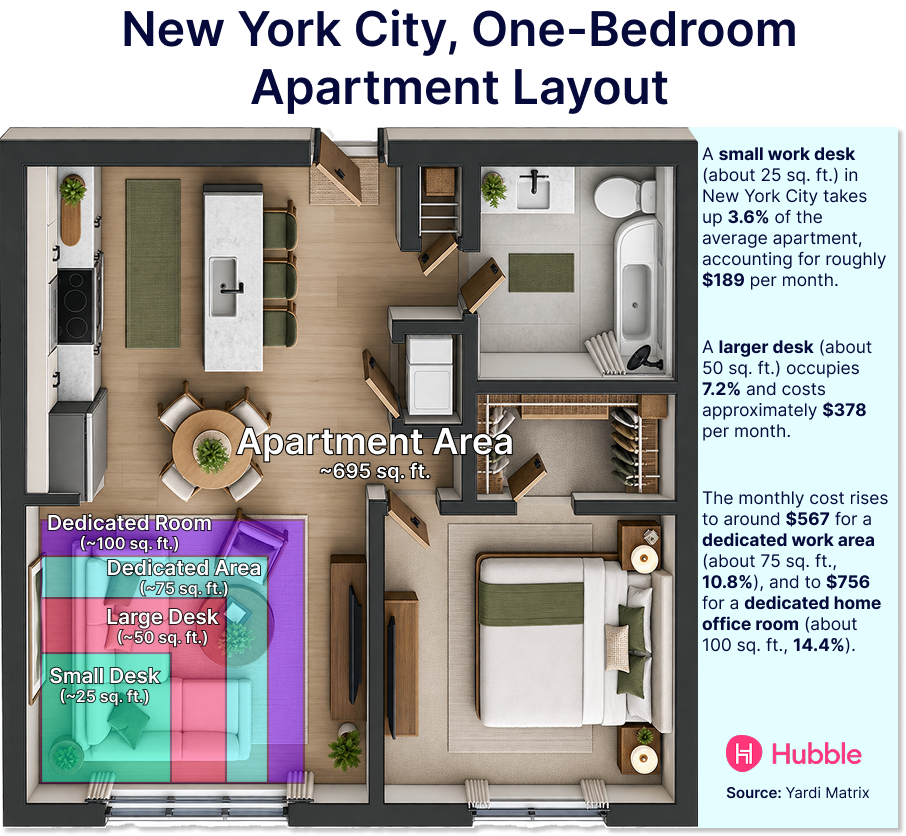
Where apartments are small and rents are high, even a modest home office takes a big share of your living space and rent.
Where a home office squeezes your apartment the most
Space is the other half of the equation. Among the 20 most populous cities, coastal hubs with compact apartments make a home workspace hardest to square financially. A 75-square-foot office takes up 11% of the average apartment in Seattle, and 10.3% in both New York City and San Francisco. These gateway cities are also the nation’s most rent-pressured, so a larger apartment that can host an office comes at a higher price per square foot.
At the other end, Jacksonville has the most generous apartment size of the 20 cities, and the same office there takes a more manageable 7.6%. Larger homes across the South make home offices easier to fit, with Charlotte, Fort Worth and Houston also scoring well. Step up to a 100-square-foot study, a comfortable but hardly lavish size, and the workspace claims between 10% and 15% of the average apartment in every one of the 20 cities.
Apartment type matters too. Seattle has the smallest average apartment overall, but the smallest studios are in Columbus: 400 square feet on average, compared with 412 in Seattle. For a remote worker in a Columbus studio, a dedicated desk area leaves very little room for anything else, which is exactly the situation where offloading belongings to storage makes the most sense.
How coworking and a 5’x5’ storage unit changes the math
A 5’x5’ unit measures 25 square feet, the same footprint as the small desk in our analysis. Many remote workers are ditching their pandemic-era home office setups(opens in new tab) because they feel isolated or want a firmer line between work and home. If you are one of them, there is a financial upside too. You can downsize your home(opens in new tab), rent a coworking hub desk(opens in new tab) for the work, and use self storage for the belongings that no longer fit.
Los Angeles is a good example of how that can play out. Moving from a three-bedroom to a two-bedroom apartment cuts rent by an average of $1,210 per month. A coworking membership plus a 5’x5’ storage unit in Los Angeles(opens in new tab) costs an average of $350 per month combined, which leaves a net saving of $859. Even after factoring in the cost of getting to the coworking space, the savings are substantial, and you gain a place to work that is separate from home, with people to bounce ideas off(opens in new tab).
With a few exceptions, the biggest savings come from dropping from a three-bedroom to a two-bedroom. In New York(opens in new tab), Philadelphia, San Francisco and Seattle, that move saves roughly $880 to $1,340 a month after coworking and storage fees (New York leads at $1,344).
Where a home office away from home doesn’t pay off
The math looks different in lower-rent markets, where a smaller apartment saves less than it costs to rent coworking and storage. Switching from a one-bedroom to a studio would add to your monthly spending in Houston (-$66), Dallas (-$47), Fort Worth (-$14), Austin (-$131), Oklahoma City (-$131), Charlotte (-$163) and Indianapolis (-$69). Going from a two-bedroom to a one-bedroom also comes out negative in Columbus (-$14), Indianapolis (-$11) and Oklahoma City (-$50).
In those cities, the better move may be keeping your current apartment and using a storage unit only to free up room for a desk, rather than giving up a bedroom.
What to move into storage to make room
Whether you downsize or just want your home office back as living space, a small unit can hold more than you might think. Good candidates include:
- Seasonal items such as holiday decorations, winter gear and sports equipment
- Extra furniture, including that spare desk or bookshelf
- Archived paperwork and files you must keep but rarely open
- Spare office equipment, such as old monitors, printers and cables
- Boxes you have not opened since your last move
A 5’x5’ unit works for a handful of boxes and small furniture, while a bigger unit suits the contents of an entire spare room. Pick the smallest size that fits, since every extra square foot adds to the monthly bill you are trying to cut.


Is Your Home Office Worth the Rent? What Coworking and Self Storage Could Save You
Every square foot of your apartment comes with a price tag, and a home office claims more of them than most renters expect. It starts with a desk. Then come the second monitor, the printer, the filing cabinet and the overflow boxes. Before long, the corner you set aside for work has turned into a small room you are paying for every month.

America’s Top Snowbird Destinations for 2026–2027: Florida Leads in Numbers, Texas Wins on Value
For Americans living in colder states, the approach of winter is reason enough to start looking south. Cold weather carries costs that go beyond the heating bill and shoveling snow. Seasonal affective disorder(opens in new tab) is far more prevalent in northern states, so a temporary move south isn’t simply an escape from the cold, but a chance to spend the hardest stretch of winter outdoors and in the sun.

How much does Halloween really cost in 2026? Plan wisely to avoid the scare of hidden costs
Americans’ love for Halloween is almost frightening — this year alone, we are on our way to spending $13.5 billion, according to data from the National Retail Federation(opens in new tab). That breaks down to about $115 Halloween costs per person, a whopping 49% more than 10 years ago.
How to Store LEGOs: All the Fun, None of the Clutter
How to store LEGOs largely comes down to how your household uses them. If the bricks are part of everyday play, you need a setup that keeps them within easy reach and makes cleanup quick (for your feet’s sake, at least). Toy storage(opens in new tab) such as simple bins, playmats or containers that children can put away themselves may be enough. Larger or more serious collections usually need more organization, such as labelled drawers for loose pieces, trays for unfinished builds, shelves for completed models and separate storage for retired sets.

Cardboard Costume Guide: Tips and Ideas for a DIY Halloween
Whether for kids or adults, cardboard costume ideas often make the biggest splash once materialized, and that’s for a simple reason: doing a lot with a little is a universally impressive feat (especially in this economy). If you don’t have enough boxes you could temporarily repurpose, don’t worry! There are many places where you can find free moving boxes(opens in new tab), from stores and supermarkets to online groups and recycling drop-off spots. On the run? Try your luck at a self storage(opens in new tab) facility that sells moving supplies, often for cheap. This way, you can choose moving boxes of different shapes and sizes(opens in new tab), so you can make your costumes as complex as you want.

How to Celebrate Halloween: 9 Non-Spooky Ways To Enjoy It
As soon as October starts, it’s the official Halloween month. And while for many people it means it’s open season to get the scare of a lifetime, others, especially families with small children, might prefer to celebrate in a tamer way that’s both kid- and adult-friendly. While you’re likely to find more events where the spook factor is high, here’s how to celebrate Halloween in a not-so-scary way:

Motorcycle Storage Guide: How to Store Your Bike Safely
Motorcycles may be born to be wild, but eventually even the wild ones need somewhere to park. Whether riding season is winding down or your current living situation comes with plenty of square footage for you and less for your bike, motorcycle storage is one of those parts of ownership that doesn’t get as much airtime as the open road.

Halloween Decorating on a Budget (And Cheap Ideas for Everything Elsee)
Halloween has crept a long way from its eerie origins. While All Hallows’ Eve has transformed through the centuries, it wasn’t until the 1930s that trick-or-treating became a tradition in the U.S. and businesses began conjuring up mass-produced Halloween costumes. Now, Halloween is a monster-sized, billion-dollar industry, with a cauldron full of costumes and decorations ranging from the mainstream to the macabre. But is it all really worth your wallet? Maybe, but we’ll let you in on a little secret: You can keep your Halloween decorating on a budget and save on everything else, too. Take this plan and see it through!

Moving From a House to an Apartment: What to Expect, How to Downsize & How Self Storage Helps
For some, moving from a house to an apartment is a financial decision. For others, it’s about simplifying life. Maybe the kids have moved out and half the house sits empty, or you’re approaching retirement and no longer want to spend weekends on repairs. Or perhaps you’ve been weighing the cost of buying a home and wondering whether renting simply makes more sense right now.