


- The Southeast dominates the retirement landscape, securing half of the nation’s top metros — led by Cape Coral–Fort Myers, Naples–Immokalee–Marco Island, and North Port–Sarasota–Bradenton.
- The Northeast emerges as a strong contender, offering top-ranked metros for longevity, safety, and healthcare access. NYC lives up to its reputation with a high concentration of healthcare providers, world-class medical facilities, and a strong life expectancy.
- In the top four retirement metros, life expectancy surpasses 80 years (2020–2022), underscoring the region’s exceptional quality of life. Naples, FL, leads the nation with an average life expectancy of 84 years.
- More than half of the top metros feature self storage costs below the national average, with Boise, ID, standing out as the best deal at just $100 per unit.
When the hair turns silver and the years turn golden, priorities begin to shift — especially when searching for the best places to retire. Choosing where to spend your next chapter isn’t just about palm trees or proximity to a golf course anymore — it’s about peace of mind. Today’s retirees are looking for something deeper: financial resilience, reliable healthcare, and a sense of purpose that keeps life rich and rewarding. But as America ages, a question looms — are our cities ready for this new wave of retirees?
That question feels more pressing than ever. Retirement age is striking like a lightning rod, fueled by a historic wave of Americans reaching 65. In 2026, more than 4 million people are expected to hit this milestone, extending the nation’s ongoing “Peak 65” moment. That’s over 11,200 Americans entering retirement age every single day — a pace markedly higher than what we saw just a decade ago.
At the same time, this unprecedented cohort is stepping into retirement amid economic uncertainty. Inflation and healthcare costs continue to climb, prompting many to seek part-time work or rethink traditional retirement timelines. Adding to the complexity is the rise of the “solo ager” — more than 15 million Americans over 55 are navigating aging without children, creating new expectations around housing, healthcare, and community support.
Even so, the desire for independence remains strong. According to AARP, more than 75% of older adults say they plan to age in place, valuing familiarity and community ties over relocation to retirement enclaves.
Against this backdrop, our team set out to discover which cities are best prepared for the coming wave of retirees — those ready to blend affordability, comfort, and care in equal measure.
We analyzed over 100 of the nation’s largest metro areas, weighing a broad mix of factors that truly shape retirement readiness:
- Demographics: Which metros have the highest share of residents aged 65+ and how life expectancy compares.
- Financials: Cost of living, average retirement incomes, and housing affordability.
- Dedicated housing: Availability of age-restricted or senior-friendly communities.
- Safety: Offenses per capita and overall community security.
- Lifestyle & comfort: Mild weather, cultural amenities, and recreational options like golf courses and outdoor access.
- Healthcare: The number of healthcare providers per 10,000 residents and how quickly cities respond in emergencies.
Because downsizing often defines this stage of life, we also looked at how self storage fits into the transition. From holding seasonal items or heirlooms to easing the move into a smaller home, storage quietly supports retirees in embracing change without sacrificing comfort or memories.
Our analysis shows that the best places to retire in 2026 aren’t simply sunny or scenic — they’re resilient and balanced. These are the metros where affordability meets access to care, where safety and community still shape daily life, and where retirees can thrive — not just live.
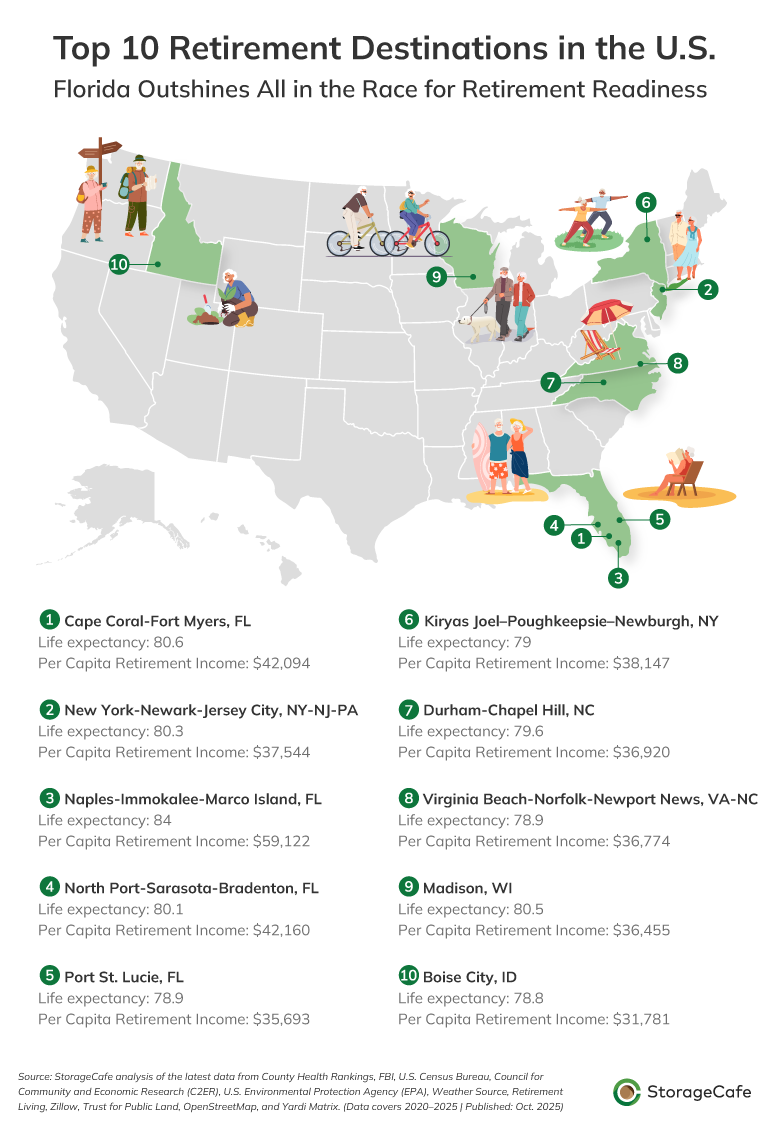
Where to find the best places to retire
Florida still holds the crown as America’s retirement capital, claiming four of the nation’s top 10 metros for retirees. Sunshine and beaches never go out of style — but the cost of paradise is climbing.
With the average annual retirement income near $31,000 and insurance premiums on the rise, livability has begun to outshine the allure of sunny retreats. That’s where the Midwest and Mountain West shine — offering lower costs, safer streets, and strong communities without sacrificing comfort. Among the best bets, Boise, ID, and Des Moines, IA, deliver that balance with affordable homes and a strong sense of community. Meanwhile, Madison, WI, pairs excellent healthcare with green spaces and cultural life that keep retirees active and connected.
Here’s our shortlist of the best places to retire in the U.S. for 2026 — destinations that truly balance mind, money, and meaning.
1. Cape Coral–Fort Myers, FL
- Population over 65: 28.5%
- Life expectancy: 80.6
- Cost of living: 105.2
Florida has long rolled out the red carpet for retirees — and once again, it proves why it’s the place to be for seniors looking to enjoy their golden years worry-free. The Sunshine State remains unrivaled in its mix of amenities, infrastructure, and like-minded communities, not to mention tax advantages that stretch retirement budgets further. That leaves plenty of room for what matters most: leisure and lifestyle.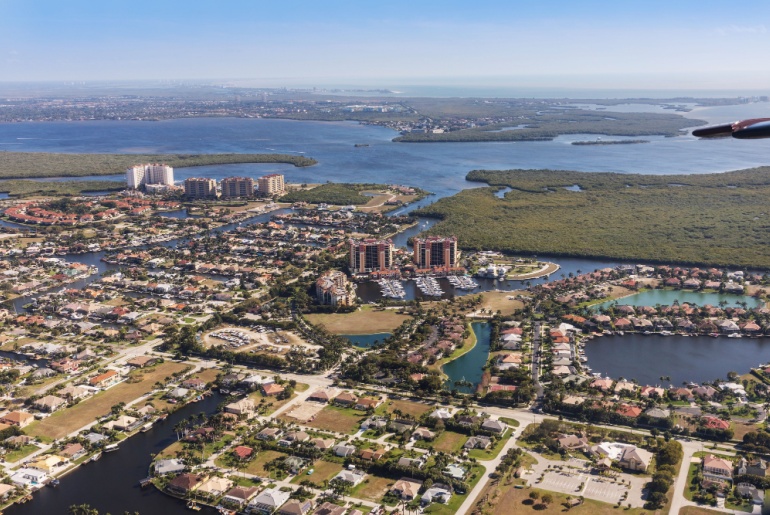
At the top of the list is Cape Coral–Fort Myers, FL, crowned the No. 1 metro for retirees nationwide. With 29% of residents aged 65 and older, well above the 18% national average, seniors here enjoy a community built around their needs. Life expectancy reaches 80.6 years, while the average retirement income climbs to $42K — significantly higher than the national benchmark of $31K.
Aptly named one of the largest canal cities in the world, Cape Coral spans more than 400 miles of waterways, offering fishing, boating, and endless opportunities for outdoor recreation.
Add in year-round pleasant weather, with an average daily temperature of 73.8°F (ranking fifth nationally), and it’s easy to see why this metro feels like the missing puzzle piece for so many retirees.
2. New York–Newark–Jersey City, NY–NJ–PA
- Population over 65: 16%
- Life expectancy: 80.3
- Cost of living: 116.6
Trading quiet beaches for culture-filled streets and age-friendly living, the New York metro area makes a bold showing as the No. 2 hotspot nationwide for retirees.
Affordability, however, can be a challenge compared with Florida’s coastal havens. While retirement income averages a mid-range $37,000, the cost of living index climbs to 116 — the highest among the top 10 metros and the 20th most expensive nationwide. Still, what the New York metro area lacks in low costs, it more than makes up for in diversity, opportunity, and access. There’s simply more of everything — from world-class entertainment and dining to world-leading healthcare.
On that front, New York stands out. The metro counts nearly 6,000 healthcare providers for every 10,000 residents — about 36% higher than the national average of roughly 4,400. This ranks it 11th nationwide for healthcare access, ensuring older residents can address health concerns quickly and confidently. Adding to that, three of the nation’s top 20 hospitals call New York City home, reinforcing its reputation for world-class medical care.
The city is also working to make life easier for its aging population. Through the Age-Friendly NYC initiative, the metro has launched nearly 90 programs aimed at improving walkability, recreation, and community connection. Combined with one of the nation’s most reliable public transit systems, these efforts help older New Yorkers stay active, engaged, and independent — no car required.
In fact, NYC ranks among the best cities for a walk-and-ride lifestyle, coming in 8th nationwide in a recent study that analyzed 180 metros based on a Car-Free Friendliness Index.
3. Naples–Immokalee–Marco Island, FL
- Population over 65: 32.2%
- Life expectancy: 84
- Cost of living: 102.4
The Naples metro area claims the No. 3 spot nationwide, with seniors making up more than 32% of its population — nearly double the U.S. average.
Retirees here enjoy the longest life expectancy in the country, at 84 years, along with the highest retirement income in the U.S. — roughly $59K. Add to that some of the cleanest air quality in the nation, and it’s easy to see why Naples continues to attract those seeking a healthier, more refined pace of life.

Known for its sandy shores, palm-lined avenues, and abundance of golf courses, Naples offers the kind of serenity and sophistication that make retirement feel like a reward. It’s a place where mornings start with sea breezes and afternoons unfold on fairways or café terraces — a luxury retreat that lets retirees truly savor their golden years.
4. North Port–Sarasota–Bradenton, FL
- Population over 65: 32.3%
- Life expectancy: 80.1
- Cost of living: 102.4
Not far behind, the Sarasota metro area ranks number 4 nationwide. Like neighboring Naples, nearly one-third of its residents are over 65, reinforcing the region’s long-standing reputation as a retirement haven.
Seniors here enjoy an average life expectancy of 80 years, excellent air quality — second only to Naples — and a warm, community-centered lifestyle that blends leisure with connection. With its white-sand beaches, vibrant arts scene, and walkable downtown, Sarasota offers retirees a coastal pace that’s relaxed yet full of life.
5. Port St. Lucie, FL
- Population over 65: 26.5%
- Life expectancy: 78.9
- Cost of living: 102.4
Rounding out Florida’s entries in the top 10, Port St. Lucie lands at No. 5 nationwide. With 26% of residents aged 65 and older, the metro still far outpaces the national average.
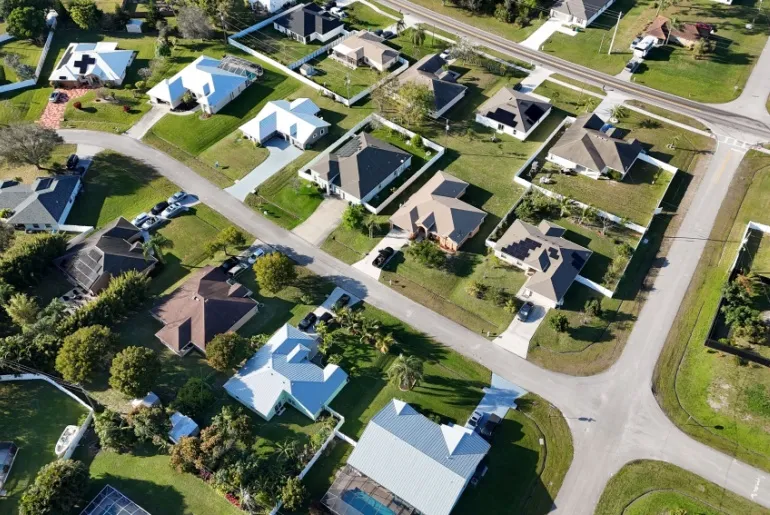
Life expectancy comes in at 78.9 years — slightly lower than in Florida’s other top retirement hubs but still within the top third nationwide. Retirees here can enjoy much of Florida’s signature sunshine, golf, and coastal charm without paying the premium of Naples or Sarasota. It’s a place where the pace is easy, the weather is warm, and the budget stretches just a little further.
6. Kiryas Joel–Poughkeepsie–Newburgh, NY
- Population over 65: 15.6%
- Life expectancy: 79
- Cost of living: 123.4
New York’s second entry comes in at No. 6 with the Poughkeepsie metro area, where 15% of the population is over the age of 65. Retirement income here reaches $37K, and life expectancy mirrors averages around 79 years old.
Safety stands out here as well. With one of the lowest crime rates in the country, ranking 11th, seniors can enjoy a greater sense of peace and security.
Where this metro really shines, however, is healthcare. It outperforms all other top-10 metros with more than 6,600 providers per 10K residents, making it the strongest option for retirees who want reliable, immediate access to medical and social assistance.
7. Durham–Chapel Hill, NC
- Population over 65: 15.4%
- Life expectancy: 79.6
- Cost of living: 103.2
In the Durham–Chapel Hill metro, 15% of residents are over 65, fostering a strong sense of community and companionship. Life expectancy averages 79 years, supported by a robust healthcare network that ranks 10th nationwide, with roughly 6,000 health and social assistance providers per 10,000 residents. Anchored by four major hospital systems — Duke, UNC, Rex, and WakeMed — plus a VA regional medical center, the area stands out as a healthcare powerhouse.
For those considering settling here for retirement, the average retirement income is about $36,000, with a cost of living index of 103 and median home prices around $418,000 — roughly 13% above the national average. While it’s not the most affordable metro on the list, its exceptional healthcare access and vibrant community make it a solid choice for retirees seeking quality and connection.
Retirement here also opens the door to lifelong learning and active living. The Senior Auditor Program at NC State allows residents 65 and older to attend courses tuition-free, keeping minds sharp and engaged. And for those who prefer the outdoors, Durham–Chapel Hill offers 33 golf courses and 3.1 parks per 10,000 residents, ensuring plenty of opportunities to stay active, social, and inspired throughout the golden years.
Settling down in the Durham–Chapel Hill area is also made easier by a renter-friendly self storage market. Locals can easily find space for heirlooms, golf or fishing gear, or other treasured but seldom-used items in secure storage facilities nearby. With average rents around $116 per month, retirees can enjoy uncluttered, comfortable homes — and the freedom to hold on to what matters without sacrificing space.
8. Virginia Beach–Norfolk–Newport News, VA–NC
- Population over 65: 14.7%
- Life expectancy: 78.9
- Cost of living: 94.8
Seniors can pencil in the Virginia Beach–Norfolk–Newport News, VA–NC metro as a warm nest to retire in. Life expectancy here hovers around 79 years, with 14.7% of the population already enjoying their golden years. With its gray-haired community encompassing about 260K seniors, ocean breeze, and an EPA air quality score of 43, retirees can look forward to quiet days filled with fishing, sea views, and mild weather that make life by the coast even sweeter.
Perhaps it’s the lull of a quieter pace, or perhaps it’s the fact that Social Security benefits aren’t taxed by the state — either way, this metro has become a magnet for retirees.
For veterans, the metro holds special appeal. Virginia Beach is home to roughly 7,000 veterans per 100K residents, making it the second most veteran-concentrated area in the nation, behind only Alaska. Not only that, but veterans here are purchasing homes at nearly twice the rate of other markets. For a chance to claim a home as their own, retirees can expect to pay an average price of around $365K — a reasonable entry point for a coastal lifestyle where the cost of living is below the country’s benchmark, sitting at 94.8.
And for those veterans, or any retirees, who need extra space to store their belongings, self storage is there to bridge the gap. The Virginia Beach metro area offers about 65.2 square feet of storage space per resident aged 65 and over, placing it around the national midpoint. The variety of available units helps keep costs affordable, with an average monthly rate of $120 per month — roughly 12% below the national average of $137.
9. Madison, WI
- Population over 65: 14.5%
- Life expectancy: 80.5
- Cost of living: 90.7
Up in the Midwest, Madison, WI, lands at number 9 when it comes to retirement hotspots.
Here, retirees make up around 14% of the population, with life expectancy reaching 80 years old and placing it at the 11th spot nationwide.
If cheese in every form already has your attention, and if a balanced climate sounds appealing, then Madison is hard to beat. The city offers the best of both worlds — four seasons without extremes — plus plenty of outdoor opportunities, from scenic parks to lakeside strolls. Wisconsin sweetens the deal with retiree-friendly tax policies, as Social Security benefits are not taxed, and generous property tax credits help stretch budgets further, allowing residents to savor all the Midwest charm.
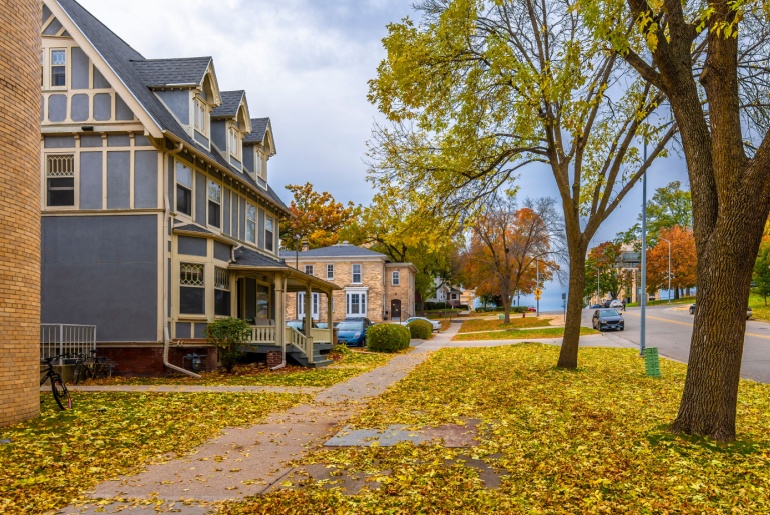
Healthcare access here is another standout. Madison ranks 4th nationally for healthcare availability, with more than 6,600 providers per 10K residents, ensuring peace of mind for seniors. It also places 2nd for park access, making fresh air and green spaces part of daily life. Add in the fact that Madison is the most affordable metro in the top 10, and it’s clear why it earns its place among the nation’s best retirement destinations.
10. Boise City, ID
- Population over 65: 14.6%
- Life expectancy: 78.8
- Cost of living: 103.2
In Boise City, ID, retirees will find a different set of advantages. The metro ranks as the safest in the nation based on crime rates, giving seniors a strong sense of security. Costs, however, are higher than in Madison, and the life expectancy here hovers around 78.8.
The cost of living index sits slightly above the national benchmark at 103, and average home prices climb to about $490K. Still, Boise’s mix of outdoor recreation and mountain scenery offers a compelling lifestyle for retirees seeking a Western backdrop for their golden years.
Boise City’s prosperous retirement scene is also supported by a strong self storage market that comes in handy during downsizing or seasonal transitions. Retirees here can turn to storage to keep outdoor gear that’s become essential for enjoying Idaho’s mountain trails and scenic rivers. Holiday décor, gardening tools, or even RVs can rest between trips in a unit. With average rents at just $100 per month, Boise offers the 8th most affordable self storage rates among the nation’s 100 largest metro areas.
Where self storage makes retirement easier — and cheaper
With many older adults choosing to age in place or move to smaller homes, the demand for flexible storage options is on the rise. Industry data shows consistent growth among users aged 60 and older, reflecting a practical shift toward smaller living and smarter space management in retirement.
As homes fill up and retirees make space for new routines, self storage offers a simple solution for life’s overflow — from heirlooms to hiking gear to RVs waiting for the next adventure. At roughly $137 a month nationwide, it’s an easy, affordable way to keep life organized.
Among the top 10 retirement metros, six stand out for below-average storage rents, averaging $122 per unit. Most deals are found in the Southeast, where affordability meets accessibility. Boise, ID, leads the pack with an average rent of $100 per unit — about 27% below the national average — and a remarkable 110 square feet of storage per resident aged 65+. Durham–Chapel Hill, NC ($116), Virginia Beach, VA ($120), and Madison, WI ($125) follow closely behind.
At the other end, tight supply drives prices higher in metros like New York–Newark–Jersey City, NY–NJ–PA ($182), Naples–Immokalee–Marco Island, FL ($173), and Kiryas Joel–Poughkeepsie–Newburgh, NY ($163). In these areas, storage availability for older residents falls below average — just 24 to 30 square feet per person compared to the 35-square-foot national benchmark.
Self Storage Street Rates in the 100 Largest U.S. Metros
| Rank | Metro Area | Self Storage Street Rate* |
|---|---|---|
| 1 | Oklahoma City, OK | $87 |
| 2 | Youngstowny-Warren-Boardman, OH-PA | $90 |
| 3 | Omaha-Council Bluffs, NE-IA | $95 |
| 4 | Chattanooga, TN-GA | $97 |
| 5 | Akron, OH | $98 |
| 6 | Little Rock-North Little Rock-Conway, AR | $99 |
| 7 | St. Louis, MO-IL | $99 |
| 8 | Boise City, ID | $100 |
| 9 | Greensboro-High Point, NC | $100 |
| 10 | Indianapolis-Carmel-Anderson, IN | $101 |
| 11 | Toledo, OH | $101 |
| 12 | Cincinnati, OH-KY-IN | $102 |
| 13 | Memphis, TN-MS-AR | $102 |
| 14 | Columbus, OH | $103 |
| 15 | Des Moines-West Des Moines, IA | $103 |
| 16 | Tulsa, OK | $103 |
| 17 | Dayton-Kettering, OH | $104 |
| 18 | Bakersfield, CA | $104 |
| 19 | Winston-Salem, NC | $105 |
| 20 | Wichita, KS | $105 |
| 21 | Louisville, KY-IN | $106 |
| 22 | Augusta-Richmond County, GA-SC | $106 |
| 23 | Columbia, SC | $108 |
| 24 | Greenville-Anderson, SC | $109 |
| 25 | Scranton---Wilkes-Barre--Hazleton, PA | $109 |
| 26 | Ocala, FL | $110 |
| 27 | El Paso, TX | $111 |
| 28 | Raleigh-Cary, NC | $112 |
| 29 | Grand Rapids-Kentwood, MI | $112 |
| 30 | Albuquerque, NM | $112 |
| 31 | Tucson, AZ | $113 |
| 32 | Milwaukee-Waukesha, WI | $114 |
| 33 | McAllen-Edinburg-Mission, TX | $115 |
| 34 | Colorado Springs, CO | $115 |
| 35 | Durham-Chapel Hill, NC | $116 |
| 36 | Cleveland-Elyria, OH | $116 |
| 37 | Baton Rouge, LA | $116 |
| 38 | Lancaster, PA | $119 |
| 39 | Houston-The Woodlands-Sugar Land, TX | $119 |
| 40 | Dallas-Fort Worth-Arlington, TX | $119 |
| 41 | Spokane-Spokane Valley, WA | $119 |
| 42 | Spokane-Norfolk-Newport News, VA-NC | $120 |
| 43 | Lakeland-Winter Haven, FL | $120 |
| 44 | Kansas City, MO-KS | $120 |
| 45 | Harrisburg-Carlisle, PA | $121 |
| 46 | Charlotte-Concord-Gastonia, NC-SC | $121 |
| 47 | Birmingham-Hoover, AL | $121 |
| 48 | Buffalo-Cheektowaga, NY | $122 |
| 49 | Minneapolis-St. Paul-Bloomington, MN-WI | $122 |
| 50 | Richmond, VA | $123 |
| 51 | Madison, WI | $125 |
| 52 | Albany-Schenectady-Troy, NY | $125 |
| 53 | Phoenix-Mesa-Chandler, AZ | $125 |
| 54 | Knoxville, TN | $125 |
| 55 | Atlanta-Sandy Springs-Alpharetta, GA | $126 |
| 56 | Asheville, NC | $126 |
| 57 | Myrtle Beach-Conway-North Myrtle Beach, SC-NC | $126 |
| 58 | Chicago-Naperville-Elgin, IL-IN-WI | $127 |
| 59 | Fresno, CA | $127 |
| 60 | Austin-Round Rock-Georgetown, TX | $128 |
| 61 | Salt Lake City, UT | $128 |
| 62 | Orlando-Kissimmee-Sanford, FL | $129 |
| 63 | San Antonio-New Braunfels, TX | $129 |
| 64 | Detroit-Warren-Dearborn, MI | $129 |
| 65 | Springfield, MA | $130 |
| 66 | Stockton, CA | $130 |
| 67 | Palm Bay-Melbourne-Titusville, FL | $131 |
| 68 | Port St. Lucie, FL | $132 |
| 69 | Hartford-East Hartford-Middletown, CT | $132 |
| 70 | Rochester, NY | $132 |
| 71 | Jacksonville, FL | $133 |
| 72 | Las Vegas-Henderson-Paradise, NV | $133 |
| 73 | Philadelphia-Camden-Wilmington, PA-NJ-DE-MD | $133 |
| 74 | Tampa-St. Petersburg-Clearwater, FL | $134 |
| 75 | Nashville-Davidson-Murfreesboro-Franklin, TN | $134 |
| 76 | Denver-Aurora-Lakewood, CO | $135 |
| 77 | North Port-Sarasota-Bradenton, FL | $136 |
| 78 | Pittsburgh, PA | $136 |
| 79 | Portland-Vancouver-Hillsboro, OR-WA | $136 |
| 80 | Deltona-Daytona Beach-Ormond Beach, FL | $136 |
| 81 | Syracuse, NY | $137 |
| 82 | Charleston-North Charleston, SC | $137 |
| 83 | Riverside-San Bernardino-Ontario, CA | $137 |
| 84 | New Orleans-Metairie, LA | $137 |
| 85 | New Haven-Milford, CT | $138 |
| 86 | Allentown-Bethlehem-Easton, PA-NJ | $138 |
| 87 | Baltimore-Columbia-Towson, MD | $141 |
| 88 | Salisbury, MD-DE | $141 |
| 89 | Cape Coral-Fort Myers, FL | $142 |
| 90 | Sacramento-Roseville-Folsom, CA | $142 |
| 91 | Providence-Warwick, RI-MA | $143 |
| 92 | Portland-Vancouver-Hillsboro, OR-WA | $146 |
| 93 | Worcester, MA-CT | $147 |
| 94 | Boston-Cambridge-Newton, MA-NH | $161 |
| 95 | Poughkeepsie-Newburgh-Middletown, NY | $163 |
| 96 | Washington-Arlington-Alexandria, DC-VA-MD-WV | $164 |
| 97 | Miami-Fort Lauderdale-Pompano Beach, FL | $166 |
| 98 | Seattle-Tacoma-Bellevue, WA | $166 |
| 99 | Naples-Immokalee-Marco Island, FL | $173 |
| 100 | San Diego-Chula Vista-Carlsbad, CA | $178 |
| 101 | New York-Newark-Jersey City, NY-NJ-PA | $182 |
| 102 | Bridgeport-Stamford-Norwalk, CT | $182 |
| 103 | Santa Rosa-Petaluma, CA | $190 |
| 104 | San Jose-Sunnyvale-Santa Clara, CA | $192 |
| 105 | Oxnard-Thousand Oaks-Ventura, CA | $195 |
| 106 | Los Angeles-Long Beach-Anaheim, CA | $204 |
| 107 | San Francisco-Oakland-Berkeley, CA | $209 |
| 108 | Honolulu, HI | $260 |
Source: StorageCafe analysis of Yardi Matrix data( Data as of Sep. 2025 | Pub: Oct. 2025)
Ultimately, self storage is becoming an overlooked part of retirement planning — offering flexibility, security, and peace of mind as living spaces evolve. It’s not just about downsizing anymore; it’s about creating room for the life retirees want next.
Retirement in 2026 is about living fully
Retirement in 2026 is no longer about where life slows down — it’s about where it feels full.
From Florida’s golden coastlines to Madison’s Midwestern balance or Boise’s mountain backdrop, today’s retirees have a wealth of destinations to match their needs. With record numbers of Americans turning 65 and new lifestyle patterns emerging, retirement can mark the chance to turn silver hair into golden days.
Here’s how the nation’s 100 largest metro areas stack up when it comes to retirement friendliness and quality of life.
Methodology
This analysis was conducted by StorageCafe, an online platform providing nationwide listings of self storage units.
For this study, we examined the 100 largest U.S. metropolitan areas by population, ranking them based on where retirees are already concentrated and where the overall quality of retirement living is strongest. The evaluation considered financial well-being, lifestyle opportunities, and overall quality of life — key factors shaping how comfortably and actively Americans can spend their retirement years.
To identify which areas best meet retirees’ needs, we developed a weighted index incorporating the following indicators:
Data on self storage was sourced from Yardi Matrix, StorageCafe’s sister division, which provides a business development and asset management platform used by brokers, sponsors, banks, and equity sources for underwriting investments in the multifamily, office, industrial, and self storage sectors.
Fair use and distribution
This study serves as a resource for the general public on issues of common interest and should not be regarded as investment advice. The data is true to the best of our knowledge but may change if amendments to it are made. We agree to the distribution of this content, but we do require a mention in return for attribution purposes.


Moving From a House to an Apartment: What to Expect, How to Downsize & How Self Storage Helps
For some, moving from a house to an apartment is a financial decision. For others, it’s about simplifying life. Maybe the kids have moved out and half the house sits empty, or you’re approaching retirement and no longer want to spend weekends on repairs. Or perhaps you’ve been weighing the cost of buying a home and wondering whether renting simply makes more sense right now.

Family Heirlooms Overload: How to Handle Family Inheritance Without Regret
Handling family heirlooms after a loss requires managing legal authority, emotional pressure and practical logistics at the same time, and the order you take them on matters more than most people expect.

Blanket Storage: The Right Method for Every Space and Season
Blankets make our lives cozier, and storing them well is what keeps them soft and comfortable in the long run. Knowing how to store a blanket properly means your favorites come out of storage smelling fresh, feeling the same as when they went in, and lasting years longer than they otherwise would.

Board Game Storage Ideas That Keep Your Collection in Fighting Shape
Nobody warns you that getting into board games usually unlocks a second hobby, the much dreaded one that includes figuring out where on earth to put them. One game becomes a few, expansions start spawning beside their base boxes and before long, board game storage requires as much strategy as whatever is waiting on the other side of those lids.

Storage Locker vs. Storage Unit: What’s the Difference?
A locker and a unit may sound like two names for the same four walls and a lock, and depending on the storage facility, you may even see the terms used that way. However, once you start comparing available spaces, storage lockers tend to occupy the smaller end of the spectrum, while storage units(opens in new tab) give you considerably more room to work with.

Storage Ideas for Small Spaces: 9 Ways to Max Out Your Home
A messy home contains the seeds of its organization. Those seeds are everywhere: the space above doors, under beds, behind sofas and inside furniture can all become storage. Here are the best storage ideas for small spaces, so you can make the most of your cozy home.

Best U.S. Cities to Live Uncluttered: Plano, TX, Offers the Most Room to Breathe
Clutter is in our homes as much as in our heads. Both are shaped by where we live.

How to Organize Your Bathroom: 8 Ways to Stay Tidy
You already know why an organized bathroom is worth the effort, but let us remind you: it makes rushed mornings easier, keeps counters cleaner and just helps get you in the mood to go through your skincare routine like you should. Plus, in bigger households, it helps everyone find what they need. And you know how much a tidy bathroom counts for your self-esteem when a guest or a partner shows up. Luckily, you don’t need a degree to know how to organize your bathroom. The secret is keeping less, giving every item a home and making that home simple to use. Let’s go through some practical steps can help you create a bathroom that stays functional and nice to look at.

How to Use Silica Gel Packets for Storage
Moisture can cause significant damage to items in storage, leading to rust on tools, mold on clothing and warping in documents. Silica gel uses science to fix that. Often found in small packets inside product packaging, silica gel is a desiccant that absorbs moisture from the air, keeping your stored items dry and protected. This guide explains what silica gel is, how it works and how you can use it to preserve your belongings in self storage.