

If you’ve ever searched for car storage and ended up wading through listings for 5×5 climate-controlled units, you know the problem. Most storage search tools are built for boxes, not vehicles – and filtering your way to relevant results takes more effort than it should.
StorageCafe’s Car Storage Directory is built differently. It’s a dedicated search experience designed specifically for passenger vehicle storage, so the listings you see from the start are actually relevant to what you’re looking for.
Why most car storage searches fall short
When you search for car storage online, you typically end up in one of two places — and both have real limitations.
The first is a single-operator site. These are useful if you’ve already decided on a specific storage brand, but they only show that company’s facilities. You’re comparing options within one inventory, not across your full local market.
The second is a general storage marketplace. These aggregate listings from multiple operators, which helps with coverage, but car storage is usually just one filter among many. The search experience is built around household storage, and vehicle-specific results often sit alongside listings that were never designed for cars.
StorageCafe’s Car Storage Directory takes a different approach. It draws from more than 30,000 verified facilities nationwide – independent operators alongside major brands – and surfaces only those configured for passenger vehicle storage.
What makes our car storage search different – and better
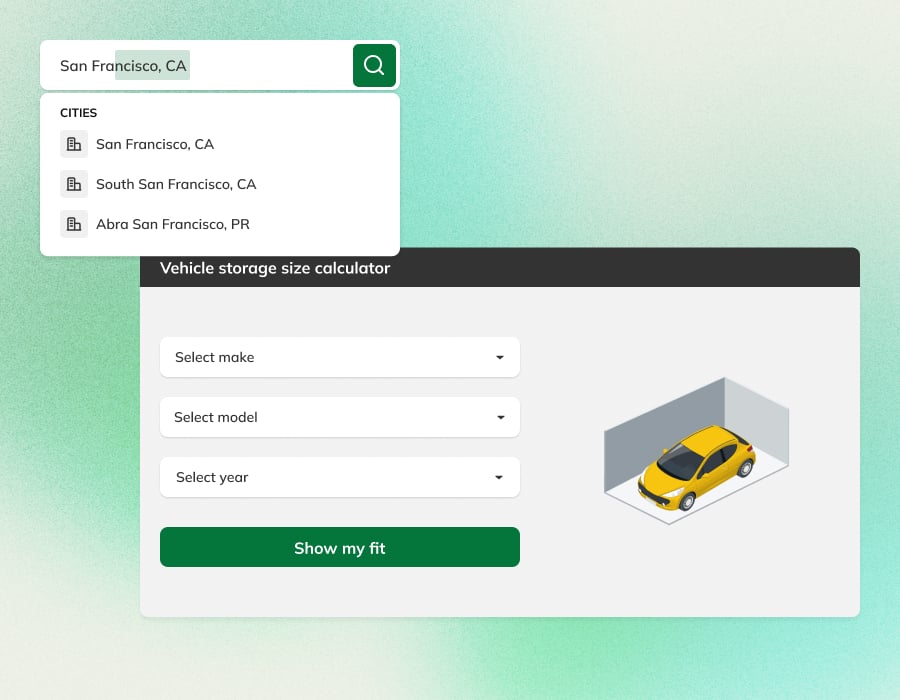
Standard storage search tools aren’t optimized for vehicles. Search for car storage through a general directory and you’ll often see facilities that lack drive-up access, can’t accommodate a vehicle’s footprint, or simply aren’t set up for car storage at all. You’re expected to filter down from a broad set of results and make judgment calls without much guidance.
The Car Storage Directory skips that process. It surfaces only facilities suited to regular passenger vehicles, organized around the considerations that actually matter: parking configuration, drive-up access, indoor versus outdoor options, and security. You start with relevant results rather than working backward to find them.
Search by city, find what fits
The directory connects to localized city pages that show only car storage-capable facilities in a given market. Each city page also displays the average street rate for that area alongside the national car storage average — so before you even look at a single listing, you know whether your market runs expensive or affordable, and what a reasonable price looks like.
Budget-conscious renters will also find the most affordable options surfaced upfront, including the lowest-priced neighborhoods and facilities in the area, rather than having to sort through the full results to find them.
Whether you’re in a dense urban area with limited options or a suburb with more flexibility, the city pages cut through the noise and give you a clear picture of what’s available, what it costs, and what amenities each facility offers.
What to think about before you search
Not all car storage is the same, and the right choice depends on a few factors worth considering before you start comparing facilities.
How long are you storing it?
Short-term storage can work fine with an outdoor covered space. Long-term storage — especially for a classic or high-value vehicle — usually calls for an indoor unit with climate control.
What kind of protection do you need?
Outdoor uncovered spaces are the most affordable but leave your car exposed to the elements. Covered outdoor and indoor options offer increasing levels of protection at increasing price points. Each city page breaks down all three options with guidance on when each makes sense for your situation.
What size unit do you actually need?
This is where a lot of renters get stuck. Unit dimensions mean little if you don’t know how your specific car maps to them — and most storage searches leave you to figure that out on your own.
StorageCafe’s vehicle size calculator solves that directly. Enter your car’s make, model, and year, and it gives you a specific recommendation based on your actual vehicle’s dimensions. Search for a 2023 BMW X5, for example, and it tells you the SUV is roughly 7 feet wide and 16 feet long, and that a 10’×20′ unit gives you a comfortable fit with room to spare for easy access. No guesswork, no measuring tape, no calling the facility to ask.
It’s a small step that makes the rest of the search significantly more confident — because once you know the right size, you can filter and compare listings with a clear target in mind rather than second-guessing every option.
What does access look like?
Gate hours, drive-up access, and whether the facility has an on-site manager are all worth confirming before you commit, especially if you need to retrieve your car on a specific schedule.
FAQs about StorageCafe’s Car Storage Directory
How do I find car storage near me?
Enter your city, ZIP code, or address into the Car Storage Directory search bar. Each result shows available storage types, amenities, and pricing where available, so you can compare options and contact a facility directly from the page.
What’s the difference between indoor, covered outdoor and uncovered car storage?
Uncovered outdoor spaces are the most affordable option and work well for short-term storage or vehicles you’re comfortable leaving exposed to weather. Covered outdoor spaces add a roof — useful for blocking sun, rain, and debris — without the cost of a fully enclosed unit. Indoor storage offers the most protection: your vehicle sits inside a secured building, shielded from the elements and out of sight. For long-term storage, high-value vehicles, or classic cars, indoor is usually worth the additional cost.
Can I compare multiple car storage facilities?
Absolutely. StorageCafe allows you to view and compare multiple facilities in the same area, making it easier to evaluate location, amenities and pricing before making a decision.
Does StorageCafe show car storage prices?
Pricing is shown where available and reflects current street rates. Because rates can change, it’s always a good idea to verify details before reserving a space.
———————————————-
If you need to store a car — for a move, a season, a deployment, or just because your driveway is out of space — the StorageCafe Car Storage Directory is the fastest way to find facilities that are actually set up for it. Search by city or ZIP code to see what’s available near you.


25 Mudroom Storage Ideas (And Mistakes to Avoid)
When you come home with muddy boots, an armful of bags and a coat you can’t wait to take off, it’s nice to have somewhere to put it all. With a mudroom, you can leave the outdoor mess at the door instead of carrying it through the house. Traditionally, you’d set aside a separate room, but you can just as easily use a hallway, an entryway closet, a laundry-room corner or a stretch of wall near the entrance.

Is Your Home Office Worth the Rent? What Coworking and Self Storage Could Save You
Every square foot of your apartment comes with a price tag, and a home office claims more of them than most renters expect. It starts with a desk. Then come the second monitor, the printer, the filing cabinet and the overflow boxes. Before long, the corner you set aside for work has turned into a small room you are paying for every month.

America’s Top Snowbird Destinations for 2026–2027: Florida Leads in Numbers, Texas Wins on Value
For Americans living in colder states, the approach of winter is reason enough to start looking south. Cold weather carries costs that go beyond the heating bill and shoveling snow. Seasonal affective disorder(opens in new tab) is far more prevalent in northern states, so a temporary move south isn’t simply an escape from the cold, but a chance to spend the hardest stretch of winter outdoors and in the sun.

How Much Does Halloween Really Cost in 2026? Plan Wisely to Avoid the Scare of Hidden Costs
Americans’ love for Halloween is almost frightening — this year alone, we are on our way to spending $13.5 billion, according to data from the National Retail Federation(opens in new tab). That breaks down to about $115 Halloween costs per person, a whopping 49% more than 10 years ago.

How to Store LEGOs: All the Fun, None of the Clutter
How to store LEGOs largely comes down to how your household uses them. If the bricks are part of everyday play, you need a setup that keeps them within easy reach and makes cleanup quick (for your feet’s sake, at least). Toy storage(opens in new tab) such as simple bins, playmats or containers that children can put away themselves may be enough. Larger or more serious collections usually need more organization, such as labelled drawers for loose pieces, trays for unfinished builds, shelves for completed models and separate storage for retired sets.

Cardboard Costume Guide: Tips and Ideas for a DIY Halloween
Whether for kids or adults, cardboard costume ideas often make the biggest splash once materialized, and that’s for a simple reason: doing a lot with a little is a universally impressive feat (especially in this economy). If you don’t have enough boxes you could temporarily repurpose, don’t worry! There are many places where you can find free moving boxes(opens in new tab), from stores and supermarkets to online groups and recycling drop-off spots. On the run? Try your luck at a self storage(opens in new tab) facility that sells moving supplies, often for cheap. This way, you can choose moving boxes of different shapes and sizes(opens in new tab), so you can make your costumes as complex as you want.

How to Celebrate Halloween: 9 Non-Spooky Ways To Enjoy It
As soon as October starts, it’s the official Halloween month. And while for many people it means it’s open season to get the scare of a lifetime, others, especially families with small children, might prefer to celebrate in a tamer way that’s both kid- and adult-friendly. While you’re likely to find more events where the spook factor is high, here’s how to celebrate Halloween in a not-so-scary way:

Motorcycle Storage Guide: How to Store Your Bike Safely
Motorcycles may be born to be wild, but eventually even the wild ones need somewhere to park. Whether riding season is winding down or your current living situation comes with plenty of square footage for you and less for your bike, motorcycle storage is one of those parts of ownership that doesn’t get as much airtime as the open road.

Halloween Decorating on a Budget (And Cheap Ideas for Everything Elsee)
Halloween has crept a long way from its eerie origins. While All Hallows’ Eve has transformed through the centuries, it wasn’t until the 1930s that trick-or-treating became a tradition in the U.S. and businesses began conjuring up mass-produced Halloween costumes. Now, Halloween is a monster-sized, billion-dollar industry, with a cauldron full of costumes and decorations ranging from the mainstream to the macabre. But is it all really worth your wallet? Maybe, but we’ll let you in on a little secret: You can keep your Halloween decorating on a budget and save on everything else, too. Take this plan and see it through!