

Key Takeaways
- Strong fencing marks property boundaries and deters trespassers, with well-maintained barriers signaling active management.
- Access control (keypads, key cards, mobile apps) logs entries and exits, with restricted hours or time-based access for extra protection.
- Disk or cylinder locks resist cutting or prying, while smart locks send alerts for unauthorized door openings.
- Individual unit alarms trigger alerts for unauthorized access, often linked to property-wide monitoring systems for rapid response.
- Video surveillance, lighting and onsite staff work together to deter crime, capture evidence, and provide real-time oversight.
Self storage security varies a lot. Some facilities lean on the basics — locks, fences, and a few cameras — while others invest heavily in technology, alarms, and staff oversight. Each property has its own approach. If one feature is missing, you’ll often find another that fills the same role. “You should look for a combination of physical and digital security features,” explains Faraz Hemani, owner of Iron Storage. “Good fencing, lighted grounds, and gates with limited access should be part of the mix, along with cameras and smart locks that notify you of suspicious activity.”
To help you understand what real security looks like, we spoke with several experienced operators and managers from across the country. Here’s what they recommend you check before signing a lease.
1. Sturdy fencing
Every secure facility starts with a strong fence line. It’s the property’s first barrier and the clearest sign of where public space ends and private storage begins.
Good fencing keeps trespassers out and helps guide both cars and people through designated gates. You’ll usually see tall chain-link or steel fencing—sometimes with rolled tops or barbed wire to discourage climbing.
A well-maintained fence says a lot about management. Bent panels or gaps may mean neglect. Clean, solid fencing tells you someone’s paying attention. In higher-end properties, you might also find privacy fencing or even electric barriers that raise the overall level of deterrence.
2. Access control
The gate is where security becomes active. Every vehicle or person coming in or out should be logged. Most facilities handle this with keypads or key card access systems; others have moved to mobile apps that open the gate with a tap on your phone.
Self storage operators say restricted access is one of the most effective ways to prevent problems. “Our property is not a 24-hour facility and I think that helps reduce unauthorized access,” says Jamie M. Salas, onsite manager at Osprey Storage Huntsville. “I do ensure my tenants have my cell phone in case of an emergency or they need access outside the normal 6am-10pm 7 days a week.”
Some properties take it further. Some may even photograph vehicles or logging license plates when they enter. Inside larger buildings, certain facilities limit movement so you can only reach the corridor or zone where your unit sits. Others assign time-based access through software, blocking entry during low-traffic hours.
As you’d expect, price follows capability. Standard keypad gates usually cost around $50-$80 per month, while advanced access systems generally range from $80-$120.
3. Disk or cylinder locks
The lock on your storage unit is your most direct form of protection. Most facility managers recommend disk, cylinder and combination padlocks, since these are much harder to cut or pry than simple padlocks. You can usually bring your own, but most offices sell approved versions so you can be sure the fit is right.
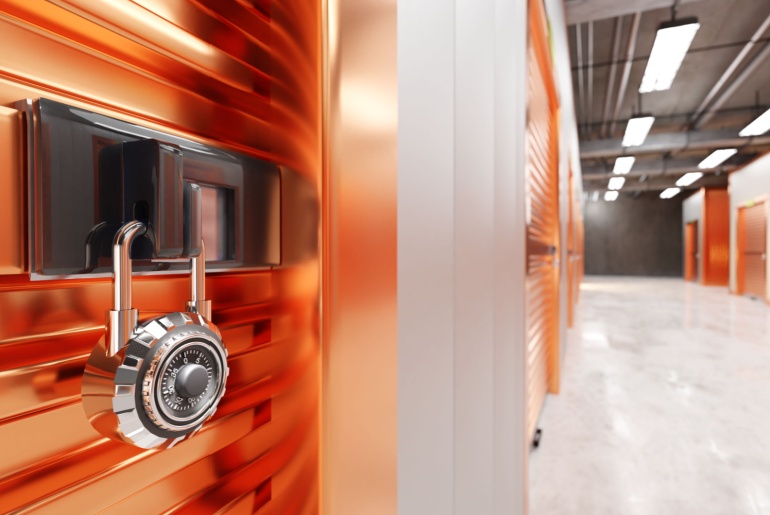
If you ever lose a key or your lock jams, don’t try to force it. Ask management how they handle lockouts or emergencies. Many facilities partner with licensed locksmiths or have 24-hour services that can help you get back in quickly and safely.
Smart locks are catching on fast. They connect to mobile apps and send alerts whenever your door is opened. They’re convenient and give an added layer of reassurance. Even so, no lock replaces insurance. A sturdy lock and a solid policy together give you both physical and financial peace of mind.
4. Individual unit alarms
Individual alarms take protection a step further. These systems link directly to your unit’s door, then sound an alert if someone tries to open it without authorization. Many are tied into a property-wide network that immediately notifies staff (and, in some cases, you) via a phone app.
High-end facilities connect these alarms to cloud-based or AI-powered systems that track unusual movement patterns. If a door opens unexpectedly, staff can check the footage and respond before anything goes missing.
Because of the technology and monitoring involved, facilities with individual unit alarms usually charge between $150 and $250 per month.
5. Video surveillance
Surveillance remains one of the backbones of modern storage security. Cameras act as both prevention and proof, capturing what happens across gates, hallways, and driveways. Most record around the clock; others switch on with motion sensors to save bandwidth. Cloud-based systems store footage offsite, so that evidence won’t be lost in case of damage or tampering.
When you tour a property, ask a few practical questions: How long do they keep recordings, how often do they check equipment, and do they use infrared cameras for night coverage? “It is important that your cameras on not just monitoring current events but recording them as well,” says Jamie M. Salas. “My cameras are monitored on my phone when I am away from the office and notify me immediately if there is an issue with a camera or the camera needs maintenance.”
Facilities with robust, regularly reviewed surveillance networks typically charge $120-$175 per month, depending on the local market and coverage area.
6. Good lighting
Lighting ties every other security feature together. Bright, consistent illumination helps cameras capture clear footage and makes you feel safer when visiting after sunset. It also discourages trespassing and vandalism.
Operators agree that strong lighting should reach all driveways, hallways, and loading zones. “Our cameras once captured suspicious activity after hours,” says Christine King, owner of Pontoon Plaza Storage. “Because the lighting was strong and the footage clear, we were able to work with local authorities immediately. That situation could have escalated if we hadn’t invested in reliable surveillance and staff protocols.” So, when you visit a facility, pay attention to how evenly lit the property is.
7. Onsite staff
There’s a long tradition in self storage of keeping real people on the property — managers who walk the grounds, check locks, and keep watch over what cameras might miss. That human presence remains one of the strongest forms of security today. Onsite managers handle daily inspections, answer questions, and respond quickly when something doesn’t look right.
Self storage experts also stress that visible staff deter unwanted activity simply by being there. “The quality of lighting, staff presence, and how well the site is managed day-to-day are often stronger indicators of safety than any single tech feature,” says Sergio Altomare, CEO at Hearthfire Holdings.
Daily inspections further strengthen protection. “I do daily walkthroughs to ensure each unit is secure,” says Jamie M. Salas. “Even after office hours, I review gate logs and check the property if something looks unusual.”
Some facilities also employ security patrols or 24-hour guards. Others rely on call centers that can dispatch help after hours. These measures bring extra reassurance for renters storing high-value or irreplaceable items.
8. High-tech security
Security has gone digital in recent years. Many facilities now protect both belongings and customer data through encrypted, cloud-based systems. These track every login, gate code, and access attempt.
Self storage experts also point out that technology keeps improving fast. “Storage security technology has improved a lot,” says Paul Simpson, Managing Partner at Juneau Self Storage. “Many properties now use Bluetooth-enabled locks and remote monitoring that allow both managers and customers to control access in real time.”
Advanced sites often integrate AI-driven cameras that detect unusual movement or sounds and send instant alerts. Properties offering this level of automation and monitoring tend to rent at $250 per month or higher, particularly in urban markets where around-the-clock access is expected.
9. Insurance
Even the tightest security system can’t remove every risk. That’s why insurance is essential. It protects you financially if something unexpected happens — fire, flood, or theft.
Most facilities make it simple by offering their own insurance plans through trusted third parties. You can also use your homeowner’s or renter’s policy if it covers off-site storage. Before you sign anything, confirm what’s included, what’s excluded, and what the deductible is.
Before you sign anything, ask what types of loss are covered, what the deductibles are, and whether your homeowner’s or renter’s policy extends to stored items. “Many renters assume that their contents are covered under the facility’s master insurance policy but in almost every case, these policies don’t cover the contents stored in the facility,” says Mike Bowman of Patio Productions. “Basically, renters must either confirm that their homeowners or renters insurance policies cover their contents that are in off-site storage or purchase additional storage insurance to protect themselves against loss due to theft or damage.”
10. What to watch for when comparing facilities
Before you rent, take a few extra steps:
- Ask how long camera footage is stored and who reviews it.
- Confirm whether staff are available after hours.
- Check if you can access video or alerts remotely.
- Read your rental agreement and insurance options carefully.
- Ask when security systems were last inspected or updated.
Self storage experts also stress that many customers overlook these questions and later discover gaps in monitoring or coverage that could have been avoided. Asking up front helps you find a facility that matches your expectations.
11. How pricing aligns with security
Security directly influences monthly cost. Here’s a quick guide based on current averages:
- Basic security ($50 — $80/month): Fencing, keypad gate, limited cameras.
- Mid-level ($80 — $150/month): Controlled entry, good lighting, consistent video coverage.
- Enhanced ($150 — $250/month): Smart locks, unit alarms, and on — site staff.
- Top-tier ($250+): Cloud systems, remote monitoring, and round — the — clock management.
Final takeaway: Self storage security is essential
Every expert we spoke with agrees: good security comes from layers working together — fencing, lighting, locks, staff, and technology. Each piece supports the others. As Faraz Hemani explains, “The key is to have a layered security method whereby many individual features, rather than a single feature, work together for positive protection.”
Modern operators now offer both physical protection and real-time oversight. When those systems are well-managed and supported by responsive staff, you can trust that your belongings — and your information — are in safe hands.



Storage Ideas for Small Spaces: 9 Ways to Max Out Your Home
With micro-housing on the rise(opens in new tab) and apartment sizes trending downward(opens in new tab), it came as no shock to us that more than a third of Americans felt overwhelmed by clutter in our recent survey(opens in new tab). Plus, science shows that we’re bound to feel bad in places that are too small(opens in new tab) for our needs. Fortunately, a messy home contains the seeds of its organization. Those seeds everywhere: the space above doors, under beds, behind sofas and inside furniture can all become storage. Here are the best storage ideas for small spaces, so you can make the most of your cozy home.
How to Organize Your Bathroom: 8 Ways to Stay Tidy
You already know why an organized bathroom is worth the effort, but let us remind you: it makes rushed mornings easier, keeps counters cleaner and just helps get you in the mood to go through your skincare routine like you should. Plus, in bigger households, it helps everyone find what they need. And you know how much a tidy bathroom counts for your self-esteem when a guest or a partner shows up. Luckily, you don’t need a degree to know how to organize your bathroom. The secret is keeping less, giving every item a home and making that home simple to use. Let’s go through some practical steps can help you create a bathroom that stays functional and nice to look at.

Best U.S. Cities to Live Uncluttered: Plano, TX, Offers the Most Room to Breathe
Clutter is in our homes as much as in our heads. Both are shaped by where we live.

How to Use Silica Gel Packets for Storage
Moisture can cause significant damage to items in storage, leading to rust on tools, mold on clothing and warping in documents. Silica gel uses science to fix that. Often found in small packets inside product packaging, silica gel is a desiccant that absorbs moisture from the air, keeping your stored items dry and protected. This guide explains what silica gel is, how it works and how you can use it to preserve your belongings in self storage.

Where to Find Moving Boxes in Los Angeles
Moving in Los Angeles is its own thing, and figuring out where to get moving boxes sorted is just the start of everything you’ll need to organize before moving day.

10 Best Places to Donate Books in Philadelphia
Did you know Philadelphia’s book-sharing roots go back to 1731? Benjamin Franklin and The Junto Club gathered their personal collections into a shared library, thus sparking a tradition of pooling knowledge for the common good. Today, you can carry on that spirit by donating books to local organizations and free libraries.

How to Sell Furniture (For Quick Deals and Side-Hustles)
Selling used furniture can be quick, profitable and even rewarding if you know where to list, how to present your pieces and what buyers are looking for. Just a tiny bit of patience and some good planning will take you a long way. This guide covers everything you need to sell your furniture efficiently and safely, for the best possible price.

1 in 4 Americans Rent Self Storage — and the Next Wave Is Already Coming
About one in four Americans is already using self storage and just as many are actively searching for a unit online right now. Across the 150 largest U.S. cities, self storage searches rose 23% year-over-year in 2025 — nearly triple the growth recorded the previous year, up from around 8% in 2024.

Where to Donate Furniture in Philadelphia
Philadelphia has a strong tradition of giving back, and donating furniture is a practical way to support local charities while freeing up space in your home. Whether you’re downsizing, moving, or just decluttering, there are plenty of organizations ready to take your gently used furniture. And if you’re not ready to part with certain pieces just yet, self-storage can buy you time to decide.