

Key Takeaways
- Before you book movers, compare your piano’s market value with the full cost of moving, storing and tuning it, since many older grands are worth less than the move.
- Measure the piano as it will sit on its side on the skid, then check every doorway, stair turn and landing on the route, paying special attention to headroom.
- Hire experienced grand piano movers with a skid, straps and a full crew, because moving a grand yourself risks serious injury and costly damage.
- Read your mover’s coverage before you sign, since Released Value protection caps liability at 60 cents per pound.
- Protect the piano from sudden humidity changes with climate-controlled storage if needed, and wait a few weeks after delivery before tuning it.
Before we get into the nitty-gritty of the matter, let’s agree on the simple fact that, unlike other types of relocation conundrums, moving a piano is just a very cool thing to see, let alone accomplish. The labor that makes piano concerts possible and keeps legendary instruments alive, a piano relocation takes meticulous planning, special equipment and a crew that really knows their stuff. That is, unless you’re set on recreating the piano crash of a classic Looney Toons gag.
If you want to know why a grand piano is so tricky to move and even store, it’s worth checking under the hood. Your average baby grand weighs around 550 pounds, a six-foot grand about 700 pounds and a concert grand up to a whopping 1,200 pounds. Most of that weight comes from the cast-iron plate that holds the strings under tension and gives notes that powerful resonance. Add in that weight’s uneven distribution and you’re in for a tricky job. Meanwhile, on the outside, those lacquered finishes make for easy scratching, while the legs and casters that support the piano are just not built for moving it.
This guide covers whether your piano is worth moving, how to prepare and transport it, how it’s protected if something goes wrong and how to store it safely.
Is your piano worth the moving cost?
A piano relocation is costly, so let’s not call the movers right away. First, figure out how much the piano would sell for, then compare that to the cost of movers. Unfortunately, many older grand pianos, especially models that were mass-produced in the mid-20th century, are worth less than what you’d pay for moving, storing and servicing them. As for damaged pianos, the cost of restoring it may not be worth it either.
Find out how old your piano is
Lift the lid near the tuning pins, then check the cast-iron plate for the serial number. Most pianos have their number stamped on that plate and if it’s not there, it’s probably somewhere else. Once you have the number, check out reference guides such as the Pierce Piano Atlas, which list serial numbers by manufacturer and year, or give it to a piano technician so they can figure out the dating for you.
Get a professional opinion on your piano’s value and condition
Age is not enough when you want to figure out your piano’s market worth (feelings aside). Since they have the proper equipment, get a piano inspector to look at:
- The soundboard: Check for cracks or loss of shape in the wood.
- The pinblock: Check whether the tuning pins still hold tension by testing the torque with a piano hammer.
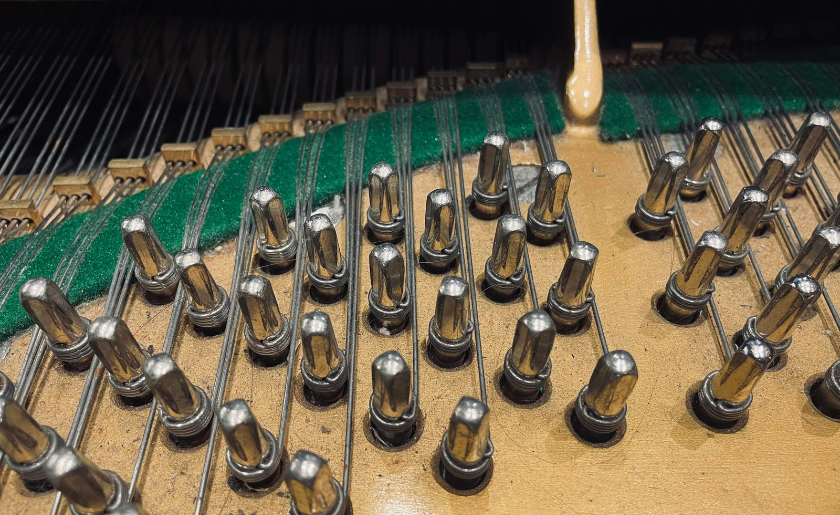
- The action and hammers: Check wear and whether regulation is needed.
- The case and legs: Look for loose joints or damaged leg plates.
- Market value: Get an estimate based on make, model, age and condition.
When you get your piano inspected before the move, you’ll also get a written record of the piano’s condition, which is a godsend if you need to make a damage claim later.
Add up the full cost
Include every expense, besides the moving quote:
- Moving fees, including stairs, disassembly and any crane work.
- Storage, if you can’t move the piano directly into its new place.
- Tuning after delivery and possibly further regulation or repairs.
- Extra mover coverage or separate insurance (if you don’t have it yet).
If you find that total is close to or higher than the piano’s value, it’s financially smarter to think of alternatives. You could either sell it locally, which may take a while, or just donate it to a school, church or community organization. You can also check if there are any piano rehoming services nearby, so you can send it to a new homeowner and avoid the bummer of having it end up in a landfill. If not, ask a technician or local piano dealer if they know options in your area.
What you need before moving a grand piano
Professional piano movers should bring the equipment needed for your instrument and route. You should see the crew (usually three or four people) come with:
- A piano skid (piano board), basically a padded board that supports the piano on its side.
- A heavy-duty four-wheel dolly, made from rubber wheels and a load rating suitable for the piano.
- Thick moving blankets, which protect the finish and detached parts.
- Moving straps, which keep the piano safe up to the skid and inside the truck.
- Ramps or skid plates for thresholds, steps and loading it into the truck.
- Screwdrivers and wrenches to remove the piano’s legs and pedal assembly.
- Labeled hardware bags to keep screws, hinge pins and small parts organized.
- Caster cups, which go under the wheels once the piano is in its final position.
If you’re thinking of doing this without a professional crew: please don’t. Plan to hire a professional crew. Even for a short move, use a piano skid or a properly rated dolly, never household equipment. If you can’t get the right equipment, hire a specialist who has it.
How to prepare a piano for moving
Here’s what to do ahead of the big day, so you can save time.
Step 1: Measure the piano on its side, then measure the route
A grand piano’s dimensions change once it’s on it’s on the skid and on its side. Some basic geometry is involved:
- Its width becomes its height. Most grand pianos are around five feet wide, so they stand about that tall on the skid, plus the skid itself and the dolly.
- Its length stays its length. When you plan for corners and stair turns, use this measurement.
- The depth of the case becomes its thickness. You’ll have to fit the piano through doorways, so use this dimension for that.
Measure your own piano with as much precision as you can, then add a healthy margin for blankets and straps.
Then compare those numbers with the route, as in the table below.
The hardest things to miss is the measure height of headroom at stair turns. Next thing you know, the piano’s upper corner catches on the ceiling or a light fixture when tilting, even if the stairwell is wide enough.
Once you’ve gone through this step, send photos and measurements to your mover before moving day. They should know whether the route will work or whether you’ll need to go the infamous window-and-crane route for the job.
Step 2: Remove and protect detachable parts
It’s enough to close the keyboard cover (the fallboard). The crew can then remove the lid and music desk.
Then, wrap each part separately in moving blankets and put hinge pins and other small fittings in labeled bags (trust us, it’s worth it).
Step 3: Remove the pedal assembly
The pedal assembly, called the lyre, hangs beneath the piano. Movers remove it before tipping the piano onto its side. If it stays attached, it can break under pressure.
Step 4: Transfer the piano onto the skid
This critical step should be handled only by experienced piano movers.
The crew will support the keyboard end, remove the appropriate leg and lower the piano onto its padded side on the skid. The piano will need controlled support throughout so it doesn’t tip or fall.
Step 5: Remove the remaining legs and secure the piano
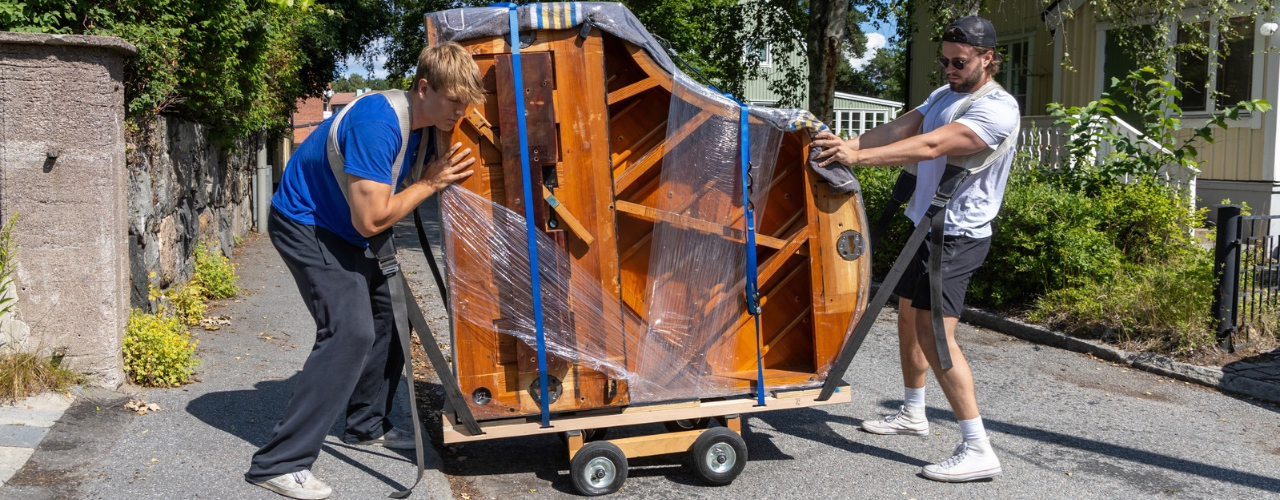
Once the piano is on the skid, the crew will remove the remaining legs. They’ll wrap it in blankets and strap it firmly to the board so they can move the piano and skid as one unit. Beneath the piano, they’ll secure a dolly for safe moving across level floors.
Step 6: Organize the parts
Keep the legs, lyre, lid and music desk together and label hardware bags by component so the crew can match every fitting during reassembly. Crucially, make sure each detached part is padded and secured for transport.
How to move a grand piano safely
Safety is everything, so let’s go through the fundamentals.
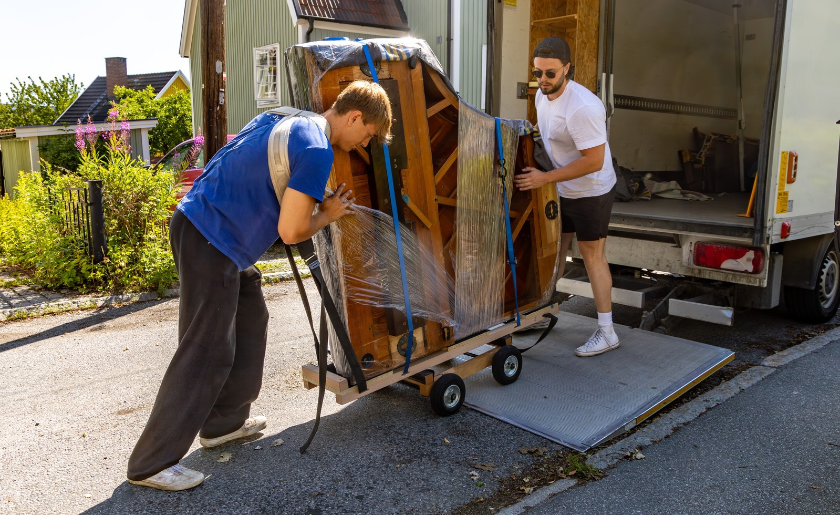
Keep it secured to the skid
Secure the piano on its side and on the skid for the whole move: through the building, onto the truck and into the new place. Keep it strapped in place until the crew is ready to reassemble it.
Don’t move it on its own casters
Piano casters are for small adjustments, not for moving the instrument around. If you roll a grand piano across floors or thresholds, you’ll damage the flooring and strain the legs. Make sure to flatten or avoid any uneven surfaces, since they’re a surefire way to lose control of the piano.
Protect the piano in narrow spaces
It’s like a dance. Move the piano slowly through doorways and around corners. The crew should watch the clearance on every side and stop before the piano touches a wall or door frame. And any seasoned mover will tell you to keep hands clear of pinch points between the piano and surrounding surfaces (the crew can prepare for this ahead of time just by scouting the route).
Plan stair moves separately
The simple law of gravity makes stairs particularly tricky for piano moving. That’s why stairs call for a separate assessment of the piano’s weight, the staircase and the working space. The crew size and equipment must match those conditions for the move to work. Depending on the route, professionals may use a padded sled, a stair-climbing machine or other specialized equipment.
Secure the piano inside the truck
Load the piano with a suitable ramp or liftgate. Inside, strap it on its skid against the truck wall with protective padding, the piano won’t be able to slide, tip or rub against anything during transit.
Can a grand piano be moved through a window?
Yes and it’s quite a sight. When a staircase or landing can’t fit the piano, professional movers may use a crane to lift it through a window or onto a balcony.
This can involve removing a window, hiring a specialist rigging crew and getting local permits. The movers need to assess the opening, the lifting access and any building requirements before scheduling the job. Also, when a house is under construction, some homeowners even have the piano lowered into their living room before the next floor starts construction.
In high-rise buildings, a freight elevator is often the simpler route, so take some time out to confirm its dimensions, weight limit and booking rules with building management in advance. For instance, moving a piano in NYC (which The New York Times once called a miracle(opens in new tab)) involves narrow walk-up stairwells, tight elevators and doorman buildings that won’t let movers in without a certificate of insurance and many co-ops and condos also limit moves to set hours with a reserved freight elevator. If the piano has to go through a window, the crane work falls under Department of Buildings rules and needs a licensed operator and using the street or sidewalk may need separate city permits, so leave those filings to an experienced rigging company.
Can you move a grand piano yourself?
No. You cannot and should not move a grand piano by yourself. The physical injury you risk with tipping or falling piano is so likely and so damaging that it’s just not worth it. On the financial side, you can easily damage the rim, cast-iron plate or soundboard by moving a piano on your own and the repairs will likely cost more than the piano is worth. And this is all without even mentioning the task of loading and unloading the piano.
However, one frugal alternative is to use a rental truck and leave the rest to specialists.
How to choose a piano mover
You don’t need to overthink this, but it’s good to be informed. Ask a piano technician or local piano dealer for recommendations. Before booking, ask each mover:
- How often do you move grand pianos?
- What equipment will you bring?
- How will you handle the stairs or other access problems?
- Does the quote include disassembly and reassembly?
- What coverage applies if the piano is damaged?
- Does that coverage reflect the piano’s full value?
Get the scope of work, price and coverage in writing. Also, check how your piano is protected during the move. Many people assume their mover will pay to repair or replace the piano if it’s damaged. Whether that’s true depends on the coverage you choose and sign for.
What does a grand piano move cost?
Local piano moves typically cost between $500 and $1,200 or more, depending on the piano type, weight, number of stairs, carry distance and whether the move requires disassembly and specialized rigging. The main factors are:
- Piano type, size and weight.
- Stairs and difficult access.
- Distance between the building and the truck.
- Disassembly and reassembly.
- Crane work or other rigging.
- Travel distance.
Grand pianos usually fall toward the higher end. Removing the legs, lyre and lid adds about $50–$150 to most local grand and baby grand moves, although some movers include it in their quote.
For long-distance moves, compare specialist piano transport with professional crating and freight services. Ask how the piano will be protected from freezing temperatures if the move happens in winter.
Understand the two levels of mover liability
As per the Federal Motor Carrier Safety Administration(opens in new tab), federal law requires movers to offer two liability options for interstate moves in the U.S.: Full Value Protection and Released Value.
- Full Value Protection: The mover is responsible for the replacement value of lost or damaged goods and this is the default level unless you choose Released Value. The cost varies by mover and may come with different deductible levels.
- Released Value: This option costs nothing extra, but the mover is responsible for no more than 60 cents per pound per article.
For a piano, the difference is huge. Under Released Value, a damaged 700-pound grand would be covered for about $420, regardless of its actual value. Because Released Value is free, it’s easy to choose it to lower the quote without realizing what it means for a valuable instrument. Read every waiver before you sign it.
A few things to consider doing:
For a high-value piano, declare it in writing. Under Full Value Protection, movers may limit their liability for items of “extraordinary value,” meaning items worth more than $100 per pound. A concert grand weighing about 1,000 pounds and worth more than $100,000 would fall into that category. If your piano’s value is more than $100 per pound, list it in writing on the mover’s paperwork before the move.
Check the rules for local moves. Many piano moves are local and fall under state rules, not federal ones, so coverage varies by state and by company. Ask each mover what coverage applies, what it costs and how claims are settled and get the answers in writing.
Check your own insurance. Your homeowner’s or renter’s policy may or may not cover the piano during a move. Some owners buy a separate instrument insurance policy for valuable pianos. Ask your insurer before moving day.
Document the piano’s condition before the move
Before the movers arrive:
- Photograph every side of the piano, including the lid, legs, pedals, keyboard and finish.
- Record the make, model and serial number.
- Keep the technician’s inspection notes and recent service records.
- Note any existing scratches, chips or repairs.
On delivery day, inspect the piano with the movers before they leave and write any new damage on the delivery paperwork.
Plan for changes in humidity
Physics makes it so a simple change of environment can affect a piano as much as the physical move itself. Wood absorbs and releases moisture slowly, so a sudden shift in humidity stresses the soundboard, the pinblock and the glued joints.
The risk is greatest when the two environments are very different, for example:
- Moving from a humid summer climate into a dry, heated apartment in winter.
- Moving between regions with very different climates, such as a coastal area and a desert.
- Delivering a piano from storage in a different season from when it went in.
How to reduce the shock:
Time the move if you can. Spring and autumn often mean smaller differences between indoor environments.
Use climate-controlled storage(opens in new tab) as a buffer. Stable storage conditions help when the piano is moving between two very different homes.
Prepare the new room. Check the humidity with an inexpensive hygrometer. If the air is very dry, run a humidifier for several days before delivery.
Keep the piano away from heat sources. Avoid radiators, heating vents, fireplaces and exterior doors.
Ask about a humidity control system. Your technician can advise whether a system installed inside the piano would help in your new home.
Wait before tuning the piano again
Give the piano a breather and let it adjust to its new room for a few weeks before tuning it. Tuning it right after delivery often means paying for a second tuning once the wood settles. If the piano went through a big humidity change, ask your technician to check for cracks, loose tuning pins or sticking keys during that first visit.

How to store a piano away from home the safe way
A piano may need storage during a move, a renovation or a temporary relocation. The main considerations are environmental conditions, available space and safe handling.
Self storage(opens in new tab) can work for a few weeks or months, especially if you can visit the unit to check on the piano. Rates vary widely by location, even at the city-level, so scout some self storage websites(opens in new tab) to compare unit sizes(opens in new tab), features(opens in new tab) and prices(opens in new tab).
Choose a unit with temperature and humidity control
Humidity swings are the main threat to a piano’s wood, felt and glued joints. Climate-controlled units(opens in new tab) keep temperature and humidity constant year-round and are generally recommended for expensive and delicate items, including antiques.
Ask each facility what its climate-controlled service includes and whether it manages humidity as well as temperature. Aim for temperatures of 64 to 72°F and relative humidity between 40 and 50 percent. Ask your technician whether your piano needs different conditions.
If you can’t go for climate control, still keep it away from moisture and temperature changes
Exterior walls see the biggest temperature swings and are the most likely place for water to get in, so place the piano in the middle of the unit or against an interior wall. Keep it away from the roll-up door and air vents and leave space around it for airflow and inspection.
Ask the mover how to keep it off a cold or damp floor while keeping it securely supported. Don’t improvise a platform that could shift or collapse under its weight.
Measure the piano before choosing a unit size
Measure the piano in the position it will be stored in, including wrapping, the skid and space for safe access.
Baby grand on its legs: A 10×10 unit(opens in new tab) usually fits it, along with the bench and a few other items.
Larger grand on its legs: A 10×15(opens in new tab) unit may be needed.
Smaller grand on its skid: A 5×10(opens in new tab) or 10×10(opens in new tab) may work because it takes less floor space. Confirm with your mover for larger grands.
Confirm the dimensions with your mover, including the unit door opening and the route through the facility.
Ask whether to store it on its legs or on the skid
Professional advice varies. The right choice depends on the piano’s condition, how long it will be stored and how it will be supported. Ask your technician and your mover to agree on a plan. For short stays, the piano may stay on its padded skid. For longer stays, they may recommend setting it back on its legs.
Use a breathable cover
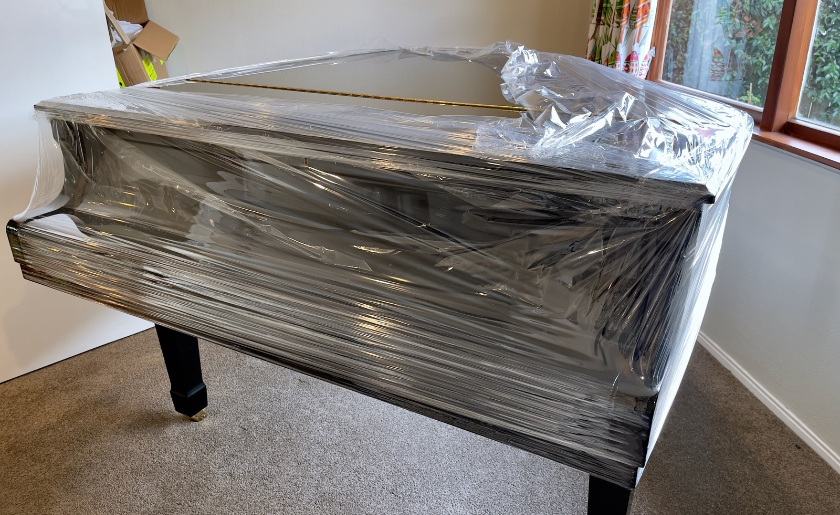
Use breathable moving blankets or a fitted piano cover. Don’t seal the piano tightly in plastic, which can trap moisture against it.
Keep the top clear
Never put boxes, furniture or other items on the piano, even if it’s covered. Keep nearby items stable so they can’t fall against it and leave a clear path for inspection and removal.
Consider specialist piano storage
For valuable pianos or long-term storage, ask piano movers about their own climate-controlled facilities. Some offer storage-in-transit, where the mover holds the piano at a monthly rate and delivers it when you’re ready, so it’s handled only once instead of being moved into a third-party unit and moved again. Confirm how the piano will be stored, monitored and insured during that time.
Common mistakes to avoid when planning to move a piano
No one was born a professional piano mover. So here’s what professional piano movers advise against:
- Moving a piano worth less than the move: Get a technician’s opinion first.
- Measuring only the doorways: Headroom at stair turns and landings often causes the real problems.
- Signing a Released Value waiver without reading it: Coverage may drop to 60 cents per pound.
- Skipping the condition record: Without photos and notes, damage claims are harder to prove.
- Rolling the piano on its casters: This can damage floors and strain the legs.
- Leaving the lyre attached during tipping: The pedal assembly can break.
- Moving without a piano skid: The piano loses essential support and protection.
- Using too small a crew: The team may not be able to control the piano safely.
- Hiring movers without grand piano experience: General moving experience isn’t enough.
- Ignoring humidity changes: Sudden shifts can crack the soundboard and loosen tuning pins.
- Choosing storage without checking conditions: Poor temperature and humidity control can cause lasting damage.
- Sealing the piano in plastic: Trapped moisture damages wood and metal.
- Stacking items on the piano: Added weight and shifting items can damage it.
- Tuning immediately after delivery: Let it adjust first.
Moving a grand piano is a big job, but it doesn’t have to go wrong. Check first that the piano is worth moving, measure the route with the piano on its side, hire a crew that moves grands regularly and read the coverage paperwork before you sign. If the piano needs a temporary home, choose storage with stable temperature and humidity. Once it arrives, put caster cups under the wheels, give it a few weeks to settle and then call your tuner.
FAQ
How much does it cost to move a grand piano?
Local piano moves typically run from $500 and $1,200 or more, depending on the piano’s type and weight, stairs, carry distance and whether disassembly or rigging is needed. Grands usually land at the higher end and long-distance moves and crane work cost more.
Can a grand piano fit through a standard door?
Usually, yes. With the legs, lid and lyre removed and the piano standing on its side on a skid, most grands fit through standard doorways. Headroom at stair turns and tight landings is more often the problem.
Is it safe to put a grand piano on its side?
Yes. That’s the standard way professionals move grand pianos. The piano is padded, strapped to a skid and supported the whole time.
How many people does it take to move a grand piano?
Usually three or four experienced movers. Stairs, tight access or a concert grand may call for more people or specialized equipment.
Does my mover’s insurance cover the full value of my piano?
Not always. For interstate moves, Released Value protection is free but covers no more than 60 cents per pound per article. Ask what coverage applies, declare high-value pianos in writing and check your own insurance before moving day.
How long should I wait to tune a piano after moving it?
A few weeks. The piano needs time to adjust to the temperature and humidity of its new room before a tuning will hold.
Can I store a grand piano in a regular storage unit?
For short stays it’s possible, but a unit that controls both temperature and humidity is much safer. Keep the piano away from exterior walls and the roll-up door, use a breathable cover and never stack anything on top.


How to Move a Piano: Moving, Insurance & Storage Guide
Before we get into the nitty-gritty of the matter, let’s agree on the simple fact that, unlike other types of relocation conundrums, moving a piano is just a very cool thing to see, let alone accomplish. The labor that makes piano concerts possible and keeps legendary instruments alive, a piano relocation takes meticulous planning, special equipment and a crew that really knows their stuff. That is, unless you’re set on recreating the piano crash of a classic Looney Toons gag.

Hall Closet Organization: 30 Ideas for Simpler Storage
Your hall closet works best when you can grab anything quickly and put it back just as fast. These 30 ideas walk you through planning, deciding where things go, deep shelves, coats and shoes, containers, extra space and upkeep, plus what you can do when your closet still runs out of room.

Holiday Decoration Storage: A Guide for Every Season
Taking down the holiday decorations is never as exciting as putting them up. One minute, your home is looking wonderfully festive, and the next, you’re trying to remember which box the Christmas ornaments came in while wrestling with a string of lights that managed to tie itself into a dozen knots. With every holiday bringing its own collection of decorations, a good holiday decoration storage system helps you keep a growing collection under control.

Where to Get Moving Boxes in Philadelphia
Philadelphia’s historic charm can put your patience to the test on moving day. Between cobblestone streets, narrow rowhouse entrances and the occasional pothole, you don’t want to worry about not having enough boxes on top of it all. Start gathering your moving boxes early and you’ll have one less box to check off on packing day. Luckily, you have plenty of places to get your boxes from.

Art Supply Storage from A to Easel
Paint tubes, brushes, sketchbooks, scraps of paper, beads, half-used rolls of tape and that one very specific pen you swear you just had in your hand. Building up an art supply collection is rarely a neat process, and each new material brings its own storage needs.

Scary Good DIY Halloween Decorations That Won’t Haunt Your Wallet
A few floating candles in the hallway, a family of ghosts by the front door and a suspicious number of bats climbing up the bedroom wall can make October feel a whole lot spookier. While Halloween stores are full of tempting finds, some of the best DIY Halloween decorations can come from things you already have tucked away in drawers, closets or the recycling bin.

Suburban Giants and Urban Risers: Where America’s 100 Largest Metros Fall on the Self Storage Map
Self storage has long been a suburban story. Across America largest 100 metros, 59% of the inventory built over the past decade sits outside city cores, largely preserving the ratio of the total existing inventory.

Sweatshirt Storage Ideas Worth Keeping Up Your Sleeve
Sweatshirts are great until you realize how much room they take up. A few thick hoodies can fill a drawer fast, with lighter crewnecks getting squashed underneath or pushed somewhere you forget about. Good sweatshirt storage can make that pile much easier to manage without requiring a bigger closet.

Living Room Storage Ideas: 28 Ways to Reclaim Your Hosting Space
If a living room is where most of a household’s living happens, good storage should be the top priority for setting up or revamping the place. After all, think of how easier it would be to have people over when tidying up the place is just a matter of putting things in their right place (in a time when fewer and fewer people are entertaining friends at home(opens in new tab)). The trick is making room for all those wayward clothes, blankets, chargers and other small things that end up on (or, inexplicably, in) the sofa. Here are 28 living room storage ideas to get you started and make tidying up a quick affair.