
How to Organize Your Kitchen Drawers: Smart, Practical Ideas That Make a Real Difference

The best way to organize your kitchen drawers boils down to a few core principles: give each drawer a specific role, store items close to where you use them, and choose organizers only after you’ve decluttered. Most kitchen drawers aren’t cluttered because of a genuine lack of space but because no one decided what belongs where. Fix that first, and the rest becomes much easier.
We all know how it happens: a spare spatula ends up with the cutlery, a handful of takeaway chopsticks migrate next to the measuring spoons, and before long you’re rummaging through layers of gadgets to find the can opener. The good news is that fixing the problem has very little to do with buying expensive drawer organizers and more to do with finding the right flow for your habits.
Whether you’re starting from scratch or just trying to make better use of what you already have, these ideas will help you organize your kitchen drawers in a way that’s functional and easy to maintain.
Start by emptying everything out
Before touching a single organizer, take everything out of the drawers — all of it. This is the step most people skip, and it’s why their drawers still aren’t organized after a full afternoon of effort.
Emptying forces you to see what you actually have: duplicates, broken utensils, and things that migrated in from other rooms entirely. Most households discover they own four vegetable peelers, three sets of measuring spoons, and at least one gadget bought for a specific recipe years ago that hasn’t been touched since. Get rid of everything you don’t use with some regularity. That watermelon slicer taking up prime real estate? It can go.
Assign every drawer a purpose before putting anything back
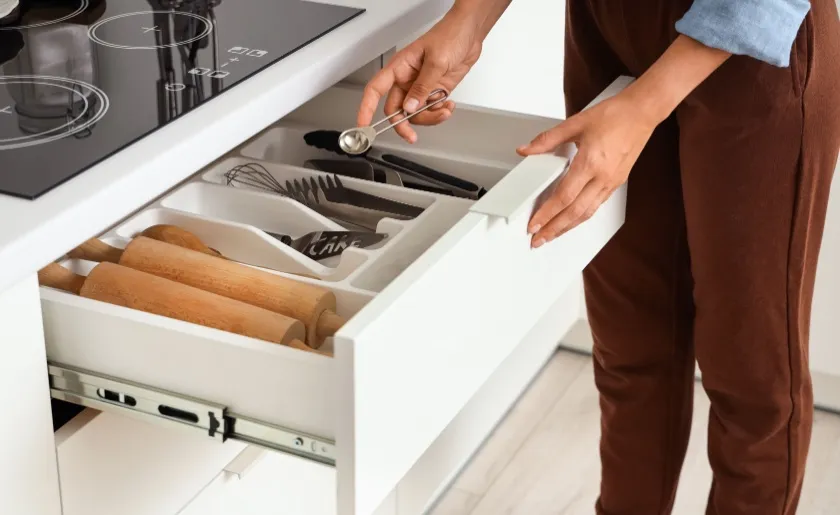
The easiest way to organize kitchen drawers is to stop thinking about individual items and start thinking about clusters related to the job they do. Instead of drawers each filled with an eclectic mix of kitchen stuff, assign roles:
- Prep drawer — peelers, graters, measuring spoons, kitchen scissors;
- Cooking drawer — spatulas, tongs, ladles, wooden spoons;
- Baking drawer — rolling pin, pastry tools, cake testers, piping tips, cookie cutters;
- Wraps and storage drawer — plastic bags, foil, parchment, cling film;
- Cutlery drawer — everyday flatware, nothing else;
- Utility drawer — batteries, tape, scissors, the things that don’t belong anywhere else but still need a home;
Once every drawer has a specific job, it becomes obvious where each item belongs and, just as importantly, where it doesn’t.
Store items where you actually use them
Items should live as close as possible to where they’re used. This simple rule has a huge impact and will help you streamline cooking. Simply think about where you stand when you do various kitchen specific jobs and store utensils and appliances you need for each task nearby.
- Prep tools (peelers, graters, knives) near your main work surface;
- Cooking utensils beside the stove;
- Flatware close to the dishwasher and table;
- Wraps and storage bags near where you pack leftovers;
- Spices and oils near the range;
The reason professionally designed kitchens feel so intuitive is that items don’t require you to cross the room to retrieve them. Organizing around workflow is the single change that makes the biggest difference in how a kitchen feels day to day.
Organize shallow and deep drawers differently
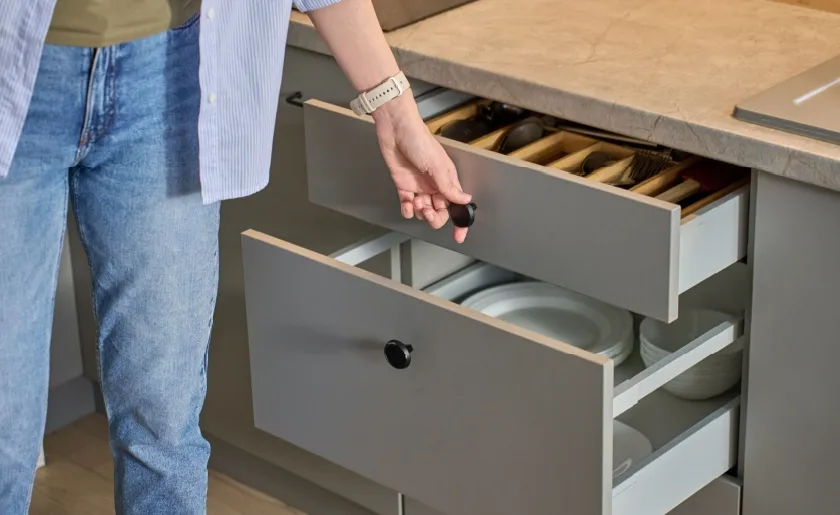
One of the most common mistakes is treating every drawer the same way. Shallow drawers and deep drawers have fundamentally different storage requirements.
Shallow drawers
Shallow drawers work best for everyday essentials: flatware, prep tools, measuring spoons and small gadgets. Everything should be accessible at a glance without having to move other items out of the way.
Keep one small compartment specifically for tiny items such as wine stoppers, bag clips, tea infusers, meat thermometer.
Avoid overfilling: a shallow drawer with breathing room between categories is easier to maintain than one packed to full (or shall we say overfull) capacity.
Deep drawers
Don’t treat your deep drawers like giant empty buckets where you can simply pour stuff (never to be found again, if we’re being fair). These drawers work best when they convert horizontal stacks into vertical groups.
- Pans and lids — use vertical dividers or a pan rack so each item can be grabbed without unstacking the whole drawer
- Plates and bowls — a peg system or non-slip mat keeps items from sliding; dishes stored in deep base drawers are often more ergonomic than upper cabinets, and faster to unload from the dishwasher
- Long tools (rolling pins, grill tools, oversized spatulas) — store diagonally to use the full length of the drawer rather than forcing them into square compartments that are too short
The main rule to remember: the deeper the drawer, the more you should think vertically. The shallower the drawer, the more you should think compartmentally.
Choose organizers that fit your drawers
The most reliable kitchen drawer organizers are adjustable, modular, expandable or trimmable. Drawers are rarely standard sizes and needs change over time, so it’s important to purchase items that can be re-used and re-purposed.
For shallow utensil drawers: Expandable trays work in most widths and can be reconfigured as your kitchen evolves. If space is tight, a compact tiered cutlery organizer layers flatware vertically in a smaller footprint.
For deep drawers: Peg systems keep dishes, bowls, and lids from shifting and can generally be fitted in drawers that aren’t standard sizes.
For knives: An in-drawer knife rack keeps blades protected and frees up counter space.
For spices: If you’d rather keep spices in a drawer than a cabinet, a flat spice liner stores jars label-up so you can see the entire collection at once.
For food storage bags and wraps: Removing bulky cardboard packaging and loading into a dedicated dispenser the box-on-box friction that makes these drawers hard to maintain.
One practical tip before buying anything: line the drawer with paper, trim it to size, and take that template to the store. It’s the most reliable way to avoid wasted inches and returns.
Don’t try to eliminate the “junk” drawer, just give it purpose instead
Almost every kitchen has a drawer that holds things that don’t naturally belong anywhere else. That’s fine. The goal isn’t to eliminate it but to give it a real purpose and boundaries.
Decide which household essentials belong there: pens, batteries, tape, scissors, candles, reusable clips. Then use small bins or dividers to keep categories from bleeding into one another. A utility drawer can hold miscellaneous tools and still stay organized, as long as it has a defined job and doesn’t become the default destination for everything without a home.
Before buying permanent organizers for this drawer, try repurposed cardboard boxes or containers you already own. Test the layout for a week or two, then invest in proper inserts once you know what actually works.
Creative kitchen drawers organizing ideas worth considering
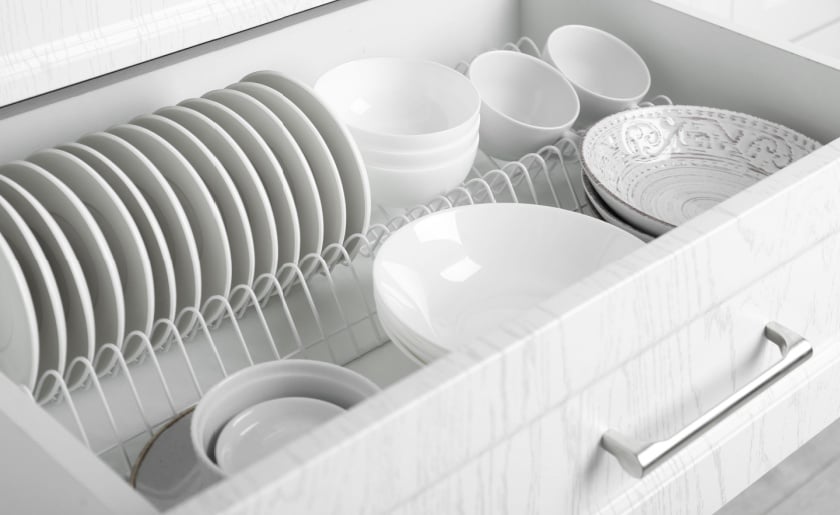
Once the basics are in place, a few less conventional solutions can make a real difference:
Dish drawers: storing everyday plates and bowls in deep drawers instead of upper cabinets speeds up dishwasher unloading and makes better use of the drawer’s depth. It’s actually more ergonomic than most people expect.
Toe-kick drawers: the recessed space beneath lower cabinets can be converted into shallow drawers for baking trays, pizza stones, placemats, and other flat items that are generally very difficult to store. It requires planning right from the start when you design your kitchen or some serious retrofit work but offers some of the highest “found space” payoff available in a kitchen.
Diagonal dividers: for drawers holding rolling pins, grill tools or other oversized utensils, diagonal dividers are very useful as you get the full length of the drawer.
One viral idea worth skipping: the TikTok flatware arrangement that stores pieces side-by-side in perfectly nested rows. It looks great, but real-use testing shows it collapses quickly once pieces are removed. Good drawer organization has to survive repeated access — not just the moment after you’ve finished setting it up.
Use self storage to carve out more space in your kitchen
Some kitchen items are worth keeping but don’t need to live in a drawer or a cabinet at all. Seasonal pieces such as the huge trays for cooking the Thanksgiving dinner, specialty appliances used a few times a year, bulk purchases of paper towels and other kitchen supplies or inherited serving sets all have one thing in common: they take up daily space for access you rarely need.
A small self storage unit can act as an overflow cabinet for anything that belongs in your life but not in your kitchen.
Here are some of the items you can store in a small storage unit located close to your home:
- Seasonal entertaining supplies — Thanksgiving platters, holiday serving pieces, punch bowls.
- Specialty appliances — whether it’s an ice cream machine that you take out a few times in the summer or a chocolate fountain you use for parties, there’s little sense to have them around year-round.
- Bulk purchases — extra paper goods, backup pantry supplies
- Inherited pieces — family china, crystal, heirloom cookware
How to keep your kitchen drawers organized long-term
Once you’ve organized your kitchen drawers, maintaining them is much easier than starting over. Put things back in the same place after cooking, take a few minutes every few months to remove tools you no longer use, and adjust the layout if your cooking habits change.
Just remember: no organization system can compensate for too much stuff in too little space. When drawers are genuinely at capacity, the fix is reducing what competes for the same space, not buying another organizer.
FAQs
How do I organize my kitchen drawers on a budget?
Start with what you already have. Repurpose shoeboxes as dividers, use rubber bands to keep lids grouped or cut cereal boxes into shelf risers. Spend money only on the one or two spots that cause the most daily friction, like a sturdy turntable for a corner cabinet or a tiered riser for spices.
Test with cardboard first; buy permanent organizers only once you know the layout works.
How do I organize kitchen drawers in a small kitchen?
Prioritize ruthlessly. A small kitchen can’t afford to store things used twice a year. Use door-mounted organizers for wraps and foil, stack stackable items, and pull double duty from every surface. For a deeper look, our small kitchen storage ideas guide covers practical steps worth working through.
How do I organize kitchen drawers without dividers?
Lean on grouping and zones instead of physical barriers. Wrap rubber bands around bundles of similar tools, store categories in repurposed tins or small containers you already own, and keep the commitment to one category per drawer strict enough that items self-sort over time. Cardboard box inserts cut to size work surprisingly well as free interim dividers until you’re ready to invest in something permanent.
How do I organize kitchen drawers when I have a lot of gadgets?
The first step is a ruthless audit — most kitchens have more gadgets than cooking habits actually justify. Group what remains by task (prep, baking, specialty cooking), assign each group its own drawer or a clearly bounded zone within a drawer, and store rarely used items in a separate location or a nearby self storage unit rather than letting them occupy prime drawer real estate.
Can organizing kitchen drawers help reduce food waste?
Yes. When dry goods and spices are on hand and label-up, you tend to use what you have before it expires. A 2025 EPA report found that the average family of four wastes nearly $3,000 worth of food annually and visibility is a significant part of the fix. Take things a step further and organize your pantry as well to ensure your entire kitchen is perfectly equipped to avoid food waste.



How to Use Silica Gel Packets for Storage
Moisture can cause significant damage to items in storage, leading to rust on tools, mold on clothing and warping in documents. Silica gel offers a simple yet powerful solution. Often found in small packets inside product packaging, silica gel is a desiccant that absorbs moisture from the air, keeping your stored items dry and protected. This guide explains what silica gel is, how it works and how you can use it to preserve your belongings in self storage.

Where to Find Moving Boxes in Los Angeles
Moving in Los Angeles is its own thing, and figuring out where to get moving boxes sorted is just the start of everything you’ll need to organize before moving day.

10 Best Places to Donate Books in Philadelphia
Did you know Philadelphia’s book-sharing roots go back to 1731? Benjamin Franklin and The Junto Club gathered their personal collections into a shared library, thus sparking a tradition of pooling knowledge for the common good. Today, you can carry on that spirit by donating books to local organizations and free libraries.
How to Sell Furniture (For Quick Deals and Side-Hustles)
Selling used furniture can be quick, profitable and even rewarding if you know where to list, how to present your pieces and what buyers are looking for. Just a tiny bit of patience and some good planning will take you a long way. This guide covers everything you need to sell your furniture efficiently and safely, for the best possible price.
1 in 4 Americans Rent Self Storage — and the Next Wave Is Already Coming
About one in four Americans is already using self storage and just as many are actively searching for a unit online right now. Across the 150 largest U.S. cities, self storage searches rose 23% year-over-year in 2025 — nearly triple the growth recorded the previous year, up from around 8% in 2024.
Where to Donate Furniture in Philadelphia
Philadelphia has a strong tradition of giving back, and donating furniture is a practical way to support local charities while freeing up space in your home. Whether you’re downsizing, moving, or just decluttering, there are plenty of organizations ready to take your gently used furniture. And if you’re not ready to part with certain pieces just yet, self-storage can buy you time to decide.

Jet Ski Storage: How to Winterize & Where to Keep Your Watercraft
If you want your jet ski to deliver the fun times for years on end, then proper storage is in order. Leaving it exposed to weather, UV rays, or theft can lead to costly damage, mold, or vandalism. Here’s everything you need to know to store your jet ski safely.
How to Organize a Guest Room: From Decluttering to Storage
A guest room often becomes a holding zone for spare furniture, seasonal bins and unfinished decisions. To reclaim it, start with three basics: a comfortable place to sleep, room for a guest to unpack and the everyday essentials that make the space easy to use.

Where to Donate Furniture in Phoenix (And Some Back-Up Plans)
Whether you’re downsizing, moving, redecorating, or clearing out an estate, giving your gently used furniture a second life is one of the most rewarding ways to declutter. Phoenix has a deep bench of nonprofits that will happily take your couch, dresser, or dining set, and many of them offering free pickup right from your driveway. This guide covers where to donate furniture in Phoenix, what each organization accepts, how pickups work, and when a storage unit(opens in new tab) can help with the items you would still like to keep.