

Nobody warns you that getting into board games usually unlocks a second hobby, the much dreaded one that includes figuring out where on earth to put them. One game becomes a few, expansions start spawning beside their base boxes and before long, board game storage requires as much strategy as whatever is waiting on the other side of those lids.
Board games aren’t known for being cooperative partners, which makes storing them the unofficial first round of game night. Boxes come in dimensions that seem personally designed to ruin a good shelf arrangement and the miniature you spent an entire evening painting deserves better than being tossed into a bag with 47 tokens and a rulebook. Add playmats, card decks and the 27th dice set you definitely needed and your hobby starts rolling for additional square footage.
Luckily, tabletop players have been solving this campaign for years. From the beloved Kallax and custom inserts to dedicated board game shelves and some wonderfully unhinged space-saving hacks, there are plenty of board game storage ideas for keeping a growing collection organized without banishing half of it to the dungeon.
So, roll for initiative. We’re taking on the real tabletop boss battle: the collection versus the available space.
Start with the board game organizer you already own
The best board game shelf is the one that works with the collection you already own and leaves a little room for the games you haven’t talked yourself out of buying yet. Before shopping for shelving, measure your biggest boxes along with the space where the shelf will live. Board games have never agreed on a standard box size, and your symmetrical shelving plan won’t persuade them to start now.
Depth deserves particular attention, as a shelf that handles Catan perfectly well may leave an oversized campaign game hanging over the edge, while smaller boxes can disappear behind each other when the shelf is unnecessarily deep. Look at the collection as a whole, along with the games whose dimensions already make them difficult to store.
Then there’s the question of how the shelving handles the boxes you already own and the ones still incoming. That answer tends to reveal itself once the collection includes its first oversized arrival.
A shelf can hold every game perfectly and still be annoying to use when reaching Azul requires relocating half of Wingspan and whatever else ended up on top. Stacking six games horizontally may technically make them fit, right up until someone wants the one at the bottom and game night begins with an excavation.
Shelving that lets you pull out a title without dismantling half the collection makes it easier to keep the whole setup organized after you’ve used it.
Don’t underestimate the weight involved, either. Cards, boards, rulebooks and wooden components add up across a large collection, so check the shelf’s weight capacity and anchor tall furniture where the manufacturer recommends it. Your games can roll for falling damage during play, but the actual collection doesn’t need to.
But before committing to any shelving decision, it’s worth understanding why so many collectors end up in the same place. Spend enough time looking at board game collections and the IKEA Kallax starts to seem like it comes bundled with your tenth game purchase — and it’s not hard to see why.
Which brings us to that debate.
Best shelving options for board game storage
Not all board game collections fit the same shelf, and the Goldilocks type of storage (not too big, not too small) usually comes down to what you are working with.
The Kallax has entered the campaign
Few pieces of furniture have become as closely associated with board gaming as the IKEA Kallax(opens in new tab). The appeal is easy to understand once you start loading one up.
Its square compartments are deep enough for plenty of standard game boxes, the open front keeps the collection visible rather than hiding it behind doors, and you can position the unit horizontally or vertically. An eight-cube version also sits around the $80 mark, making it an approachable upgrade when your previous storage system was wherever the boxes happened to fit.
The cubes can do more than hold games, too. IKEA’s drawer inserts turn one compartment into a handy spot for the smaller inhabitants of a tabletop collection, including spare dice, card decks and accessories that don’t have an obvious box to call home. Rolled playmats present their own storage puzzle, and the Kallax has a tidy answer for those too.
Orientation gives you another choice, as a Kallax can stand tall when floor space is scarce or run horizontally beneath a window or along a wall. Some collectors combine several units as their library grows. Just check IKEA’s placement and anchoring instructions for whichever configuration you’re using. A collection heavy enough to make moving day feel like someone cast Encumber on the entire household deserves the wall anchor.
For all its tabletop fame, however, the Kallax has one stat you can’t level up: those cubes stay the same size.
Purpose-built shelving for bigger collections
There will inevitably come a time when a game will roll up with no respect for the established shelf dimensions. Oversized boxes are the Kallax’s natural enemy, and games such as Gloomhaven can turn a neat wall of cubes into a geometry problem remarkably quickly.
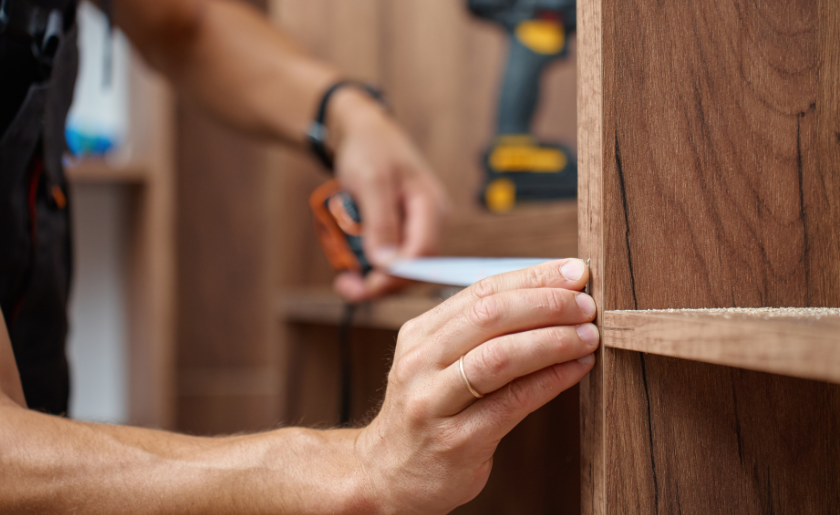
This is where adjustable shelving starts gaining points. Instead of asking every game to conform to a fixed cube, you can move shelves around the awkward boxes already in your collection. It also leaves more options when the next Kickstarter arrives in packaging roughly the dimensions of a carry-on suitcase.
Purpose-built shelving offers a way to design around the games instead of asking the games to fit the furniture. BoxThrone(opens in new tab) takes the horizontal approach literally, using individually adjustable shelves so games can lie flat without piling on top of one another. GamePillar(opens in new tab) uses adjustable shelving as well, with its steel system designed around different board game box heights. They’re a much bigger investment than a Kallax, with GamePillar’s short and tall configurations listed around $219 and $299 respectively, but the extra flexibility becomes easier to appreciate when fixed cubes have started dictating which games can live where.
There’s no need to pledge allegiance to one shelving system.
Once you’ve found somewhere every box can physically live, though, tabletop storage opens its next debate. Do the games lie flat or stand spine-out?
Flat or spine-out? Pick your side
Ask board game collectors how boxes belong on a shelf and you’ve found a debate capable of lasting well past game night. Flat storage keeps gravity working in your favor — useful when a game relies on an insert with dedicated spots for cards and tokens. Open the lid and everything should still be roughly where you left it rather than having staged a coup somewhere between the shelf and the table.
The trouble starts once those horizontal stacks grow. Enough weight piled onto one box can put pressure on the lid — smaller boxes stacked over larger ones without their edges lining up for support make this worse in a hurry.
Spine-out storage borrows from the bookshelf playbook, letting each game stand vertically with its title facing the room. You can spot what you want and pull it straight out, which makes a packed collection easy to browse. There is something deeply satisfying about seeing Root, Everdell and Terraforming Mars lined up like a tiny tabletop library — even more so after the inevitable debate about how to arrange them. Gravity, unfortunately, gets a turn.
Cards can slip out of their wells and an insert that looked organized while flat may become less impressive after a few weeks on its side. This is one reason resealable bags remain such a beloved low-tech solution among collectors who store vertically, and custom inserts can make things friendlier when they’re designed to hold everything securely regardless of orientation.
Box lids deserve some attention when they’re standing vertically as well. Regular rubber bands are commonly suggested as a quick fix, though they’re not a favorite option for a collection you care about long-term. Rubber can dry out and create friction against box surfaces, while reusable fabric box bands are designed to hold lids closed without narrow rubber digging into the edges.
So, which side wins? Tabletop collectors themselves remain thoroughly divided, and mixed storage may be the most practical answer for a collection full of wildly different boxes. A tightly packed Azul or Pandemic can behave perfectly well spine-out, while a game whose insert dumps everything the moment you tilt the box has already cast its vote for flat storage. Community discussions reflect exactly that split, with plenty of collectors choosing orientation game by game rather than declaring permanent membership in Team Flat or Team Vertical.
The board game organizer rabbit hole goes deep
Opening a board game box should not feel like you’ve triggered a random encounter. Once a collection starts including games with hundreds of components, a good board game organizer can save as much frustration at the table as it does space inside the box.
There isn’t one organizing system that works for every game. Some boxes behave perfectly well with what the publisher gave you, while others invite a complete interior renovation the moment you punch out the cardboard. How far down the organizer rabbit hole you go can depend on the number of components you’re wrangling and how the game is set up.
Start with bags, trays and the insert you already have
Before sending the factory insert into the recycling bin, see how well it works once every component has been punched, sorted and packed. Card dividers keep different decks from becoming one enormous shuffling problem, and labeled bags are worth using even when the factory insert does most of the sorting work.
Rather than automatically grouping every identical component together, consider what needs to come out at the same point during setup. Player-specific pieces can share a bag or container, for instance, so everyone can grab their set and get started.
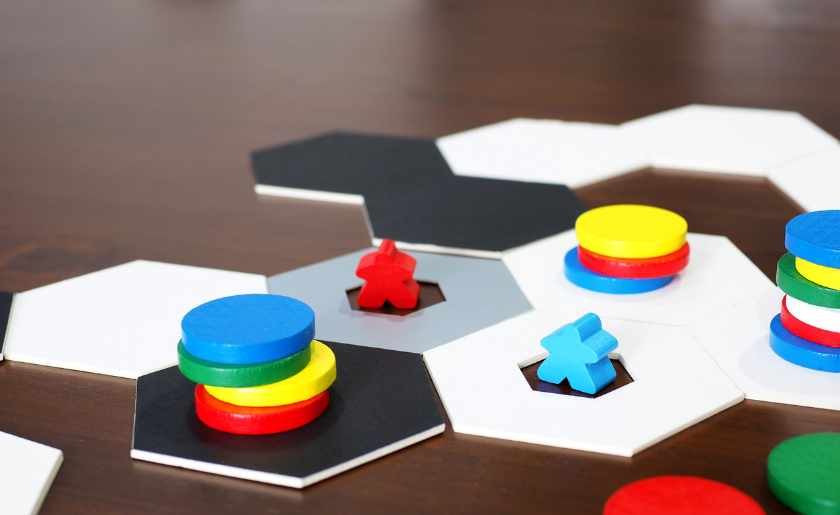
Some factory inserts leave enough empty space for components to roam once the game is stored on its side. Keeping the leftover punchboards beneath the insert is a popular trick for filling that gap and bringing the contents closer to the lid. It costs nothing and it requires no crafting proficiency.
DIY board game inserts: when to build your own
At some point, organizing board games can unlock crafting as an unexpected expansion pack. The real advantage is control over the layout. Instead of accepting whatever configuration came inside the box, you can build around the way you play and create removable trays for the table or accommodate components you’ve added since buying the game. Sleeved cards are a classic reason for redesigning an insert, since that extra layer of protection can make decks too thick for their original wells.
Of course, “I’ll just make an insert” has the same dangerous energy as “I’ll paint one miniature tonight.” Assembling a custom layout can become an evening project before you’ve opened the rulebook. For people who enjoy crafting, that’s half the appeal.
Your 3D printer has accepted a side quest
Owning a 3D printer opens an alarmingly deep branch of the board game storage skill tree. Sites such as Printables(opens in new tab) host community-designed files for specific games, including organizers built around the exact dimensions of their cards and player pieces.
A well designed insert can change more than how tidy the box looks on the shelf. Removable resource trays can travel from box to table and cleanup becomes a matter of returning pieces to designated compartments rather than rebuilding the box from scratch. That alone can be a compelling reason to print one.
 There is one important character check before committing several hours of filament. Make sure the design matches your copy of the game. Expansions, revised editions and card sleeves can alter what needs to fit and discovering that your printed card tray is two millimeters too narrow is the kind of critical failure nobody needs.
Commercial board game inserts: what to look for
Commercial inserts offer the same basic idea in a ready-designed format, with options ranging from lightweight foam organizers to laser-cut wood systems made for individual titles.
Materials can change the experience more than you might expect. Foam keeps the organizer light, while wooden inserts tend to add more weight to an already component-heavy box and may require assembly. Before buying, check whether the design accommodates sleeved cards and the expansions you own, since an organizer made for the base game can become obsolete the moment another box joins the family.
Some designs also turn storage components into play components. Folded Space(opens in new tab), for example, makes game-specific organizers with removable trays intended to go directly onto the table, including designs for titles such as Carcassonne and Arcs.
Does every board game need a custom organizer?
The existence of an engineered organizer for a game does not automatically mean your copy needs one. A title with relatively few components may already pack away neatly, leaving a custom insert to solve a problem you never really had.
The calculation changes when you notice yourself avoiding a game because setting it up feels like work. That’s usually the right cue for a dedicated organizer, whether printed, bought or built from scratch and the clearest sign it will earn its place on the shelf.
One box to rule them all: Consolidating expansions
Buying an expansion often leaves you with an oddly familiar packing problem. The new cards and components take up half the box they arrived in, yet the box itself demands a full spot on the shelf. Once a game has picked up several expansions, combining them can recover a good amount of space.
Start by seeing what the base-game box can accommodate without forcing the lid upward or cramming components together. Removing a molded factory insert can open up room for expansion content, with labeled bags, dividers or fitted trays taking over the sorting duties. Dominion players have been doing versions of this for years, and expandable card games such as Arkham Horror: The Card Game present the same question on a larger scale as new campaigns join the collection.
Organizing expansions inside a single board game box
Consolidation works better when you can still tell everything apart after the boxes disappear. Card dividers can separate sets, while labeled bags keep tokens or other expansion-specific components from blending into the base game.
The organizing system should follow how you play. Someone who always uses every expansion has little reason to preserve strict boundaries between them, while a group that regularly switches modules may want those divisions to remain obvious.
What do you do when one box isn’t enough?
Some game families need more than their original packaging can offer, which is where larger collection boxes and so-called monster boxes come into play. They’re designed to bring a base game and substantial expansion content under one lid, often with dividers or trays that keep the collection navigable.
Before moving everything over, check the weight of the finished box along with its dimensions. Hundreds of cards, boards and wooden components concentrated in one container can become cumbersome to lift, and an overfilled box puts more strain on its corners and lid. Two manageable boxes can serve you better than one container you dread taking down from the shelf.
Should you keep empty board game expansion boxes?
Throwing away an expansion box can feel mildly criminal when you’ve paid for the game, like the artwork or enjoy seeing the complete series lined up. Keeping every empty box, however, can undermine much of the space you gained by consolidating in the first place.
Collectors who expect to resell games later may have a reason to hang onto original packaging, while those planning to keep a title indefinitely have more freedom to recycle boxes they no longer use. Some boxes can also be flattened without damaging them, provided their construction allows it, giving you a middle ground when your collector brain refuses to sign the recycling paperwork.
No rule says consolidation has to be all or nothing. Keep the packaging that matters to you, combine the expansions that play well together and let the shelf decide how many empty boxes it is willing to host.
After all, one box to rule them all only works when you can still lift the thing.
How to store board games by type
Cards need dividers. Campaign games need a system that remembers what happened last session when nobody else does. Tile-heavy games bring another storage problem altogether. The contents of the box should have a say in how you organize it, rather than making the entire collection follow one set of rules.
Storage tips for card-heavy board games
Once games such as Dominion, Marvel Champions and Arkham Horror: The Card Game start accumulating additional content, browsing the card collection becomes just as important as fitting it inside the box. Clearly labeled dividers can separate expansions or card types according to how you build decks and prepare for play.
Hundreds of sleeved cards occupy noticeably more room than bare ones, so organizers and card boxes need enough width and depth to accommodate the version of the collection you play with. Leave some room for additions rather than packing every row edge to edge from the beginning.
How to store tile-heavy board games
Azul and Carcassonne don’t occupy enormous boxes, yet a collection of chunky tiles can become deceptively heavy. That matters both for the shelf supporting several games and for whatever you’re using to organize the contents.

Shallow trays work well for tiles because you can separate them without creating deep stacks, then bring the containers directly to the table when it’s time to play. For games where tiles need to be drawn randomly, an opaque bag may already be part of the design, in which case the game has kindly handled part of the storage problem for you.
Storage tips for campaign and legacy board games
Keep active campaign materials clearly separated from unused content and store your progress notes with the game rather than trusting everyone to remember what happened three weeks ago. Anything intended to remain hidden until later should have a defined spot where curious hands won’t encounter it while looking for another component.
Spoilers are bad enough on the internet. Your board game organizer doesn’t need to join in.
Resource-heavy games should be organized around play
A game such as Terraforming Mars or A Feast for Odin can put a considerable number of resources on the table before the first proper turn begins. Small removable trays can hold those pieces between sessions and then move directly from box to table when everyone sits down.
Consider which components are used together rather than sorting everything according to shape or whatever arrangement looks neatest inside the box. A storage system that mirrors setup cuts down on sorting and gives every tray an obvious destination again when game night ends.
How to store trading cards and card game decks
A mixed tabletop collection may stretch beyond board games into Magic: The Gathering, Pokémon, Lorcana or another TCG, bringing hundreds or thousands of loose cards along for the ride. Deck boxes work well for active decks, while larger card boxes with dividers can organize the rest by set, color, format or whatever filing system prevents you from having to flip through 800 cards to find one.
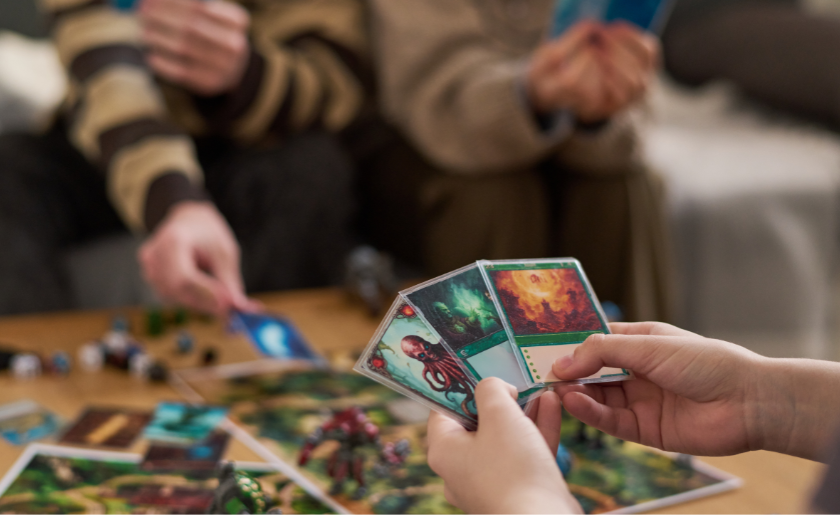
Sleeves, binders and long-term card protection all come down to having the right system for storing trading cards(opens in new tab). Sleeved cards take up more room than bare ones, so leave some breathing space when choosing a box rather than packing rows tightly from day one. Keeping labels visible from above can also save time when several decks share the same drawer or container.
Spare sleeves deserve a home nearby instead of being distributed across every drawer in the room like tabletop confetti. Keeping unopened packs and leftovers together makes it far more likely you’ll remember what you already own before buying another set.
With the flat, rollable and generally well-behaved accessories accounted for, we can move on to the collection members that demand a gentler hand. The minis have officially entered the battlefield.
How to store oversized and oddly shaped board game boxes
Collector’s editions and unusually proportioned games can wreck a shelf layout you spent far too long measuring. Rather than squeezing an oversized box into a cubby and damaging its corners, give awkward titles a dedicated section or adjust the shelving around their dimensions.
Weight can help determine placement as well. Keeping the heaviest boxes lower down makes them less awkward to retrieve and avoids asking the upper shelves to carry the collection’s resident tanks.
Where do all the board game accessories go?
The games may have claimed the shelves, yet the rest of the tabletop arsenal still needs somewhere to live. Giving these accessories designated spots keeps them within reach without giving up another shelf that could be holding a game.
How to store board game playmats without creasing them
Folding a playmat may save room in the moment, though the resulting creases aren’t what you want greeting your cards at the next session. Rolling them avoids those fold lines, and tubes or vertical compartments can keep individual mats from becoming one long pile you have to rummage through.
Kallax owners have a wonderfully specific hack available here. A bottle organizer insert divides one cubby into smaller horizontal compartments, and those openings happen to work well for rolled playmats. Instead of dedicating a drawer or balancing rolls on top of the games, each mat gets its own slot right beside the collection.
For a larger playmat stash, storing the rolls upright in a tall basket or divided container can accomplish the same thing. Just keep them somewhere dry and away from direct sunlight, since prolonged UV exposure can fade printed surfaces.
Give the dice hoard somewhere to roll home to
There comes a point when “my dice” becomes “my dice collection,” and as a tabletop player you probably rarely need help identifying when that transition occurred. Dice bags remain the obvious choice for sets you regularly bring to the table, while drawers or divided containers can handle everything waiting in reserve.
Kallax drawer inserts can turn one cube into accessory storage without sending your d20s rolling around alongside full-size game boxes. Small compartments also work well for generic counters and other loose gaming pieces that aren’t assigned to a particular title.
And yes, the Crown Royal bag remains a time-honored member of the tabletop storage ecosystem. Some traditions require no redesign.
Minis have entered the battlefield
Painted miniatures require a little more diplomacy than the average game component. Tossing them loose into a bag invites chipped paint and the undignified sight of your carefully painted hero arriving at the next session missing an arm.
For miniature-heavy games such as Zombicide, Nemesis and HeroQuest, compartmentalized cases or foam trays can keep figures from knocking against one another between sessions. The original insert may already do the job well, so there’s no reason to replace it for the sake of upgrading. Check that each figure sits comfortably without weapons, wings or other delicate parts pressing against the lid or neighboring minis.
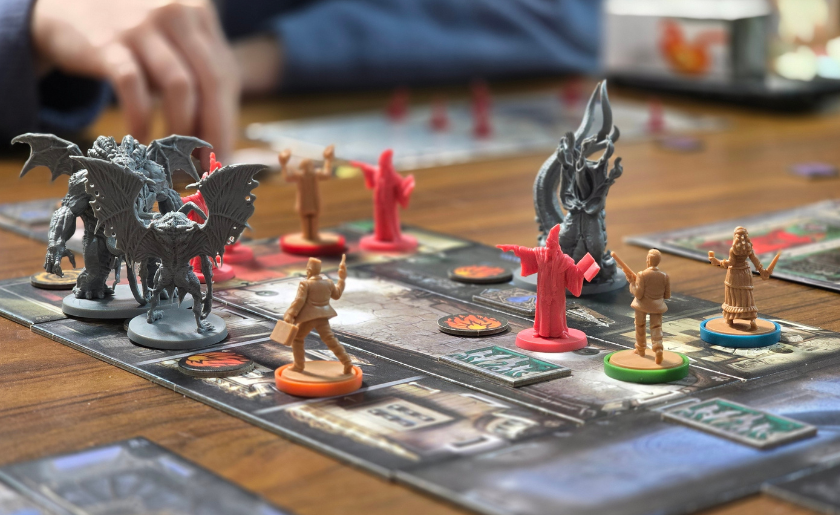
Magnetic storage offers another route, particularly once painting and customizing become part of the hobby. Small magnets attached beneath compatible miniature bases can hold figures against a metal-lined tray or case, keeping them upright without foam pressing against painted surfaces. It takes some DIY work upfront, but your lovingly painted party gets to travel standing rather than reenacting a tavern brawl inside the box.
Whatever system you use, don’t forget about height. The standard foot soldier may fit while the giant dragon has other plans. Measure the tallest and widest figures before buying trays or cases and avoid forcing delicate sculpts into compartments just because the bases fit.
If your minis have officially become a collection of their own, storing cases together and labeling them by game can keep the right army from wandering into the wrong campaign. After all, losing a miniature during combat is part of the game. Losing it somewhere in your storage system is considerably less heroic.
When your board game collection outgrows the game room
For a collection you want to keep, self storage(opens in new tab) can give the less frequently played portion somewhere to stay without forcing a ruthless round of keep, sell or donate.
The trick is deciding what deserves shelf space at home. Current campaigns and regular game-night picks belong within grabbing distance, while games that come out a few times a year can form an offsite rotation.
Board games contain plenty of materials that don’t appreciate poor storage conditions. Cardboard can absorb moisture, cards can warp and prolonged exposure to humidity can encourage mold, so a climate-controlled storage unit(opens in new tab) is worth considering when local temperatures and humidity fluctuate significantly. Games should also stay off the concrete floor on sturdy shelving or pallets, with boxes protected from anything that could crush or distort them.
How you arrange the unit matters once the collection moves beyond a handful of boxes. Keep games on shelving rather than building towering stacks, place heavier titles lower down and leave yourself a route to reach everything without unloading half the collection — a storage unit size calculator(opens in new tab) can help you pick the right fit before you book. An inventory on your phone can record which games are offsite and where they’re sitting, and the same organizing tips(opens in new tab) that work at home translate well to a storage unit too.
Rotation keeps self storage from becoming the place where games go to fail their final saving throw. Swap titles as campaigns end or as your group develops a new obsession, bringing neglected games home while others take their turn off the active shelf.
FAQ
How many board games fit in a Kallax?
A standard 4’x4’ Kallax has 16 cubes and can hold roughly 80-100 standard-sized board games stored spine-out, though that number drops significantly once oversized boxes, big-box editions or stacked horizontal games enter the collection. A 2×4 unit with 8 cubes holds approximately 40-50. The real variable is your collection — a shelf full of small card games will fit far more than one anchored by Gloomhaven and Arkham Horror.
How do you store board games in a small apartment?
Vertical storage is your best friend in a small space. A Kallax positioned horizontally under a window or along a low wall doubles as a console or bench surface. Wall-mounted shelving keeps games off the floor entirely. Consolidating expansions into base game boxes and being selective about which titles earn permanent shelf space can also make a significant difference when every square foot counts.
How do you protect board games from humidity and moisture damage?
Keep games away from exterior walls, basements and anywhere that experiences significant temperature swings, as cardboard absorbs moisture readily. Silica gel packets tucked into boxes or storage units can help manage humidity in problem areas. If storing a large collection(opens in new tab) offsite, a climate-controlled unit is worth the extra cost. Games should always be stored off bare concrete floors, which can transfer moisture upward even when conditions seem dry.
What is foamcore and why do board gamers use it?
Foamcore is a lightweight board made from a foam center sandwiched between two thin paper or plastic surfaces. Board gamers use it to build custom inserts because it’s inexpensive, easy to cut with a craft knife and sturdy enough to hold game components securely. A well-made foamcore insert can be tailored precisely to a game’s cards, tokens and boards, replacing a loose factory insert with something that keeps everything organized regardless of how the box is stored. The tradeoff is time — designing and cutting a full insert for a complex game can take an evening or more.
How do you store board games with lots of miniatures?
Foam trays with individual compartments prevent figures from knocking against each other during storage and transport. For painted miniatures specifically, magnetic storage — small magnets under bases, metal-lined trays — keeps figures upright without foam pressing against painted surfaces. Always check the height of your tallest figures before buying any tray or case, since standard compartments rarely account for large sculpts with extended weapons or wings. For games you suspect might appreciate over time, the same logic applies as it does to valuable collectibles — original packaging in good condition tends to protect resale value more than you’d expect
Make room for the next game night
A board game collection is rarely finished, because there will always be another game somebody brings over and insists you have to try. There will always be an expansion you swore you weren’t going to buy or a title that follows you home after you only went into the game store to browse.
The point of organizing all of it is to keep the collection playable. You should be able to spot what you own, pull a game out without performing minor shelf surgery and put everything away with ease. However elaborate your setup becomes, it still has to work when five people are standing around the table asking what we’re playing tonight.
When the collection changes, the storage setup can change with it. Shelves can be rearranged, inserts replaced and games rotated elsewhere when they aren’t seeing much table time. No system needs to survive every future purchase you make.
May your shelves be sturdy and your next purchase fit.



Moving From a House to an Apartment: What to Expect, How to Downsize & How Self Storage Helps
For some, moving from a house to an apartment is a financial decision. For others, it’s about simplifying life. Maybe the kids have moved out and half the house sits empty, or you’re approaching retirement and no longer want to spend weekends on repairs. Or perhaps you’ve been weighing the cost of buying a home and wondering whether renting simply makes more sense right now.
Family Heirlooms Overload: How to Handle Family Inheritance Without Regret
Handling family heirlooms after a loss requires managing legal authority, emotional pressure and practical logistics at the same time, and the order you take them on matters more than most people expect.
Blanket Storage: The Right Method for Every Space and Season
Blankets make our lives cozier, and storing them well is what keeps them soft and comfortable in the long run. Knowing how to store a blanket properly means your favorites come out of storage smelling fresh, feeling the same as when they went in, and lasting years longer than they otherwise would.
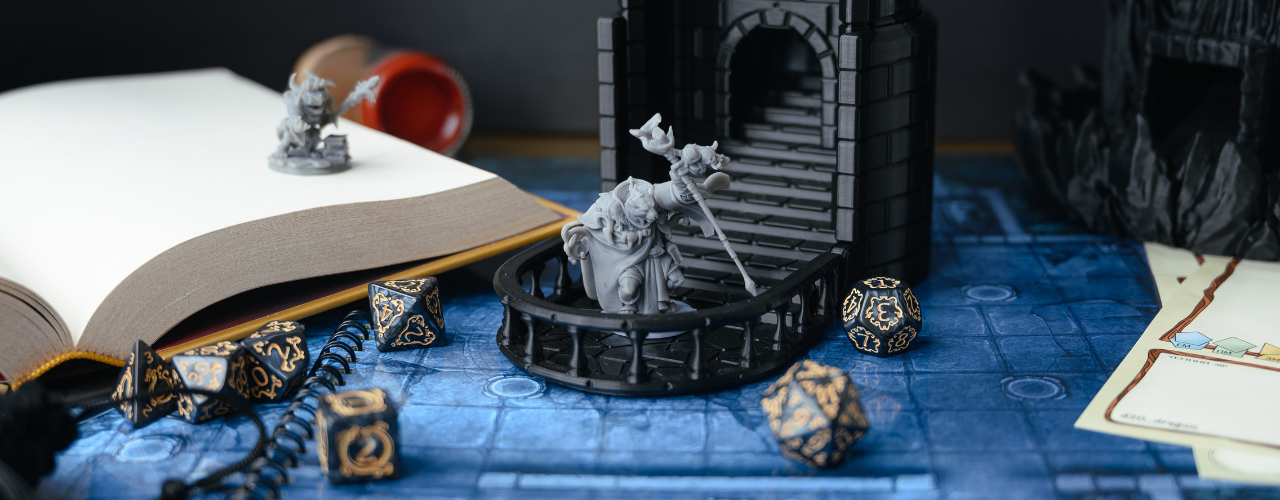
Board Game Storage Ideas That Keep Your Collection in Fighting Shape
Nobody warns you that getting into board games usually unlocks a second hobby, the much dreaded one that includes figuring out where on earth to put them. One game becomes a few, expansions start spawning beside their base boxes and before long, board game storage requires as much strategy as whatever is waiting on the other side of those lids.

Storage Locker vs. Storage Unit: What’s the Difference?
A locker and a unit may sound like two names for the same four walls and a lock, and depending on the storage facility, you may even see the terms used that way. However, once you start comparing available spaces, storage lockers tend to occupy the smaller end of the spectrum, while storage units(opens in new tab) give you considerably more room to work with.

Storage Ideas for Small Spaces: 9 Ways to Max Out Your Home
A messy home contains the seeds of its organization. Those seeds are everywhere: the space above doors, under beds, behind sofas and inside furniture can all become storage. Here are the best storage ideas for small spaces, so you can make the most of your cozy home.

Best U.S. Cities to Live Uncluttered: Plano, TX, Offers the Most Room to Breathe
Clutter is in our homes as much as in our heads. Both are shaped by where we live.
How to Organize Your Bathroom: 8 Ways to Stay Tidy
You already know why an organized bathroom is worth the effort, but let us remind you: it makes rushed mornings easier, keeps counters cleaner and just helps get you in the mood to go through your skincare routine like you should. Plus, in bigger households, it helps everyone find what they need. And you know how much a tidy bathroom counts for your self-esteem when a guest or a partner shows up. Luckily, you don’t need a degree to know how to organize your bathroom. The secret is keeping less, giving every item a home and making that home simple to use. Let’s go through some practical steps can help you create a bathroom that stays functional and nice to look at.

How to Use Silica Gel Packets for Storage
Moisture can cause significant damage to items in storage, leading to rust on tools, mold on clothing and warping in documents. Silica gel uses science to fix that. Often found in small packets inside product packaging, silica gel is a desiccant that absorbs moisture from the air, keeping your stored items dry and protected. This guide explains what silica gel is, how it works and how you can use it to preserve your belongings in self storage.