

San Francisco has no shortage of places to donate furniture, which is good news in a place where moving trucks seem to be a permanent part of the streetscape. Anyone who’s ever watched three friends pivot a couch around the tight corner of a San Francisco Victorian knows moving day here can turn into a spectator sport. Apartments change, roommates come and go and sometimes the couch that fit in one place might not make the trip to the next.
Sometimes it’s not the furniture that’s too big — it’s the floor plan that’s too small. The average San Francisco home is about 20% smaller than the national average — roughly the equivalent of giving up an entire couch’s worth of living room. It’s little surprise, then, that furniture accounts for 27% of everything people keep in self storage, making it the most commonly stored category. That coffee table that’s been collecting moving boxes for the past month could just as easily be holding someone’s morning coffee next week.
Whether you’re leaving the Mission or finally admitting the sectional you fell in love with online was never going to fit your apartment, there are plenty of local organizations ready to give it a fresh start in someone else’s home.
1. Out of the Closet
- Best for: Donating gently used furniture, appliances and household items
- Location: 1295 Folsom St, San Francisco, CA 94103 (second location at 1498 Polk St, San Francisco, CA 94109)
Walk around San Francisco on the last weekend of the month and you’re almost guaranteed to find a perfectly good bookshelf sitting on the curb. Before your furniture becomes part of that familiar streetscape, send it Out of the Closet.
Operated by the AIDS Healthcare Foundation, Out of the Closet turns donated furniture and household goods into funding for HIV testing, treatment and prevention services, with 96 cents of every dollar earned supporting those programs.
The Folsom Street location accepts gently used furniture, household items, home décor and select appliances in good condition. If you’re donating a larger piece, you don’t even have to figure out how to get it across the city. Schedule a pickup through the online donation form and one of the organization’s drivers will collect qualifying furniture straight from your home. To qualify for free pickup, donations must include at least two large accepted furniture items or a minimum of ten large bags of household items.
Instead of becoming another curbside find, your donation can help furnish someone’s home while simultaneously supporting healthcare programs that have served San Francisco for decades.
2. Grateful Gatherings
- Best for: Donating couches, coffee tables, dressers, dining sets and desks directly to Bay Area families transitioning out of homelessness
- Location: No fixed storefront — donations submitted via online form at gratefulgatherings.org. There is no pickup available, but they can provide delivery referrals
Four walls can make a house. A couch, a dining table or a desk is what starts making it feel like home. Through donated furniture, Grateful Gatherings helps Bay Area families transitioning out of homelessness turn empty spaces into lived-in homes.
The organization — based in Oakland and serving the broader Bay Area — accepts furniture another family can start using from day one, including couches, coffee tables, dressers, dining sets, desks and other essential pieces. Note that mattresses and bed frames are not accepted. While it doesn’t offer pickup, donations are submitted through a short online form and the team can connect donors with delivery referrals when needed. Instead of sitting in storage or waiting for its next owner, your sofa becomes someone’s fresh start.
3. Freecycle
- Best for: Rehoming furniture of any condition directly to a neighbor who needs it, no middlemen involved
- Location: No storefront. Post your item online at freecycle.org and coordinate pickup with a local member
Sometimes the most direct route is a neighbor with a pickup truck and a need for exactly what you have.
Freecycle is a nonprofit network where San Francisco residents post items they want to give away — for free, to local people, no strings attached. You post your piece, someone in the community claims it and comes to get it. No minimum number of items, no condition requirements, no scheduling windows to work around.
It’s useful for the pieces that fall through the cracks elsewhere. If it still has life in it, someone in SF probably wants it.
The one thing to keep in mind is that you’re coordinating directly with whoever claims it, so timing depends on the other person. But for furniture that might not make the cut anywhere else, it’s hard to beat free, local and immediate.
4. Community Thrift Store
- Best for: Donating furniture while directing proceeds to a charity of your choice
- Location: 623 Valencia St, San Francisco, CA 94110
Most donations ask you to let go, but what makes Community Thrift Store stand out is the fact that it lets you hold on to one final decision: where the proceeds from your furniture will go. Instead of choosing the recipient, you choose the cause.
Founded in 1982, Community Thrift Store partners with more than 200 Bay Area charities, allowing you to designate which nonprofit will benefit when your furniture is sold. Whether you’re passionate about animal welfare, environmental conservation, youth programs or healthcare, your donation can support a cause that’s already close to home. Furniture donations can be dropped off at the Valencia Street store, and free furniture pickup is also available within San Francisco by appointment Sunday through Thursday.
It’s a rare chance to donate twice with a single piece of furniture. Once when someone gives it a new home and again when the proceeds go where you want them to.
5. Remoov
- Best for: Donating, selling and recycling furniture in one pickup — you earn back proceeds from anything that sells
- Location: 2415 17th St, San Francisco, CA 94110. Schedule online at remoovit.com, call 415-857-2791 or text photos to 415-969-4060
In a city that’s spent more than two decades championing zero waste, throwing away a good piece of furniture can feel like breaking an unwritten rule. If you believe one last chance is better than a trip to the landfill, Remoov was built with that mindset in mind.
Instead of asking you to choose between donating, selling or recycling, Remoov does all three. After you submit photos online or by text, the team sorts through what can be resold, donates furniture that still has plenty of life left and responsibly recycles whatever can’t be reused. Better yet, you’ll receive a share of the proceeds from anything that sells.
Not everything belongs in the donation pile, and not everything belongs in the landfill either. Remoov flips that around by evaluating each piece after pickup and finding the best possible outcome for it.
6. Make It Home Bay Area
- Best for: Donating quality furniture directly to Bay Area families and individuals transitioning out of homelessness or crisis
- Location: Warehouse in Novato — serves San Francisco and all Bay Area counties, drop-off by appointment or deliver directly
Make your move and Make It Home. Founded by interior designer Carolyn Flannery, the nonprofit furnishes entire homes for families and individuals transitioning out of homelessness or crisis. Every home they furnish is different, and they treat it that way.
They work directly with social service agency case managers, who reach out when a client has finally found housing, so your couch isn’t heading to a storefront shelf. Instead, it’s going to a specific person, in a specific home, on a specific day that matters a lot to them.
Donations are drop-off only, so you’ll need to get your furniture to their Novato warehouse. They do hold items to a high standard — clean, functional, no stains, no pet odors — but furniture that’s in good shape will be well used.
Between keeping and donating, self storage keeps your options open
Donating furniture gets talked about as though it’s a simple decision. Keep it or let it go. In reality, there’s a third option that often gets overlooked.
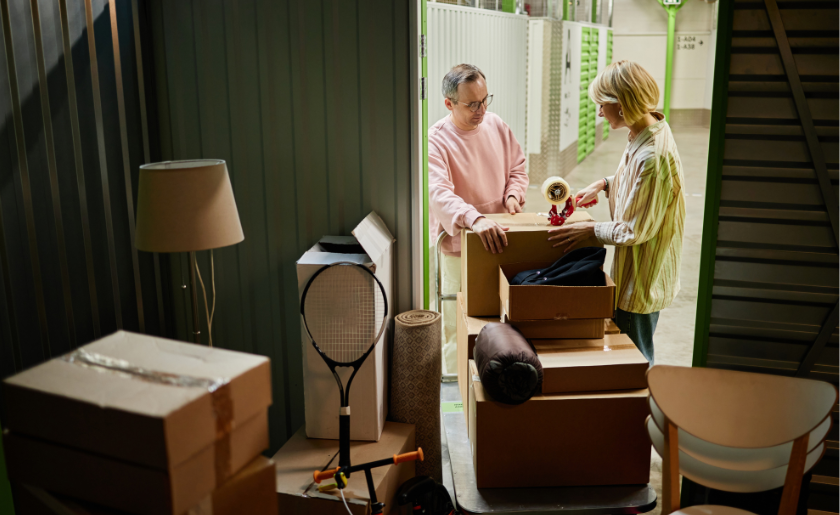
Maybe you haven’t lived in your new place long enough to know what fits. Maybe you’re attached to a piece you aren’t ready to part with. Either way, forcing a decision because moving day is chaotic isn’t always the smartest one, so your best bet might be to table it for the time being. In the meantime, a storage unit gives you something most moves don’t: time. Time to measure the room twice. Time to schedule a donation with an organization you want to support.
Time, though, only works in your favor if your furniture stays in good condition while you wait. A few simple precautions will help ensure it’s just as ready for donation when it comes out of storage as it was when it went in.
A storage unit is a pause, not a goodbye
Some furniture just needs to wait. Maybe the new place is smaller or maybe you’re just not there yet. A storage unit is a good place to keep it until the timing is right.
Start with these storage habits:
- Clean every surface before storing it. Dust and moisture are much easier to prevent than remove later.
- Take apart larger pieces when you can. Table legs, shelving and bed frames travel more safely when they’re
- disassembled. Store the hardware in a labeled bag attached to the furniture.
- Skip the plastic wrap. Breathable furniture blankets or cotton covers protect against dust while allowing air to circulate, helping prevent trapped moisture.
- Raise furniture slightly off the floor. Pallets or sheets of cardboard improve airflow and add another layer of protection.
- Choose climate-controlled storage for wood, leather, antiques and sentimental pieces. Stable temperature and humidity help prevent cracking, warping and mold during longer stays, especially when it comes to leather furniture storage.
FAQ
1. Can I get a tax deduction for donating furniture in San Francisco?
Yes. Donations to registered 501(c)(3) organizations — like Out of the Closet and Community Thrift Store — are generally tax-deductible. Ask for a receipt at drop-off or pickup and consult a tax professional to confirm eligibility and valuation.
2. What furniture is typically NOT accepted by donation centers?
Most San Francisco donation centers won’t accept mattresses, box springs, items with stains, tears or significant damage, furniture with mold or pest damage, or large built-in pieces. When in doubt, call ahead before scheduling a drop-off or pickup.
3. How do I donate furniture in San Francisco if I don’t have a car or truck?
Several organizations on this list — including Out of the Closet, Community Thrift Store and Remoov — offer free or paid pickup directly from your home, so you don’t need to arrange transport.
4. How do I donate furniture for free in San Francisco?
Several organizations will pick up furniture from your home at no charge. Out of the Closet offers free pickup for qualifying loads (at least two large furniture items), Community Thrift Store provides free pickup by appointment Sunday through Thursday, and Grateful Gatherings can connect you with delivery referrals. All three are free to the donor.
5. Are there eco-friendly furniture disposal options in San Francisco?
Yes. San Francisco has strong zero-waste infrastructure. Remoov prioritizes resale, donation and recycling before any landfill disposal. The city’s Recology program also accepts some bulky items. Donating to any nonprofit on this list keeps furniture out of landfills entirely.
6. How do I donate furniture to Goodwill in San Francisco?
Goodwill does not currently accept furniture donations in San Francisco. For furniture donation in the city, organizations like Out of the Closet, Community Thrift Store and Grateful Gatherings are the closest equivalents — all offer free pickup and direct the proceeds to local causes.
Every piece has its place
Finding room for furniture in San Francisco isn’t always easy, but finding it a second home can be. Whether you donate furniture to a local organization or store it until the timing feels right, every thoughtful choice helps keep pieces in circulation instead of on the sidewalk. When one door closes, another one re-furnishes.


How to Store LEGOs: All the Fun, None of the Clutter
How to store LEGOs largely comes down to how your household uses them. If the bricks are part of everyday play, you need a setup that keeps them within easy reach and makes cleanup quick (for your feet’s sake, at least). Toy storage(opens in new tab) such as simple bins, playmats or containers that children can put away themselves may be enough. Larger or more serious collections usually need more organization, such as labelled drawers for loose pieces, trays for unfinished builds, shelves for completed models and separate storage for retired sets.

Cardboard Costume Guide: Tips and Ideas for a DIY Halloween
Whether for kids or adults, cardboard costume ideas often make the biggest splash once materialized, and that’s for a simple reason: doing a lot with a little is a universally impressive feat (especially in this economy). If you don’t have enough boxes you could temporarily repurpose, don’t worry! There are many places where you can find free moving boxes(opens in new tab), from stores and supermarkets to online groups and recycling drop-off spots. On the run? Try your luck at a self storage(opens in new tab) facility that sells moving supplies, often for cheap. This way, you can choose moving boxes of different shapes and sizes(opens in new tab), so you can make your costumes as complex as you want.

How to Celebrate Halloween: 9 Non-Spooky Ways To Enjoy It
As soon as October starts, it’s the official Halloween month. And while for many people it means it’s open season to get the scare of a lifetime, others, especially families with small children, might prefer to celebrate in a tamer way that’s both kid- and adult-friendly. While you’re likely to find more events where the spook factor is high, here’s how to celebrate Halloween in a not-so-scary way:

Motorcycle Storage Guide: How to Store Your Bike Safely
Motorcycles may be born to be wild, but eventually even the wild ones need somewhere to park. Whether riding season is winding down or your current living situation comes with plenty of square footage for you and less for your bike, motorcycle storage is one of those parts of ownership that doesn’t get as much airtime as the open road.

Halloween Decorating on a Budget (And Cheap Ideas for Everything Elsee)
Halloween has crept a long way from its eerie origins. While All Hallows’ Eve has transformed through the centuries, it wasn’t until the 1930s that trick-or-treating became a tradition in the U.S. and businesses began conjuring up mass-produced Halloween costumes. Now, Halloween is a monster-sized, billion-dollar industry, with a cauldron full of costumes and decorations ranging from the mainstream to the macabre. But is it all really worth your wallet? Maybe, but we’ll let you in on a little secret: You can keep your Halloween decorating on a budget and save on everything else, too. Take this plan and see it through!

Moving From a House to an Apartment: What to Expect, How to Downsize & How Self Storage Helps
For some, moving from a house to an apartment is a financial decision. For others, it’s about simplifying life. Maybe the kids have moved out and half the house sits empty, or you’re approaching retirement and no longer want to spend weekends on repairs. Or perhaps you’ve been weighing the cost of buying a home and wondering whether renting simply makes more sense right now.
Family Heirlooms Overload: How to Handle Family Inheritance Without Regret
Handling family heirlooms after a loss requires managing legal authority, emotional pressure and practical logistics at the same time, and the order you take them on matters more than most people expect.
Blanket Storage: The Right Method for Every Space and Season
Blankets make our lives cozier, and storing them well is what keeps them soft and comfortable in the long run. Knowing how to store a blanket properly means your favorites come out of storage smelling fresh, feeling the same as when they went in, and lasting years longer than they otherwise would.

Board Game Storage Ideas That Keep Your Collection in Fighting Shape
Nobody warns you that getting into board games usually unlocks a second hobby, the much dreaded one that includes figuring out where on earth to put them. One game becomes a few, expansions start spawning beside their base boxes and before long, board game storage requires as much strategy as whatever is waiting on the other side of those lids.