
Best US Metros For Downsizing: San Jose And San Francisco Residents Stand To Cash In The Most From Switching To Smaller Living

- Homeowners across the country can save around $196K through downsizing from a 4-bedroom to a 2-bedroom home
- The San Jose metro area takes the first spot, ensuring downsizing savings of $778K, followed by San Francisco and Urban Honolulu
- The lowest amount of downsizing savings can be found in the Rochester metro area – roughly an eighth the amount that can be gained in San Jose
Downsizing can be a smart move for a variety of reasons, from wanting to reduce carbon footprints to seeking smaller bills and reducing time and effort spent on housing chores. But more than that, switching to a smaller home can give a big boost to your bank balance, allowing for various investments and travel or helping swell your retirement savings account.
Naturally, there are many factors that might affect the proceeds resulting from downsizing, including the condition of the new home and how much improvement it needs, relocation costs, and the decision about whether to continue owning or to rent. There are also HOA fees if you’re switching to condo living, as well as any capital gains tax that might be incurred from the sale.
But essentially, how much homeowners can really save from downsizing depends on location, as it dictates much of a home’s value. To determine where people can save the most, we analyzed the country’s largest 100 metros, taking into account the price difference between a 4-bedroom home and a 2-bedroom one (a classic move for empty-nesters), property tax savings over a 10-year period, as well as selling and buying closing costs for both houses. According to our study, homeowners stand to potentially gain around $196K on average from downsizing across the US, with some huge differences when zooming in on specific locations.
Downsizing may in fact create an opportunity to find financial respite even in California’s red-hot residential market, with San Jose and San Francisco giving way to the biggest savings when embracing smaller living. Honolulu, Hawaii, joins the exclusive club of cities where downsizing results in savings north of $500K.

Californian gold rush: here’s where you can cash in the most from downsizing in the Golden State
California makes it extremely profitable for homeowners to move to smaller residences, with six of the top 20 metros that offer big savings through downsizing being in the Golden State. Although the real estate market in California is starting to cool off, akin to the rest of the country, home prices remain high, which translates into impressive savings when trading a 4-bedroom for a 2-bedroom.
The San Jose-Sunnyvale-Santa Clara metro area ranks first nationally for downsizing savings – moving within the metro area from a 4-bedroom residence to a 2-bedroom home can amount to average savings of almost $778K.
Residents of San Jose itself who value big city life and the social interaction it entails can still pocket a tidy sum if they trade their 4-bedroom home for a 2-bedroom one in the city. Savings can reach $663K on average, giving San Joseans a welcome break from the high costs associated with living in the Capital of Silicon Valley.
Leaving the suburbs and heading to the city can give you even better chances of swelling your bank balance. Switching from a 4-bedroom home in Sunnyvale to a 2-bedroom in San Jose can result in savings of around $1.6M.

Downsizing is not without its pitfalls. One compromise that homeowners have to deal with is having less space at home. But the self storage sector is well developed in San Jose and can easily help address people’s storage needs. Compared to residential prices, costs for self storage are much lower, with the monthly rent of a 10’x10’ storage unit in San Jose hovering around $177, much on a par with self storage in Santa Clara. Storage units in Sunnyvale call for $207 per month.
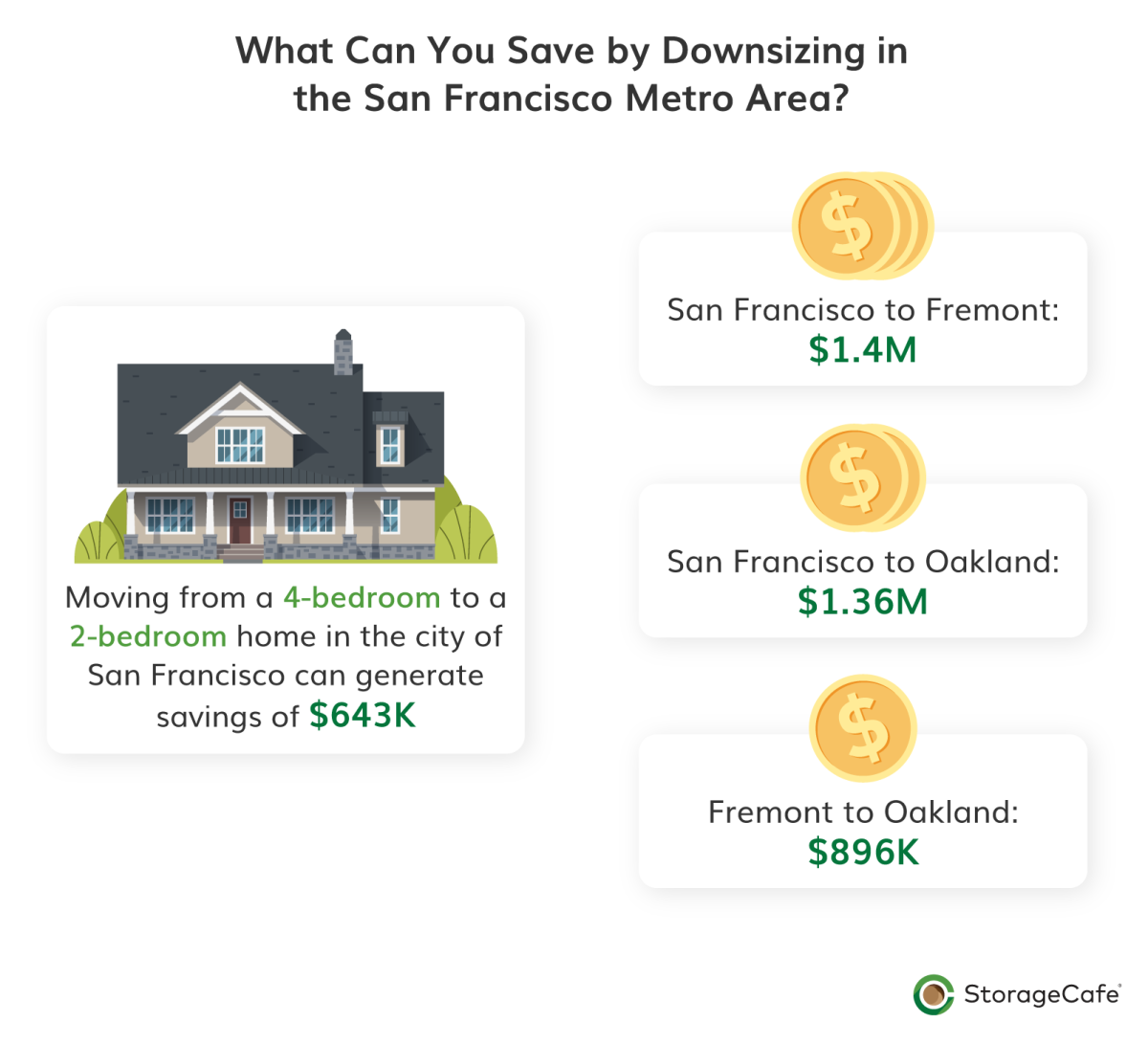
The second-most profitable downsizing location in California, and across the nation, is the San Francisco-Oakland-Berkeley metro area. Much like San Jose, the Bay Area packs a serious punch when it comes to downsizing savings potential, with a move from a 4-bedroom home to a 2-bedroom residence generating savings of approx. $563K. Settling for less square footage in the city of San Francisco proper can save nearly $642K for those who don’t mind having less room. To make up for the lost space, you can rent a 10’x10' storage unit in San Francisco that can easily accommodate the contents of two compact bedrooms.
Zooming in on popular relocation routes in the area, downsizing from San Francisco to Fremont – a good option for those in search of a slower pace of life – has the potential to save homebuyers a whopping $1.4M.
San Diego-Chula Vista-Carlsbad also makes it to the top of the list, ranking fifth in terms of potential downsizing savings. Homeowners who decide to trade their 4-bedroom home for a 2-bedroom one will save over $340K in the metropolitan area overall. Leaving the main city of the metro, San Diego, for a smaller home in a less hectic location like Oceanside gets homeowners sizable savings of $660K on average. With its iconic wooden pier, picturesque beaches, and intense foodie scene, Oceanside is a great option for those who don’t want to give up the costal lifestyle but still seek more affordable settings.
Homeowners who love living in the city of San Diego proper, and are less inclined to enjoy a daily commute, can also save almost $455K if they trade their 4-bedroom for a 2-bedroom home.
Los Angeles-Long Beach-Anaheim was surpassed by the San Diego metro area in terms of downsizing savings potential, but only by a meager $9,000: homeowners in the LA metro area can enjoy about $331K in profits if they decide they can make do in a smaller home. Downsizing from the city of Los Angeles proper to Anaheim or Long Beach can line homeowners’ pockets with $480K and $452K, respectively. Those moving from a 4-bedroom home in Anaheim to a smaller, 2-bedroom one in the city of Los Angeles will save a comparatively much smaller sum, $65K.
Downsizing within the city of LA is a smart financial move for homeowners who wouldn’t switch the City of Angels vibe for any other. Giving up a 4-bedroom for a smaller house can translate into savings of roughly $300K for downsizing Angelenos.
Honolulu joins CA in providing big savings, landing third place for downsizing gains
The Urban Honolulu metro area is not only an amazing place to live for outdoor attractions but also in terms of potential downsizing savings – homeowners who choose to live smaller can save around $519K, looking at the metro area overall. Those who prefer to move to smaller quarters but remain in the city of Honolulu are even luckier as they stand to save over $723K.
Moving from a 4-bedroom home in Honolulu to a 2-bedroom one in Pearl City – which is very popular with both young families and retirees, due to its peaceful, suburban vibe – brings in the highest city-to-city savings, at $895K. However, those who trade a larger home in Waipahu for a smaller one located in Honolulu itself can only expect to save $276K.
The East Coast leads with Bridgeport, while three other metros in the area ensure sizable downsizing profits
Four East Coast metros land positions among the top 20 nationally for downsizing savings, with Bridgeport-Stamford-Norwalk the best placed, on the fourth spot. Homeowners in the Bridgeport metro area can save over $463K if they sell a 4-bedroom home and purchase a 2-bedroom one instead. Downsizing in the city of Bridgeport can also bring homeowners a little over $100K. Relocating from a large home in Stamford to a smaller one in Bridgeport is the most profitable downsizing route between the major cities in the metro area, resulting in average savings of roughly $603K.
The Boston and New York metro areas can also provide homebuyers with great options to save while downsizing. Across the Boston area, profits may amount to $275K whereas New York-Newark-Jersey City ensures potential downsizing savings of $248K.
Looking at city-to-city relocations within the same metro area that also involve downsizing, New York City to Newark, NJ, comes with the highest potential gains – over half a million dollars.
How much can you expect to save by downsizing within New York City's neighborhoods?
With the priciest real estate in the nation, Manhattanites are some of the most likely to profit from downsizing even if they don’t want to leave the buzz of the Big Apple. Midtown, for instance, can bring in a whopping $5.8M of savings for homeowners who switch from a 4-bedroom home to a 2-bedroom home within the neighborhood.

The Flatiron District allows homebuyers to potentially gain $4M if they’re willing to sacrifice half of their living space. Similarly, average proceeds of $3.95M can be realized in Greenwich Village if you adopt a smaller-living lifestyle there.
Brooklyn Heights ensures the highest potential downsizing savings among all Brooklyn’s neighborhoods, at $2.3M. As for Queens residents, those who live in Forest Hills and want to downsize within the same neighborhood stand to gain over $1M. Those living in Riverdale are better located for downsizing than other residents of the Bronx and could gain $770K by sacrificing two bedrooms. The most profitable neighborhood for downsizing in Staten Island, on the other hand, is Tottenville – trading a 4-bedroom home for a 2-bedroom one here can potentially save around $543K.
Belleview to Tacoma among the most profitable downsizing moves in the Seattle metro area
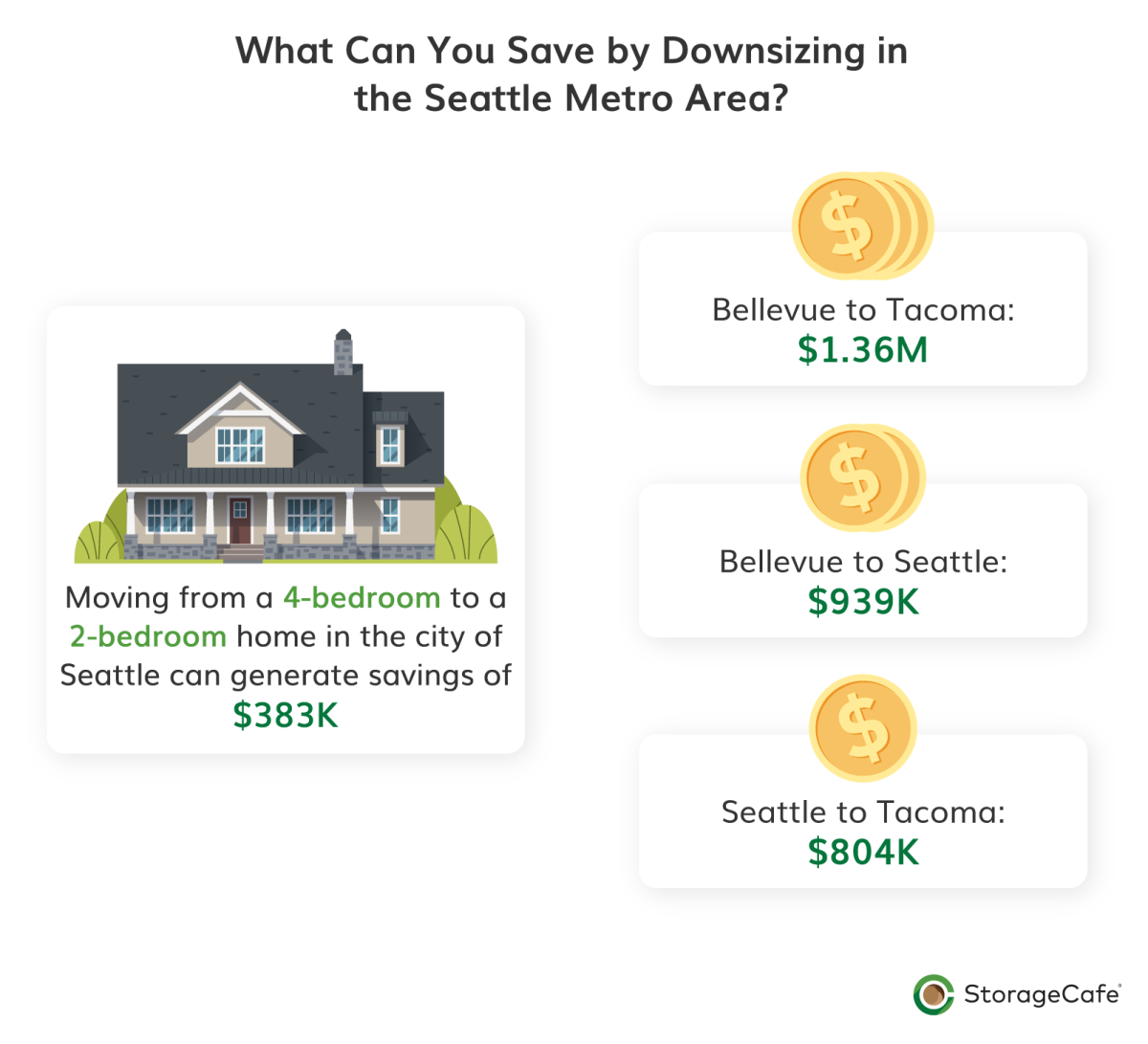
Also on the West Coast, Seattle-Chula Vista-Carlsbad, is bound to ensure sizable savings for homeowners who are ready to trade their existing 4-bedroom homes for smaller 2-bedroom ones within the metro area: around $300K, helping it rank 8th in the national ranking. Downsizing within the limits of the city of Seattle proper is even more advantageous, saving homeowners around $383K.
When it comes to relocating to a different major city within the metro area, the Belleview to Tacoma downsize takes the prize, with potential savings of around $1.36M. Belleview residents interested in downsizing within the city limits can also save a very impressive $1M.
Several Southern US metros, from Miami to Knoxville, have strong downsizing savings potential
The best-placed Southern metros in the ranking are in Florida: Miami-Fort Lauderdale-Pompano Beach on 7th and North Port-Sarasota-Bradenton on 9th places. For the Miami metro area, the overall downsizing savings homeowners can potentially pocket hover around $322K. Homeowners in the city of Miami proper can save about $218K by downsizing locally.
Downsizing between two specific cities of the metro area, on the other hand, can bring homeowners significantly more. Those willing to relocate from Fort Lauderdale to a smaller home in Miami can reap serious financial benefits: $570K. Downsizing from Fort Lauderdale to Hialeah results in even higher average savings of around $820K.
Dallas-Fort Worth-Arlington is the only Texan metro that makes it to top 20 nationally, with around $245K in potential downsizing savings. Those who don’t feel inclined to leave the city of Dallas proper stand to gain even more: approx. $360K if they swap a 4-bedroom home for a 2-bedroom one.
Two of the most popular moving routes within the metro area, Dallas to Arlington and Dallas to Fort Worth, are also very profitable for homeowners interested in relocating not only to a smaller city, but to a smaller home as well, with savings hovering just south of $420K.

Knoxville, TN, rounds out the top 20 best metro areas for downsizing savings, with potential profits of over $241K. Knoxville to Oak Ridge is the most lucrative downsizing route between the metro area's major cities, generating an average of $271K in savings. Residents of the city of Knoxville could end up with $238K in savings if they sell their 4-bedroom home and get a 2-bedroom one in the same location.
Rochester leads the pack of metros where you might as well keep living large
At the other end of the spectrum, Rochester, NY, is the metro area that offers the least amount of downsizing savings to homeowners. The price difference between a 4-bedroom home and a 2-bedroom residence in the Rochester metro area is the lowest among the country’s top 100 largest metros, resulting in less spectacular savings from downsizing – roughly $98K. Downsizing within the city of Rochester proper is a bit more profitable, generating savings of around $114K.
Ogden-Clearfield, Utah, and Tucson, Arizona, follow the same path, with downsizing savings at a low $99K within their respective metro areas.
Making do with less living space: Boise and Oklahoma City lead the country for the most storage options away from home
Downsizing is the third-most popular reason why Americans use self storage, and luckily the industry can easily respond to the need for space away from home. The self storage sector has increased significantly over the last decade so as to provide convenient options to anyone looking to hold on to important belongings while maximizing space at home. Currently, the 100 largest metro areas in the US offer almost 1.4 billion square feet of self storage space, according to Yardi Matrix.
Naturally, supply may vary from metro to metro, with some benefiting from more self storage space per capita than others. The Boise City metro area, in Idaho, ranks first in terms of self storage supply, with 14.3 square feet of space per capita, followed by Oklahoma City and Ogden-Clearfield, both with almost 11 square feet of self storage space per person. The service is affordable, with a standard 10x10 storage unit currently renting for $132 per month.
The US Metros with the Most and Least Self Storage Options Per Person
| Rank | Metro Area | Self Storage per Capita (sq. ft.) | Self Storage Street Rate * |
|---|---|---|---|
| 1 | Boise City, ID | 14.3 | $108 |
| 2 | Oklahoma City, OK | 10.9 | $80 |
| 3 | Ogden-Clearfield, UT | 10.8 | $100 |
| 4 | Tulsa, OK | 10.4 | $80 |
| 5 | Houston-The Woodlands-Sugar Land, TX | 10.1 | $100 |
| 6 | Spokane-Spokane Valley, WA | 10 | $116 |
| 7 | Colorado Springs, CO | 9.8 | $120 |
| 8 | Palm Bay-Melbourne-Titusville, FL | 9.7 | $123 |
| 9 | Dallas-Fort Worth-Arlington, TX | 9.7 | $108 |
| 10 | Little Rock-North Little Rock-Conway, AR | 9.5 | $79 |
| 11 | Austin-Round Rock-Georgetown, TX | 9.4 | $115 |
| 12 | Provo-Orem, UT | 9.4 | $98 |
| 13 | Cape Coral-Fort Myers, FL | 9.2 | $128 |
| 14 | Charleston-North Charleston, SC | 9.1 | $109 |
| 15 | Virginia Beach-Norfolk-Newport News, VA-NC | 9 | $114 |
| 16 | Jacksonville, FL | 9 | $124 |
| 17 | Las Vegas-Henderson-Paradise, NV | 8.7 | $133 |
| 18 | Baton Rouge, LA | 8.6 | $96 |
| 19 | North Port-Sarasota-Bradenton, FL | 8.6 | $142 |
| 20 | San Antonio-New Braunfels, TX | 8.5 | $113 |
| 21 | Augusta-Richmond County, GA-SC | 8.4 | $96 |
| 22 | Sacramento-Roseville-Folsom, CA | 8.4 | $147 |
| 23 | Raleigh-Cary, NC | 8.1 | $101 |
| 24 | Orlando-Kissimmee-Sanford, FL | 8 | $118 |
| 25 | Salt Lake City, UT | 7.9 | $115 |
| 26 | Memphis, TN-MS-AR | 7.9 | $101 |
| 27 | Greenville-Anderson, SC | 7.9 | $82 |
| 28 | Deltona-Daytona Beach-Ormond Beach, FL | 7.8 | $132 |
| 29 | New Orleans-Metairie, LA | 7.8 | $131 |
| 30 | Albuquerque, NM | 7.8 | $105 |
| 31 | Omaha-Council Bluffs, NE-IA | 7.7 | $89 |
| 32 | Bakersfield, CA | 7.6 | $95 |
| 33 | Indianapolis-Carmel-Anderson, IN | 7.6 | $95 |
| 34 | Charlotte-Concord-Gastonia, NC-SC | 7.6 | $101 |
| 35 | Phoenix-Mesa-Chandler, AZ | 7.5 | $128 |
| 36 | Tampa-St. Petersburg-Clearwater, FL | 7.5 | $130 |
| 37 | Jackson, MS | 7.5 | $93 |
| 38 | Riverside-San Bernardino-Ontario, CA | 7.4 | $142 |
| 39 | Richmond, VA | 7.3 | $112 |
| 40 | Nashville-Davidson--Murfreesboro--Franklin, TN | 7.2 | $115 |
| 41 | Stockton, CA | 7.2 | $137 |
| 42 | Chattanooga, TN-GA | 7.2 | $93 |
| 43 | Columbia, SC | 7.1 | $101 |
| 44 | Lakeland-Winter Haven, FL | 7 | $109 |
| 45 | Durham-Chapel Hill, NC | 7 | $108 |
| 46 | Louisville/Jefferson County, KY-IN | 7 | $95 |
| 47 | Kansas City, MO-KS | 7 | $101 |
| 48 | Denver-Aurora-Lakewood, CO | 6.9 | $136 |
| 49 | Oxnard-Thousand Oaks-Ventura, CA | 6.9 | $197 |
| 50 | Atlanta-Sandy Springs-Alpharetta, GA | 6.9 | $118 |
| 51 | Fresno, CA | 6.8 | $117 |
| 52 | Birmingham-Hoover, AL | 6.8 | $103 |
| 53 | Tucson, AZ | 6.7 | $124 |
| 54 | Portland-Vancouver-Hillsboro, OR-WA | 6.7 | $147 |
| 55 | Miami-Fort Lauderdale-Pompano Beach, FL | 6.6 | $175 |
| 56 | Dayton-Kettering, OH | 6.6 | $92 |
| 57 | Seattle-Tacoma-Bellevue, WA | 6.6 | $170 |
| 58 | Milwaukee-Waukesha, WI | 6.6 | $97 |
| 59 | Des Moines-West Des Moines, IA | 6.4 | $88 |
| 60 | Greensboro-High Point, NC | 6.4 | $97 |
| 61 | Knoxville, TN | 6.3 | $108 |
| 62 | Wichita, KS | 6.1 | $87 |
| 63 | Columbus, OH | 5.9 | $100 |
| 64 | San Diego-Chula Vista-Carlsbad, CA | 5.7 | $185 |
| 65 | Minneapolis-St. Paul-Bloomington, MN-WI | 5.6 | $114 |
| 66 | Albany-Schenectady-Troy, NY | 5.6 | $116 |
| 67 | Cincinnati, OH-KY-IN | 5.4 | $100 |
| 68 | Baltimore-Columbia-Towson, MD | 5.4 | $142 |
| 69 | El Paso, TX | 5.4 | $100 |
| 70 | St. Louis, MO-IL | 5.3 | $100 |
| 71 | Akron, OH | 5.2 | $95 |
| 72 | Grand Rapids-Kentwood, MI | 5.2 | $97 |
| 73 | San Jose-Sunnyvale-Santa Clara, CA | 5.2 | $189 |
| 74 | Chicago-Naperville-Elgin, IL-IN-WI | 5.1 | $123 |
| 75 | Madison, WI | 5.1 | $97 |
| 76 | Toledo, OH | 5.1 | $85 |
| 77 | Winston-Salem, NC | 5 | $98 |
| 78 | San Francisco-Oakland-Berkeley, CA | 5 | $222 |
| 79 | Detroit-Warren-Dearborn, MI | 4.9 | $123 |
| 80 | Washington-Arlington-Alexandria, DC-VA-MD-WV | 4.9 | $158 |
| 81 | Pittsburgh, PA | 4.9 | $119 |
| 82 | Los Angeles-Long Beach-Anaheim, CA | 4.7 | $213 |
| 83 | New Haven-Milford, CT | 4.6 | $142 |
| 84 | Hartford-East Hartford-Middletown, CT | 4.5 | $120 |
| 85 | McAllen-Edinburg-Mission, TX | 4.5 | $85 |
| 86 | Cleveland-Elyria, OH | 4.4 | $115 |
| 87 | Syracuse, NY | 4.4 | $119 |
| 88 | Boston-Cambridge-Newton, MA-NH | 4.4 | $164 |
| 89 | Harrisburg-Carlisle, PA | 4.3 | $121 |
| 90 | Philadelphia-Camden-Wilmington, PA-NJ-DE-MD | 4.3 | $147 |
| 91 | Bridgeport-Stamford-Norwalk, CT | 4.2 | $174 |
| 92 | Worcester, MA-CT | 4.2 | $132 |
| 93 | Providence-Warwick, RI-MA | 4 | $149 |
| 94 | Rochester, NY | 3.8 | $115 |
| 95 | Allentown-Bethlehem-Easton, PA-NJ | 3.8 | $127 |
| 96 | Buffalo-Cheektowaga, NY | 3.7 | $118 |
| 97 | New York-Newark-Jersey City, NY-NJ-PA | 3.5 | $201 |
| 98 | Springfield, MA | 3.3 | $134 |
| 99 | Scranton--Wilkes-Barre, PA | 2.5 | $104 |
| 100 | Urban Honolulu, HI | 2.5 | $274 |
Source: StorageCafe analysis of Yardi Matrix data
Downsizing can be a useful tool for homeowners willing to make a lifestyle change – moving to a smaller home is an adjustment, but the financial benefits are often well worth it. Common household concerns, such as upkeep and utility costs, are easier to manage in a smaller home as well.
With housing costs still high in many of the country’s major urban areas, and disposable income becoming an issue for many American families, downsizing has the potential to help homeowners achieve their goals, be they financial or personal ones.
Check out the full dataset detailing how much savings you can expect in the 100 largest US metropolitan areas in the US in the graphic below.
Expert opinion
Arthur C. Nelson, Professor Emeritus of Urban Planning & Real Estate Development, University of Arizona
Have you noticed any migration trends associated with downsizing?
I don't really track those data as much as I should but my general sense is that households wanting to downsize are competing with households wanting to buy their first home. Those households tend to be older and with higher incomes, and down payments, than first time buyers of the same age in the 2000s.
Read more....
So, they want somewhat larger homes than the 1970s-1990s starter home but this puts them into direct competition with downsizing households who want the same size home. The problem is that we're not building those homes in sufficient volume to meet both sets of demand.
Is downsizing advisable for any group of people in particular?
Downsizing is a must for households where the householder is 75 years of age or older, and who are otherwise 10-15 years away from senior living options.
Methodology
This analysis was done by StorageCafe, an online platform that provides storage unit listings across the nation.
We looked at the country’s top 100 largest metropolitan areas by population and ranked them based on potential downsizing savings resulting from moving from a 4-bedroom home to a 2-bedroom home.
For this research we used the Zillow Home Value Index, a smoothed, seasonally adjusted measure of the typical home value and market changes across a given region and housing type.
We calculated the home value difference between a 4-bedroom home and a 2-bedroom home for the country's top 100 metropolitan areas, at metro, city and ZIP Code level.
The median taxes for 4-bedroom homes are calculated by multiplying the median taxes across all properties by the ratio of 4-bedroom home values to all home values.
The median taxes for 2-bedroom homes are calculated by multiplying the median taxes across all properties by the ratio of 2-bedroom home values to all home values.
Tax savings per 10 years were calculated as the difference between median taxes for a 4-bedroom home minus median taxes for a 2-bedroom home, multiplied by 10.
Closing costs were calculated as 8% of the average home value for a 4-bedroom home (selling costs) and 3% of the average home value for a 2-bedroom home (buying costs).
Downsizing savings represent the home value difference between a 4-bedroom home and a 2-bedroom home plus tax savings per 10 years, minus the closing costs.
Fair use and distribution
This study serves as a resource for the general public on issues of common interest and should not be regarded as investment advice. The data is true to the best of our knowledge but may change if amendments to it are made. We agree to the distribution of this content but we do require a mention in return for attribution purposes.


25 Mudroom Storage Ideas (And Mistakes to Avoid)
When you come home with muddy boots, an armful of bags and a coat you can’t wait to take off, it’s nice to have somewhere to put it all. With a mudroom, you can leave the outdoor mess at the door instead of carrying it through the house. Traditionally, you’d set aside a separate room, but you can just as easily use a hallway, an entryway closet, a laundry-room corner or a stretch of wall near the entrance.

Is Your Home Office Worth the Rent? What Coworking and Self Storage Could Save You
Every square foot of your apartment comes with a price tag, and a home office claims more of them than most renters expect. It starts with a desk. Then come the second monitor, the printer, the filing cabinet and the overflow boxes. Before long, the corner you set aside for work has turned into a small room you are paying for every month.

America’s Top Snowbird Destinations for 2026–2027: Florida Leads in Numbers, Texas Wins on Value
For Americans living in colder states, the approach of winter is reason enough to start looking south. Cold weather carries costs that go beyond the heating bill and shoveling snow. Seasonal affective disorder(opens in new tab) is far more prevalent in northern states, so a temporary move south isn’t simply an escape from the cold, but a chance to spend the hardest stretch of winter outdoors and in the sun.

How Much Does Halloween Really Cost in 2026? Plan Wisely to Avoid the Scare of Hidden Costs
Americans’ love for Halloween is almost frightening — this year alone, we are on our way to spending $13.5 billion, according to data from the National Retail Federation(opens in new tab). That breaks down to about $115 Halloween costs per person, a whopping 49% more than 10 years ago.

How to Store LEGOs: All the Fun, None of the Clutter
How to store LEGOs largely comes down to how your household uses them. If the bricks are part of everyday play, you need a setup that keeps them within easy reach and makes cleanup quick (for your feet’s sake, at least). Toy storage(opens in new tab) such as simple bins, playmats or containers that children can put away themselves may be enough. Larger or more serious collections usually need more organization, such as labelled drawers for loose pieces, trays for unfinished builds, shelves for completed models and separate storage for retired sets.

Cardboard Costume Guide: Tips and Ideas for a DIY Halloween
Whether for kids or adults, cardboard costume ideas often make the biggest splash once materialized, and that’s for a simple reason: doing a lot with a little is a universally impressive feat (especially in this economy). If you don’t have enough boxes you could temporarily repurpose, don’t worry! There are many places where you can find free moving boxes(opens in new tab), from stores and supermarkets to online groups and recycling drop-off spots. On the run? Try your luck at a self storage(opens in new tab) facility that sells moving supplies, often for cheap. This way, you can choose moving boxes of different shapes and sizes(opens in new tab), so you can make your costumes as complex as you want.

How to Celebrate Halloween: 9 Non-Spooky Ways To Enjoy It
As soon as October starts, it’s the official Halloween month. And while for many people it means it’s open season to get the scare of a lifetime, others, especially families with small children, might prefer to celebrate in a tamer way that’s both kid- and adult-friendly. While you’re likely to find more events where the spook factor is high, here’s how to celebrate Halloween in a not-so-scary way:

Motorcycle Storage Guide: How to Store Your Bike Safely
Motorcycles may be born to be wild, but eventually even the wild ones need somewhere to park. Whether riding season is winding down or your current living situation comes with plenty of square footage for you and less for your bike, motorcycle storage is one of those parts of ownership that doesn’t get as much airtime as the open road.

Halloween Decorating on a Budget (And Cheap Ideas for Everything Elsee)
Halloween has crept a long way from its eerie origins. While All Hallows’ Eve has transformed through the centuries, it wasn’t until the 1930s that trick-or-treating became a tradition in the U.S. and businesses began conjuring up mass-produced Halloween costumes. Now, Halloween is a monster-sized, billion-dollar industry, with a cauldron full of costumes and decorations ranging from the mainstream to the macabre. But is it all really worth your wallet? Maybe, but we’ll let you in on a little secret: You can keep your Halloween decorating on a budget and save on everything else, too. Take this plan and see it through!