
California-To-Texas Migration Holds Steady At 100K Annually, With 1 In 5 Movers Coming From LA

- Nearly 100,000 Californians moved to Texas in one year alone — a daily average of 262 people, equivalent to relocating a city the size of Santa Barbara.
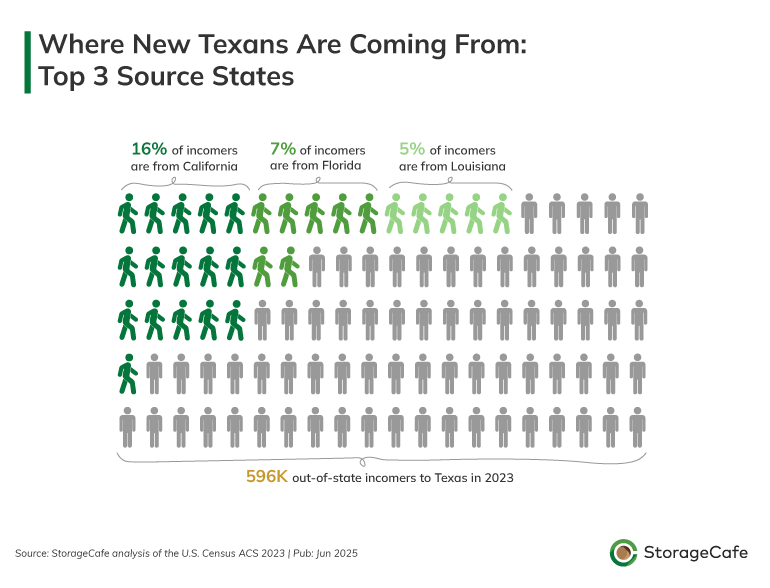
- 16% of all out-of-state newcomers to Texas are from California.
- Former Californians are finding housing in Texas that’s 63% less expensive, with rents averaging 32% lower.
- Millennials and Gen Zers make up the majority of movers, often bringing incomes above the Texas average — driving demand for both housing and services.
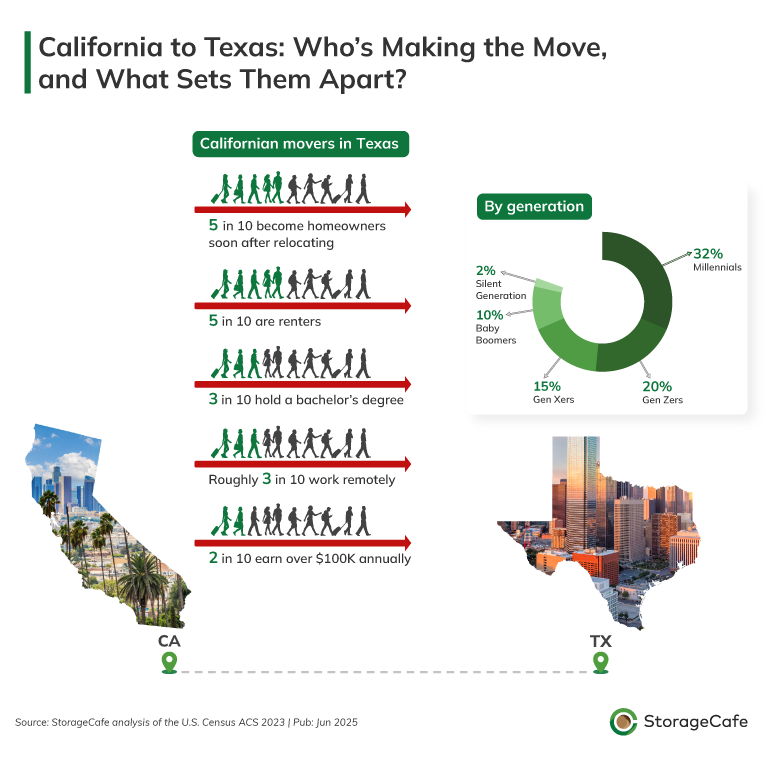
- Roughly one-third of these new Texans hold at least a bachelor’s degree, and about 27% work remotely.
- Travis and Harris counties are the favorite destinations of those leaving California, with over 10,000 movers in each.
- Six of the top 10 California-to-Texas moving routes start in Los Angeles County.
California remains the undisputed leader in outbound migration nationwide, with nearly 683,000 residents leaving the state in a single year, according to the latest available U.S. Census data. Their top destination? Texas — which welcomed approximately 98,000 former Californians in 2023 alone.
To put it in perspective, it’s as if an entire city the size of Santa Barbara relocated from California to Texas in just one year — or about 260 people every day. This makes California the largest source of newly-minted Texans, accounting for about 16% of all state-to-state migration into Texas, followed by Florida and Louisiana.
The motivations behind this steady west-to-east migration are familiar but increasingly urgent: high housing costs, state income taxes, and overall affordability are pushing many Californians to seek out lower-cost, opportunity-rich alternatives. For families, remote workers, and retirees alike, Texas offers the allure of spacious housing that is 63% less expensive, job diversity, and no state income tax — a powerful combination in a time of economic fluctuations.
“I think the migration will continue steadily. The bubble has burst when it comes to what life can look like outside of California,” explains Soomin Kim, a realtor in Austin, Texas, and a former Californian himself. “With homeownership increasingly out of reach for most young families, many will look to how their peers are living in other states — especially through social media — and start to experience real FOMO. It might not always be Texas, but it will be places like Florida, Tennessee, Idaho, Montana, and other states offering more affordability and space. The trend will continue, just not at the breakneck pace of 2020–2021.”
However, the influx isn’t without consequences. Texas housing markets are feeling the strain — especially in high-demand areas like the Dallas–Fort Worth metro area, where both home prices and competition have surged in response to the continued wave of newcomers. Across the state, home prices have risen by roughly 86% over the past decade, but in Dallas and Tarrant counties, the increases are even more dramatic, with prices more than doubling — up 114% and 130%, respectively.
The local multifamily market helps offset the housing challenge to some extent, offering access to a growing rental landscape with options across all income brackets. The Metroplex stands out as a national leader in apartment development, with cities like Frisco and Allen topping the list of the fastest-growing apartment markets in the U.S. Additionally, those embracing a renter lifestyle or downsizing for greater affordability can turn to self storage — a highly accessible solution across Texas. Dallas, in particular, is home to one of the largest self storage markets in the country, with 78.6 million square feet of space. This vast inventory translates into lower rental rates and abundant options in nearly every neighborhood.
Who’s leaving California for Texas? Mostly high-earning millennials
Millennials are taking the lead in the migration from California to Texas, making up over 31% of all movers, according to recent data. They’re followed, at a considerable distance, by Gen Zers, who account for 20%, and Gen Xers, who represent nearly 15% of those relocating. Interestingly, across every generation except one, Californians moving to Texas tend to earn more than the national average for their age group, highlighting the financial advantage many bring with them.
Millennials making the move outpace their generational peers by a significant margin, earning nearly $19,000 more per year than the national average for their cohort. Gen Xers relocating to Texas also do well, with incomes about $13,600 higher than the average for their generation. The outlier is baby boomers, who earn slightly less than the national average — but for good reason. Many are likely retirees or individuals scaling back from the workforce, opting for Texas’s lower cost of living, lack of income tax and more affordable housing to help stretch their retirement savings further.
Top landing spots in Texas for Californians
Austin and Houston are neck and neck in attracting Californians, thanks to their robust economies and cosmopolitan lifestyles that rival cities like Los Angeles and San Jose. Beyond lifestyle appeal, Austin stands out for its relative affordability compared to other popular relocation hotspots. The city has experienced slower home price growth than Dallas and Fort Worth, largely due to its steadily expanding housing inventory, which helps meet demand. Over the past decade, Austin’s single-family housing stock has grown by 44%, ranking 9th among the nation’s largest cities and outpacing other Sunbelt destinations like Phoenix (23%), Orlando (22%), and Atlanta (7%).
By contrast, California’s housing growth has been slower and more uneven. While Irvine experienced a notable 69% increase in single-family stock over the past decade, most major cities have lagged behind: Bakersfield grew by 34%, San Francisco by 30%, and San Jose by just 9%.
Houston, the second most popular destination for Californians, has also moved quickly to accommodate the influx. Known for having one of the strongest single-family markets in the country, the city has proactively diversified its housing mix by significantly expanding its multifamily sector. Over the past decade, Houston’s multifamily housing stock has surged by 114% – a strategic effort to increase housing supply and ease competition among incoming residents, including many relocating from California.
Zooming in on the top relocation matches from California to Texas, Austin emerges as a popular choice for both Los Angeles and San Jose residents, while Fort Worth is frequently chosen by Angelenos and Santa Clara residents. Here’s a breakdown of the busiest moving routes between California and Texas.
Leaving LA County — six of the top 10 routes to Texas start here
From sky-high housing and living costs to congested roads, long commutes and heavy tourism, there are plenty of reasons why even one of the most desirable and opportunity-rich regions in the U.S., Los Angeles County, is seeing a steady outflow of residents.
In just one year, nearly 20,000 people left LA County for Texas, and more than half of the top 10 California-to-Texas migration routes originated in the LA metro area. The Lone Star State continues to attract these movers with the promise of affordability, space and growing economic opportunity — though it’s worth noting that their arrival is also contributing to rising housing costs in some of Texas’s most popular counties.
Travis County, home to Austin, is the top relocation destination for former Angelenos, drawing in roughly 3,650 LA County residents in a single year. And it’s not hard to see why: Austin’s youthful, creative and tech-forward culture is a natural fit for Californians. The newcomers here tend to be young and highly educated, with an average age of 29 — nearly half are millennials, and another 21% are Gen Z.
Austin’s booming economy, driven by tech, biotech, health care, education and the creative industries, aligns with the career goals of these newcomers. About 50% hold a bachelor’s degree or higher, and an impressive 41% work remotely.
That last detail is actually an important factor shaping up the California to Texas migration trends. “With the rise of remote work — especially in the tech sector and the Bay Area — many Californians who once needed to live within commuting distance of their jobs are now free to work from anywhere. This shift has opened the door to relocating to other states in search of a better lifestyle and more affordable housing”, added Soomin Kim.
Their average annual income of $66,300 is well above the Texas state average, suggesting that career mobility and high earning potential are key drivers of this migration. While the move allows for potential home savings of close to 40%, only 30% of newcomers buy homes within their first year, with the majority opting to rent while getting to know the area.
Harris County, anchored by Houston, ranks second for incoming LA residents, with nearly 2,300 people relocating there. Houston’s broad and diversified economy, which spans energy, manufacturing, aerospace, logistics and an emerging tech sector, attracts a more varied group of transplants. The average income among these movers is still above the Texas average, at just under $48,000 per year, though lower than their counterparts in Austin. About 28% hold bachelor’s degrees, and 26% work remotely, reflecting Houston’s more traditional, in-person job base.
For those priced out of California’s market, the draw is clear: Relocating to Harris County offers single family homes that are a whopping two-thirds less expensive and rents that are roughly 30% lower than in LA, even if home prices in the Houston area also saw a significant 75% increase over the past decade. “The continued growth of the Houston area has pushed housing costs up over the last few years”, explains Daniel Potter, Director of Houston Population Research Center at Kinder Institute for Urban Research, Rice University. “There is some evidence of the real estate market cooling off, but home prices today are much higher than they were 5 years ago. Migration has a role in this, but it is not clear if this is primarily brought on by migration from California relative to other areas around the country and world”, he concluded.
Tarrant County is another very attractive destination for former Los Angelenos, with close to 2,200 people moving to the Fort Worth area in just one year. With Fort Worth’s economy rooted in highly paid, in-person industries including aerospace and defense, the area attracts young professionals, with an average age of 29, making an impressive $73.2K annually.
Apart from the dynamic job market, newcomers are also benefitting from significantly lower housing costs — single family homes are 62% less expensive, while the average monthly rent is also 24% cheaper. However, only about 28% of newcomers decide to purchase a home shortly after moving, with the rest deciding to rent for their first year, a strategy that allows them to shop around and discover their favorite areas and ideal homes.
Dallas County sees slightly fewer LA transplants but stands out in one key area: homeownership rates among newcomers. With a notable 45% of movers buying homes within their first year, Dallas appears to attract Californians eager to get on or move up the property ladder. That’s not surprising, considering homes here are 65% less expensive than in LA. However, Dallas has also experienced one of the sharpest home price increases in the country — up 130% over the past decade, compared to a national average of about 92% — partly driven by the same influx of out-of-state buyers.
Bexar County and its main urban center, San Antonio, are also popular among LA movers, especially families looking for space, affordability and a slower pace. In one year, nearly 2,000 Angelenos relocated here, and they tend to skew older and are more family-focused. San Antonio’s economy is more diversified and less reliant on remote work than other Texas cities: Only 3% of LA transplants work from home, and just 19% hold a bachelor’s degree or higher. Still, the area’s affordability is a huge asset: Single family homes are 69% cheaper than in LA, and 38% of newcomers buy homes within their first year.
Collin County, including fast-growing cities like McKinney, Frisco and Plano, also stands out as a magnet for Californians, particularly young families. McKinney, often ranked among the best places to live in the U.S., offers a walkable downtown, top-rated schools and master-planned communities — a big shift from the high-density sprawl of Los Angeles. About one-third of newcomers are millennials, and 29% work remotely, a sign that Collin County appeals to knowledge workers looking for affordability without sacrificing amenities. Thanks to the more attainable housing market, about 40% of LA transplants become homeowners shortly after their move.
Why Silicon Valley tech talent is betting on Texas
More than 8,000 residents of Santa Clara County, California, relocated to Texas in a single year, and their top destinations — Williamson County, Collin County and Travis County — point to a clear trend: These movers are seeking a combination of cost savings, tech-friendly economies and a high quality of life. With average home prices across Silicon Valley nearing $1.4 million, after having doubled over the past decade, the decision to relocate for more affordable housing is increasingly straightforward. The benefits are even more pronounced for remote workers, who can bring Silicon Valley-level incomes to much lower-cost areas in Texas.
Williamson County, just north of Austin and anchored by its county seat, Georgetown, welcomed nearly 1,900 newcomers from Santa Clara County in one year. A remarkable 79% of them purchased a home shortly after relocating — unsurprising, given that homes here are 70% less expensive than those in Silicon Valley. These buyers are primarily young families with children, a group typically focused on homeownership, space and suburban safety. The average age of movers from Santa Clara is just 21, with 40% of them millennials, reinforcing the conclusion that young families with children are driving this migration. Their average income of nearly $164,000 demonstrates both their economic strength and the financial leverage they gain by relocating.
Collin County, in the Dallas metro area, also attracted a sizable number of Santa Clara transplants. These newcomers tend to be slightly older, with an average age of 29, and a whopping 74% of them work remotely, and with an average income of over $120,000. This supports the idea that many are tech professionals capitalizing on remote flexibility to relocate to a region that offers significantly more house for the money while maintaining ties to Silicon Valley employers.
Another 1,200 Santa Clara residents opted for Travis County, home to Austin, which is fast becoming a national tech and cultural hub. These movers are highly educated: 92% hold at least a bachelor’s degree, confirming Austin’s appeal to a skilled, knowledge-based workforce. Millennials make up 56% of the group, and 35% were able to purchase single family homes shortly after relocating, showing a balanced mix of income strength and lifestyle preference.
Meanwhile, neighboring San Mateo County, another extremely affluent Bay Area enclave, saw nearly 1,300 residents head to Travis County during the same period. While tech is a shared industry between the two regions, making the transition smoother for workers, economic factors are a major driver of this migration. Home prices in Austin are 67% less expensive than those in San Mateo County, especially around areas like Redwood City, and Texas’s lack of a state income tax further sweetens the deal for high earners. Over half of those who left San Mateo for Austin successfully transitioned to homeownership shortly after arriving.
Former San Diegans trade coastal beauty for cheaper Texas homes
Mild climate, coastal beauty and laid-back lifestyle, but for many residents, the trade-offs, including skyrocketing housing prices, high state taxes and limited upward mobility, are pushing them to consider more affordable, opportunity-rich alternatives. In a single year, about 11,000 San Diegans made the move to Texas, drawn by its diverse metro areas, strong job markets, and lower overall cost of living, a combination that offers the potential for both financial relief and personal advancement.
Bexar County and its San Antonio rank as the top destination for these movers. With its relaxed, culturally rich atmosphere, San Antonio offers a lifestyle that echoes San Diego’s casual appeal — minus the oceanfront views. The incoming population skews young, with millennials making up a significant share and the average age hovering around 30. Housing affordability is a key draw: Newcomers enjoy single family homes that are 69% cheaper, so 56% were able to purchase one shortly after relocating, a striking contrast to San Diego’s competitive housing market.
Meanwhile, Fort Worth and Tarrant County have become magnets for younger generations, particularly Gen Zers. Of the nearly 1,000 San Diego residents who moved to the area, about 30% were Gen Z, and another 25% were millennials. The region’s booming job market in aviation, logistics and manufacturing is a major attraction, especially for early-career professionals. These newcomers also tend to out-earn the Texas average by nearly $10,000 annually, giving them an edge in homeownership. In fact, 39% of them purchased homes within their first year, a strong signal of both earning potential and affordability.
Other Texas counties drawing steady migration from San Diego include Williamson, Dallas and Travis counties. Williamson County, just north of Austin, stands out in particular for its high homeownership rate among newcomers: A remarkable 70% of San Diego transplants became homeowners shortly after their move. This reflects not only the cost advantage compared to Southern California, but also the area’s appeal to families and professionals seeking space, schools and a suburban quality of life.
Orange County residents looking for better value in Harris, Collin counties
As home prices in Orange County continue to climb past the $1 million mark, many residents are looking beyond California in search of more affordable, spacious and financially sustainable living options. Texas’s rapidly growing regions, including Harris County (Houston) and Collin County (the North Dallas suburbs), have become top relocation destinations.
With median home prices in Harris County roughly 72% lower than in Orange County, it’s no surprise that 41% of Orange County transplants to Texas are able to purchase homes shortly after relocating. Many are mid-career professionals eager to exchange California’s high financial pressures for more attainable homeownership. Others include remote workers taking advantage of flexible work arrangements and retirees looking to stretch their savings in a lower-cost state.
Collin County, just north of Dallas, stands out as a particularly popular destination for Californians. The region’s family-friendly atmosphere, robust housing development and proximity to major corporate campuses make it especially attractive for transplants. For Orange County residents priced out of the Southern California market, Collin County offers a rare mix of affordability, safety and long-term potential. In fact, an impressive 89% of newcomers from Orange County purchased a home during their first year, supported by an average per capita income of over $124,000 and access to homes that are roughly 50% less expensive than those in their home county.
Top 10 money-saving routes from California to Texas for homeowners and renters
If you’re a homeowner leaving California for Texas, some routes offer standout savings, especially if you’re moving from the coastal counties into Texas’ major metro areas.
The top three money-saving routes come in a virtual tie, and the savings are no small change. Moving from Orange County to El Paso County, Santa Clara County to Harris County, or San Francisco County to Harris County will all cut your home costs by a stunning 82%. That’s not just a discount; it’s a total reset on what homeownership can cost.
The savings stay strong across other major routes. Moving from Santa Clara or San Francisco to Dallas County offers an 80% drop in home prices, while Santa Clara to Tarrant County comes in close at 79%. Even popular shifts like Los Angeles to El Paso County see home prices that are 79% less expensive, making Texas cities consistently more affordable. Rounding out the top 10 are moves from Alameda to Harris County and San Mateo to Williamson County, which still deliver impressive home value drops between 72% and 76%
For renters, the savings are just as impressive. The top route for rent reductions is Orange County to El Paso County, where the average rent is 56% lower. Bay Area renters also get a break. Those moving from Santa Clara to Harris, Tarrant, or Dallas Counties see rents fall between 52% and 48%.
Even traditionally pricier Texas metros offer solid savings. Renters moving from San Mateo County to Travis County (Austin) see rents fall by 42%, and routes like Orange County to Harris County or San Francisco to Harris County still offer cuts around 43–44%.
Migration fuels self storage demand and inventory expansion across Texas
The steady influx of new residents from high-cost states like California is doing more than just reshaping housing markets — it’s also fueling rapid growth in Texas’s self storage sector. As newcomers transition into permanent housing, downsize or wait for new construction to be completed, demand for temporary storage solutions has surged.
This spike in population and the accompanying churn in housing has led to a boom in self storage development, particularly in metro areas like Dallas-Fort Worth, Austin and Houston, which are absorbing the bulk of incoming migration. According to recent industry data, Texas leads the nation in self storage construction activity, and rental rates in many fast-growing counties remain strong, reflecting sustained demand.
Self Storage Costs and Availability in Texas’s Main Cities
StorageCafe analysis of data from Yardi Matrix. (Data as of May 2025 | Pub: Jun 2025).In Travis County, home to Austin, the self storage inventory expanded by a remarkable 53%, while neighboring Williamson County saw an even more dramatic increase of 68%. These figures reflect a broader trend: As more people move to Texas in search of affordability and opportunity, the self storage industry is emerging as a key support service for transitional living and long-term lifestyle shifts.
The steady migration from California to Texas is reshaping communities on both ends of the journey, driving up demand for housing, reshaping local economies and even fueling secondary industries like self storage. As Californians seek out more affordable, spacious and opportunity-rich environments, fast-growing Texas counties are stepping in to meet the moment.
Below, you can see an overview of the most popular California to Texas moving routes and the main factors behind the migration activity:
Methodology
This analysis was done by StorageCafe, an online platform that provides storage unit listings across the nation.
For this report, we investigated the most recent California to Texas moving data provided by the U.S. Census American Community Survey 5-year Estimates Public Use Microdata Sample, 2023.
We identified 30 popular moving routes leading from California to Texas and ranked them based on individual move-ins by county. Additional data on home and rent values, generational demographics, homeownership or rental status, educational attainment, remote work status, and per capita income were also sourced from the U.S. Census’s American Community Survey.
To assess cost savings for homebuyers and renters, we calculated both the numerical and percentage differences in home and rent prices between California and Texas counties.
Additionally, the 10-year home price evolution (March 2015 vs. March 2025) for both the California and Texas counties was calculated based on Zillow data.
Self-storage data was provided by StorageCafe’s sister division, Yardi Matrix, a comprehensive business development and asset management tool serving brokers, sponsors, banks, and equity sources across multifamily, office, industrial, and self-storage sectors.
Unemployment statistics were sourced from the U.S. Bureau of Labor Statistics, reflecting data for February 2025.
Fair use and distribution
This study serves as a resource for the general public on issues of common interest and should not be regarded as investment advice. The data is true to the best of our knowledge but may change if amendments to it are made. We agree to the distribution of this content but we do require a mention in return for attribution purposes.
Want to explore how this trend has developed over time? Check out our previous reports for data and insights on CA to TX migration from earlier years:



Moving From a House to an Apartment: What to Expect, How to Downsize & How Self Storage Helps
For some, moving from a house to an apartment is a financial decision. For others, it’s about simplifying life. Maybe the kids have moved out and half the house sits empty, or you’re approaching retirement and no longer want to spend weekends on repairs. Or perhaps you’ve been weighing the cost of buying a home and wondering whether renting simply makes more sense right now.

Family Heirlooms Overload: How to Handle Family Inheritance Without Regret
Handling family heirlooms after a loss requires managing legal authority, emotional pressure and practical logistics at the same time, and the order you take them on matters more than most people expect.

Blanket Storage: The Right Method for Every Space and Season
Blankets make our lives cozier, and storing them well is what keeps them soft and comfortable in the long run. Knowing how to store a blanket properly means your favorites come out of storage smelling fresh, feeling the same as when they went in, and lasting years longer than they otherwise would.

Board Game Storage Ideas That Keep Your Collection in Fighting Shape
Nobody warns you that getting into board games usually unlocks a second hobby, the much dreaded one that includes figuring out where on earth to put them. One game becomes a few, expansions start spawning beside their base boxes and before long, board game storage requires as much strategy as whatever is waiting on the other side of those lids.

Storage Locker vs. Storage Unit: What’s the Difference?
A locker and a unit may sound like two names for the same four walls and a lock, and depending on the storage facility, you may even see the terms used that way. However, once you start comparing available spaces, storage lockers tend to occupy the smaller end of the spectrum, while storage units(opens in new tab) give you considerably more room to work with.

Storage Ideas for Small Spaces: 9 Ways to Max Out Your Home
A messy home contains the seeds of its organization. Those seeds are everywhere: the space above doors, under beds, behind sofas and inside furniture can all become storage. Here are the best storage ideas for small spaces, so you can make the most of your cozy home.

Best U.S. Cities to Live Uncluttered: Plano, TX, Offers the Most Room to Breathe
Clutter is in our homes as much as in our heads. Both are shaped by where we live.

How to Organize Your Bathroom: 8 Ways to Stay Tidy
You already know why an organized bathroom is worth the effort, but let us remind you: it makes rushed mornings easier, keeps counters cleaner and just helps get you in the mood to go through your skincare routine like you should. Plus, in bigger households, it helps everyone find what they need. And you know how much a tidy bathroom counts for your self-esteem when a guest or a partner shows up. Luckily, you don’t need a degree to know how to organize your bathroom. The secret is keeping less, giving every item a home and making that home simple to use. Let’s go through some practical steps can help you create a bathroom that stays functional and nice to look at.

How to Use Silica Gel Packets for Storage
Moisture can cause significant damage to items in storage, leading to rust on tools, mold on clothing and warping in documents. Silica gel uses science to fix that. Often found in small packets inside product packaging, silica gel is a desiccant that absorbs moisture from the air, keeping your stored items dry and protected. This guide explains what silica gel is, how it works and how you can use it to preserve your belongings in self storage.