

Good tool storage saves you time, money and the very specific rage of finding a rusted drill you paid good money for. Cleaning, drying and organizing your tools properly keeps them rust-free and findable — and it takes less effort than most people assume. True, nobody wakes up thrilled to organize their tools; it ranks somewhere between cleaning the gutters and reading the terms of service. But here’s how to do it right without the hassle.
Start with the basics: Clean, dry and prepped
Before a single tool goes into storage, it needs a little prep. Skip this and you’ll be replacing tools sooner than you’d like.
Clean every tool after use. Wipe hand tools down with a damp rag to remove dirt, grease, and debris. If you’re storing garden tools or lawn equipment, make sure they’re free of mud and grime. Anything you store should be completely dry — moisture trapped in storage is the number one cause of rust. This is especially important if you’re planning to store your tools long-term in a storage unit.
Coat metal against rust. A light film of oil or a rust inhibitor on metal surfaces goes a long way, especially in humid climates. Then, toss some silica gel packs into drawers or boxes to help absorb ambient moisture. And never store tools directly on a concrete floor — concrete wicks moisture and accelerates corrosion.
Handle power tool batteries correctly. For cordless tools, remove the batteries before long-term storage. Batteries left attached slowly drain and lose performance over time. Store them at roughly half charge in a cool, dry spot away from direct sunlight and temperature extremes, and rotate which batteries you use to extend their overall life.
Preserve calibrated tools. If you own a torque wrench, back it off to its minimum setting before storing it — this keeps the internal spring from taking a set and losing calibration.
Choose the right tool box or storage system
The right storage container depends on whether you work in one place or haul your tools around.
Portable tool boxes are the everyday workhorse. Plastic boxes are light; steel ones are more durable. Look for removable trays and, importantly, a top handle — side handles let everything inside shift and disorganize as you carry the box.
Rolling and stackable tool boxes are great if you have a lot of tools or move them between sites. Modular systems like Milwaukee Packout or DeWalt ToughSystem stack and latch into a single wheeled unit — which is genuinely useful for contractors, though often overkill (and overweight) for a homeowner whose tools rarely leave the garage. Lighter modular systems like the Bosch L-Boxx hit a nice middle ground for home users who still want to carry tools room to room.
Tool cabinets and chests are the stationary option. Large steel cabinets with deep, extendable drawers are ideal for big collections that live in one workshop, and lockable drawers add security for valuable or dangerous tools.
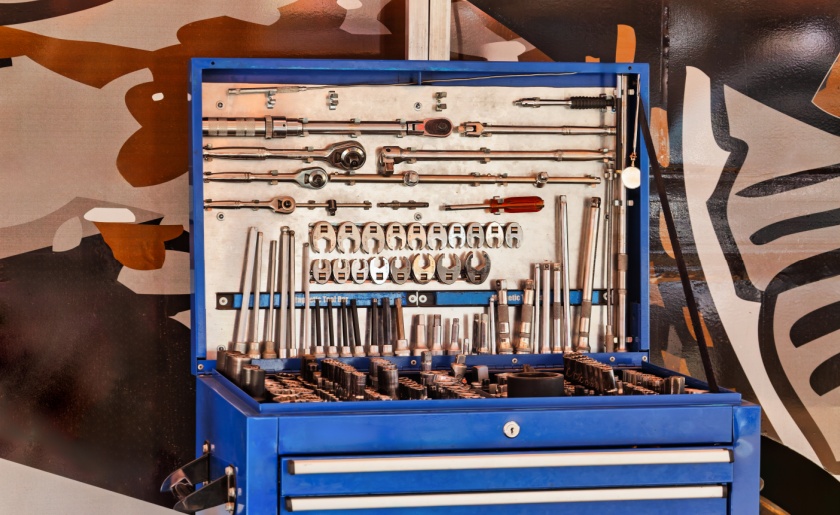
Tool bags suit smaller kits and give you padded straps and quick-grab pockets for tools you take on the go.
A word on matching systems: it looks great to have everything in one brand, but for most people tools accumulate over years. There’s nothing wrong with mixing systems — buy a few pieces, live with them, and expand only once you know a system fits how you work.
Storing power tools
Power tools are the most expensive things in most collections, so they deserve the most care.
The simplest win is to keep the original hard cases. They’re molded to fit the tool, they hold the charger and accessories in one place, and they protect against dust and knocks. No more hunting for a lost power cord or a specific sanding disk.
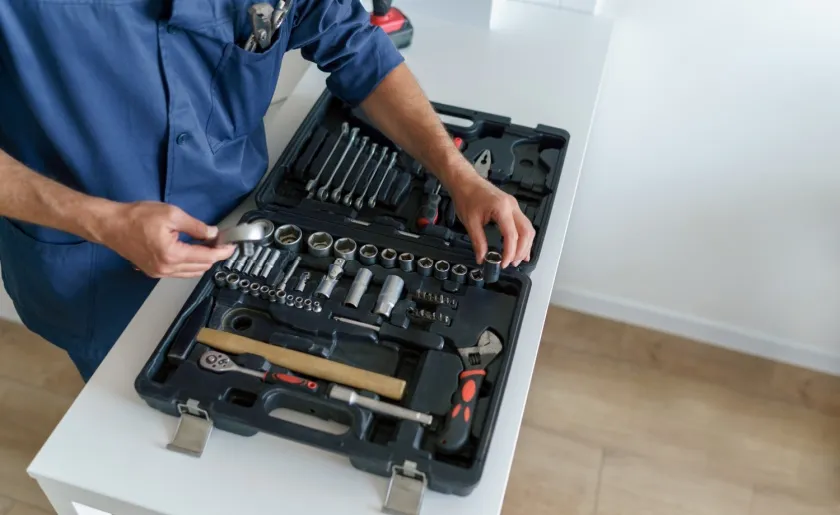
If you’ve tossed the cases, group each tool with its accessories another way. A common approach among hobbyists is a shelf-per-tool system — sander with its sanding disks, jigsaw with its blades, router with its bits — so everything for one job sits in one spot and you’re not walking to three corners of the garage for a quick task.
For cords, wrap them around the tool and secure them with a Velcro strap. When storing power tools on shelves, keep them one deep rather than stacked in a pile, so you can grab the one you need without excavating the rest.
Storing hand tools
Hand tools are small, numerous and easy to lose track of. Two principles keep them under control: make them visible and give every tool a home.
Vertical storage is your friend here. Use a pegboard to put frequently used tools — hammers, pliers, wrenches — within arm’s reach and keep your whole collection at a glance. Reserve the eye-level real estate for what you reach for most, and push specialty tools higher up or into bins. Rails and magnetic strips work the same way for metal tools and are ideal when floor space is tight.
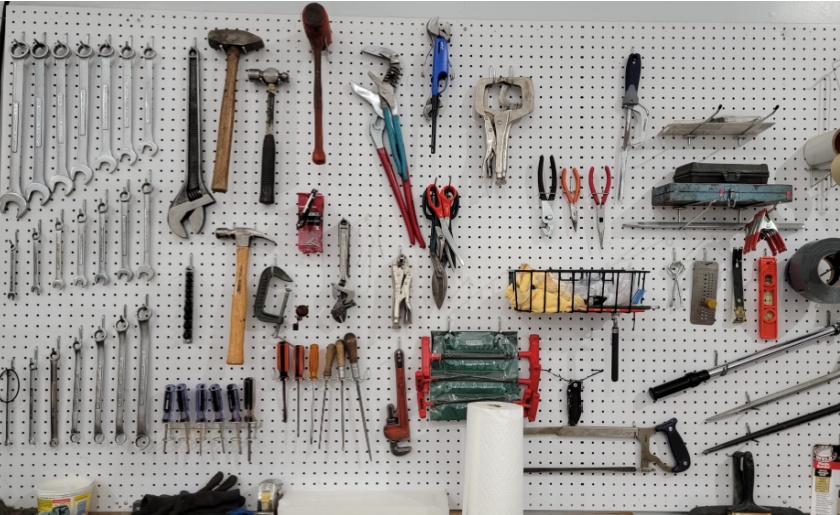
For anything in drawers, use dividers or inserts to create dedicated slots, and line the drawer bottoms with a rubber mat so tools don’t slide into a jumbled heap every time you open and close it. Also, store frequently used items in the top drawers and rarely used ones down low.
Organizing small parts
Screws, nails, washers and bolts create their own kind of chaos. A small-parts organizer — a shallow case with clear lid and removable cups — lets you see and grab exactly what you need. Cheaper double-sided organizers work fine for budget setups; larger-compartment organizers suit bulkier items like hinges and hooks. A low-cost trick: screw jar lids to the underside of a shelf, then twist clear jars up into them to store small hardware without using shelf space. Label everything.
Setting up tool storage in the garage
The garage is where most tool storage happens, so a few environmental fixes pay off. Garages run humid, and condensation is what rusts tools faster than expected. Improve ventilation, run a dehumidifier if needed, dry your vehicle after driving in wet weather, and keep tools off the concrete.
When organizing your garage, it’s also smart to combine storage types rather than relying on one: cabinets to hide clutter and protect valuables, wall systems (pegboard or slatwall) for frequently used tools, and overhead racks for seasonal and bulky items. Good lighting and a clear floor round out a workspace that’s safe as well as organized. Finally, keep sharp tools sheathed and heavy tools stored low to avoid falling hazards. And if you want to really make the most of it, we have plenty of more garage storage ideas you could explore.
When tools outgrow your space
Sometimes the problem is that you simply have more than the house can hold. Contractors face this constantly, and homeowners hit it during big renovations or when a hobby collection balloons.
A self storage unit is a practical overflow solution: it gives contractors a low-overhead home base for equipment, keeps large power tools like saws safely away from children and gives a proper home to other belongings during renovations. If self storage is the answer, the next question is how much space you need — and the honest answer is usually less than people think. Tools are dense and stack well, so you’re paying for far less square footage than you would for furniture or boxes of clothes.
Here’s a rough guide:
- 5×5 — The smallest standard unit, and plenty for a homeowner’s overflow: a few power tool cases, a rolling tool box, a couple of stacked totes and some long-handled garden tools stood against the wall. Think “the contents of one crowded corner of the garage.” With less-used equipment away, you can keep your must-have tools close by at home.
- 5×10 — The sweet spot for a serious DIYer or a contractor’s core kit. Room for a full modular stack (Packout or ToughSystem), a shelving unit, a workbench and larger equipment like a table saw or compressor, with a walking path to reach it all. Plus, if you’re remodeling your basement, its belongings can go here temporarily.
- 10×10 — For a full workshop’s worth of gear, or a contractor storing tools plus materials, ladders and job-site equipment between projects. This is also the size to consider if you want to actually work in the unit occasionally rather than just store.

A few sizing tips that save money and headaches:
Go vertical inside the unit, too. The same principle that works in your garage works here — add a cheap shelving unit and you can often drop down a size. A 5×5 with shelves holds more than a 5×10 with everything piled on the floor.
Leave an aisle. Don’t pack the unit wall to wall. Keep a narrow path to the back so you can reach the tool you drove over for without unloading the whole thing onto the pavement.
Pick climate control for anything that matters. For expensive power tools, precision instruments, or anything with electronics, a climate-controlled unit is worth the modest premium — steady temperature and humidity are what stop rust and corrosion before they start. A plain drive-up unit is fine for rugged hand tools and garden gear you’re less precious about.
Measure your biggest item first. Before you book, check how big your largest piece is — a rolling chest, a miter saw stand, a wheelbarrow. Unit access doors and interior dimensions vary, and the bulkiest thing you own dictates the minimum size more than the total volume does.
When in doubt, size up one notch. The price difference between a 5×5 and a 5×10 is usually small, and the extra room means you can get to your tools instead of playing storage-unit Tetris every visit.
FAQ on tool storage
Can I reuse silica gel packs once they’ve absorbed moisture?
Yes. Once they’ve saturated, dry them out in a low oven (around 200–250°F) for a couple of hours and they’re good to go again. Indicating gel packs that change color when spent make this easy to time. For enclosed boxes and chests, VCI (vapor corrosion inhibitor) paper or emitters are a step up, releasing a protective vapor that coats metal without any oil residue.
How do I protect wooden handles from drying out and cracking?
Wood loses moisture in dry or heated storage and eventually splits or works loose from the head. A periodic wipe of boiled linseed oil keeps handles conditioned and tight, and it’s worth doing before any long stretch in storage. Avoid the opposite extreme too, since a damp shed swells and loosens handles just as badly.
What’s the right way to store chisels, planes, and other edged tools?
Edges dull and chip against other metal, so keep them from touching anything hard. Blade guards, a slotted rack, or a rolled tool wrap keep edges isolated. A light coat of oil or paste wax matters more here than on rougher tools, and plane soles in particular rust fast on bare metal, so many people store them tipped on their side rather than flat.
Is it safe to store lithium-ion batteries in an unheated garage or shed over winter?
Cold itself won’t ruin a lithium battery, but charging one below freezing can permanently damage it, so let batteries warm to room temperature before charging. The bigger caution is heat and fire risk: store them away from anything flammable, never at full charge long-term, and out of direct sun. A cool interior spot beats an uninsulated shed that swings from freezing to baking.
How do I store a torque wrench so it keeps its calibration?
Back it off to its lowest setting before storing, which relaxes the internal spring so it doesn’t take a set and drift out of calibration. Store it flat in its case, not hanging, and treat any drop as a reason to recalibrate. Even with good habits, a wrench used regularly benefits from periodic recalibration.
Can I just leave tools in the truck bed or a job trailer between jobs?
You can, but it’s the harshest environment there is: condensation, temperature swings, theft, and constant vibration that loosens fasteners and knocks tools around. If tools live in a vehicle, lean hard on sealed cases with desiccant, lockable boxes, and a rust inhibitor on anything metal, and pull batteries and precision instruments out entirely.
Keep it up
Tool storage isn’t a one-time project — schedule a periodic pass to check for early rust, top off batteries and declutter duplicates before spots of corrosion become a full takeover.
So no, reorganizing the garage will never be the highlight of your weekend — but a system that lets you find the right tool in ten seconds comes awfully close to feeling like a superpower. Clean your tools, keep them dry, store them vertically where you can, and give everything a home. Your future self, mid-project, will thank you.



Living Room Storage Ideas: 28 Ways to Reclaim Your Hosting Space
If a living room is where most of a household’s living happens, good storage should be the top priority for setting up or revamping the place. After all, think of how easier it would be to have people over when tidying up the place is just a matter of putting things in their right place (in a time when fewer and fewer people are entertaining friends at home(opens in new tab)). The trick is making room for all those wayward clothes, blankets, chargers and other small things that end up on (or, inexplicably, in) the sofa. Here are 28 living room storage ideas to get you started and make tidying up a quick affair.

25 Mudroom Storage Ideas (And Mistakes to Avoid)
When you come home with muddy boots, an armful of bags and a coat you can’t wait to take off, it’s nice to have somewhere to put it all. With a mudroom, you can leave the outdoor mess at the door instead of carrying it through the house. Traditionally, you’d set aside a separate room, but you can just as easily use a hallway, an entryway closet, a laundry-room corner or a stretch of wall near the entrance.

Is Your Home Office Worth the Rent? What Coworking and Self Storage Could Save You
Every square foot of your apartment comes with a price tag, and a home office claims more of them than most renters expect. It starts with a desk. Then come the second monitor, the printer, the filing cabinet and the overflow boxes. Before long, the corner you set aside for work has turned into a small room you are paying for every month.

Best U.S. Cities to Live Uncluttered: Plano, TX, Offers the Most Room to Breathe
Clutter is in our homes as much as in our heads. Both are shaped by where we live.

America’s Top Snowbird Destinations for 2026–2027: Florida Leads in Numbers, Texas Wins on Value
For Americans living in colder states, the approach of winter is reason enough to start looking south. Cold weather carries costs that go beyond the heating bill and shoveling snow. Seasonal affective disorder(opens in new tab) is far more prevalent in northern states, so a temporary move south isn’t simply an escape from the cold, but a chance to spend the hardest stretch of winter outdoors and in the sun.

How Much Does Halloween Really Cost in 2026? Plan Wisely to Avoid the Scare of Hidden Costs
Americans’ love for Halloween is almost frightening — this year alone, we are on our way to spending $13.5 billion, according to data from the National Retail Federation(opens in new tab). That breaks down to about $115 Halloween costs per person, a whopping 49% more than 10 years ago.

How to Store LEGOs: All the Fun, None of the Clutter
How to store LEGOs largely comes down to how your household uses them. If the bricks are part of everyday play, you need a setup that keeps them within easy reach and makes cleanup quick (for your feet’s sake, at least). Toy storage(opens in new tab) such as simple bins, playmats or containers that children can put away themselves may be enough. Larger or more serious collections usually need more organization, such as labelled drawers for loose pieces, trays for unfinished builds, shelves for completed models and separate storage for retired sets.

Cardboard Costume Guide: Tips and Ideas for a DIY Halloween
Whether for kids or adults, cardboard costume ideas often make the biggest splash once materialized, and that’s for a simple reason: doing a lot with a little is a universally impressive feat (especially in this economy). If you don’t have enough boxes you could temporarily repurpose, don’t worry! There are many places where you can find free moving boxes(opens in new tab), from stores and supermarkets to online groups and recycling drop-off spots. On the run? Try your luck at a self storage(opens in new tab) facility that sells moving supplies, often for cheap. This way, you can choose moving boxes of different shapes and sizes(opens in new tab), so you can make your costumes as complex as you want.

How to Celebrate Halloween: 9 Non-Spooky Ways To Enjoy It
As soon as October starts, it’s the official Halloween month. And while for many people it means it’s open season to get the scare of a lifetime, others, especially families with small children, might prefer to celebrate in a tamer way that’s both kid- and adult-friendly. While you’re likely to find more events where the spook factor is high, here’s how to celebrate Halloween in a not-so-scary way: