

You can’t get the most out of a fabric without knowing how to store it. If your fabric stash is starting to outgrow your space, you’re in the right place. Here are 11 fabric storage ideas that’ll help you get organized, feel inspired and get back to creating.
1. Turn a filing cabinet into a fabric drawer
Got an old filing cabinet? Don’t toss it. Fold your fabric and stick it in hanging folders—sort by color or type. Label the tabs and tape a tiny swatch on each one so you can flip through without digging. Great for fat quarters, half yards or anything smaller that doesn’t stack well.
2. Make a swatch binder (or pin it to the wall)
Cut a little square from each fabric. Tape or glue it to a card. Label it with fabric type, how much you have, whether it’s prewashed. Keep them in a binder or pin them on a corkboard. You’ll save yourself the mess of digging through bins every time you want to “just check something.”
3. Use a bookshelf like a mini fabric store
Fold bigger yardage pieces (1+ yard) onto comic book boards and stack them upright on a shelf like books. It keeps them tidy and easy to flip through. You can sort by color or just put the loudest prints in front for some shelf drama.

Quilt fabric squares neatly stacked on open shelves for organized storage
Actually, IKEA’s Kallax cube shelf is weirdly perfect for fabric. Each cube fits a different category: folded fabric, a basket of scraps or a stack of precuts. You can go open shelf or soft bins depending on how tidy you want things to look.
4. Use zippered pouches for project kits
Put all the fabric, the pattern and the little bits you need for one project into a zippered pouch or plastic box. Label it. Stack it. Next time you want to sew, you won’t waste an hour looking for your missing bias tape.
5. Roll fabric and store it in a wine rack
Roll up your fabric like towels and tuck them into an old wine rack. It’s weirdly satisfying and it keeps fabric from creasing. You can also stand rolled fat quarters in magazine holders. Small space, big payoff.
6. Hang fabric on a ladder
Find an old wooden ladder or make one with 1x2s. Drape fabric over each rung. Not only does it keep stuff visible and wrinkle-free, it also looks kind of amazing. Like functional wall art, but cozier.
7. Use pants hangers to hang textiles
The clamp-style hangers you’d use for trousers? They’re perfect for hanging fabric. Especially helpful for larger prewashed cuts that you want to keep wrinkle-free. Use a closet rod, garment rack or tension rod.
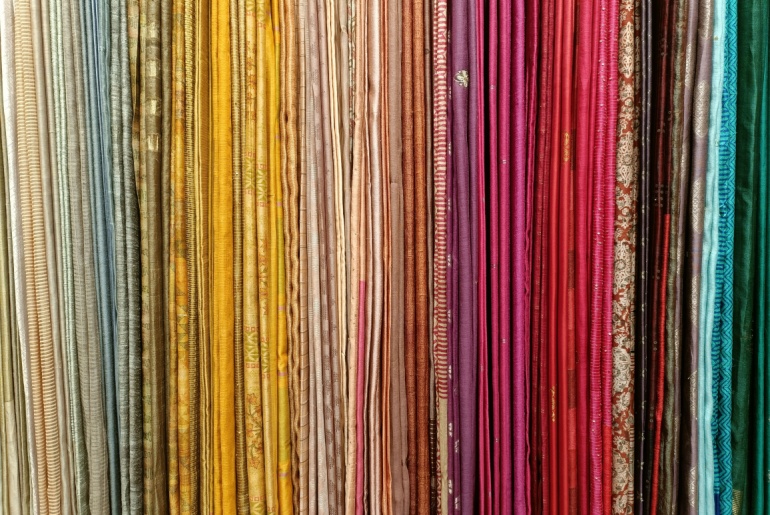
Brightly colored textiles organized in vertical storage for space efficiency.
8. Use a tall laundry basket for daily storage
Roll or fold fabric and stand it upright in a laundry basket. You’ll see everything at a glance and when you need to clear the table or change rooms, you just grab the basket and go. Works great for WIPs or overflow.
9. Keep a rolling cart for your current projects
Get a three-tier cart (IKEA RÅSKOG or any dupe). Use one level for fabric, one for tools, one for thread and notions. Roll it next to your table when you’re sewing, then tuck it into a corner when you’re not.
10. String up a line and clip fabric to it
Use twine, wire or ribbon. Run it across a window, a hallway, even a closet door. Clip fat quarters or small cuts with clothespins. It’s visual, it’s fun and it turns your stash into part of the décor.
11. Use a climate-controlled storage unit
If your stash is bigger than your space, self storage is a solid Plan B. Ideally, you’ll get a climate-controlled storage unit. That just means the unit stays at a steady temperature and humidity level year-round, usually somewhere between 55 and 80°F. It feels like a regular room indoors, not a sauna in July or a walk-in freezer in winter.
And that matters, because fabric really doesn’t handle extreme conditions well. Too much heat and humidity? Natural fibers like cotton, linen and wool can fade, stretch, break down or start growing mold. Cold, dry air? It can make certain fabrics brittle and stiff. Even worse, big temperature swings—hot during the day, freezing at night—can stress fibers and damage delicate weaves over time.
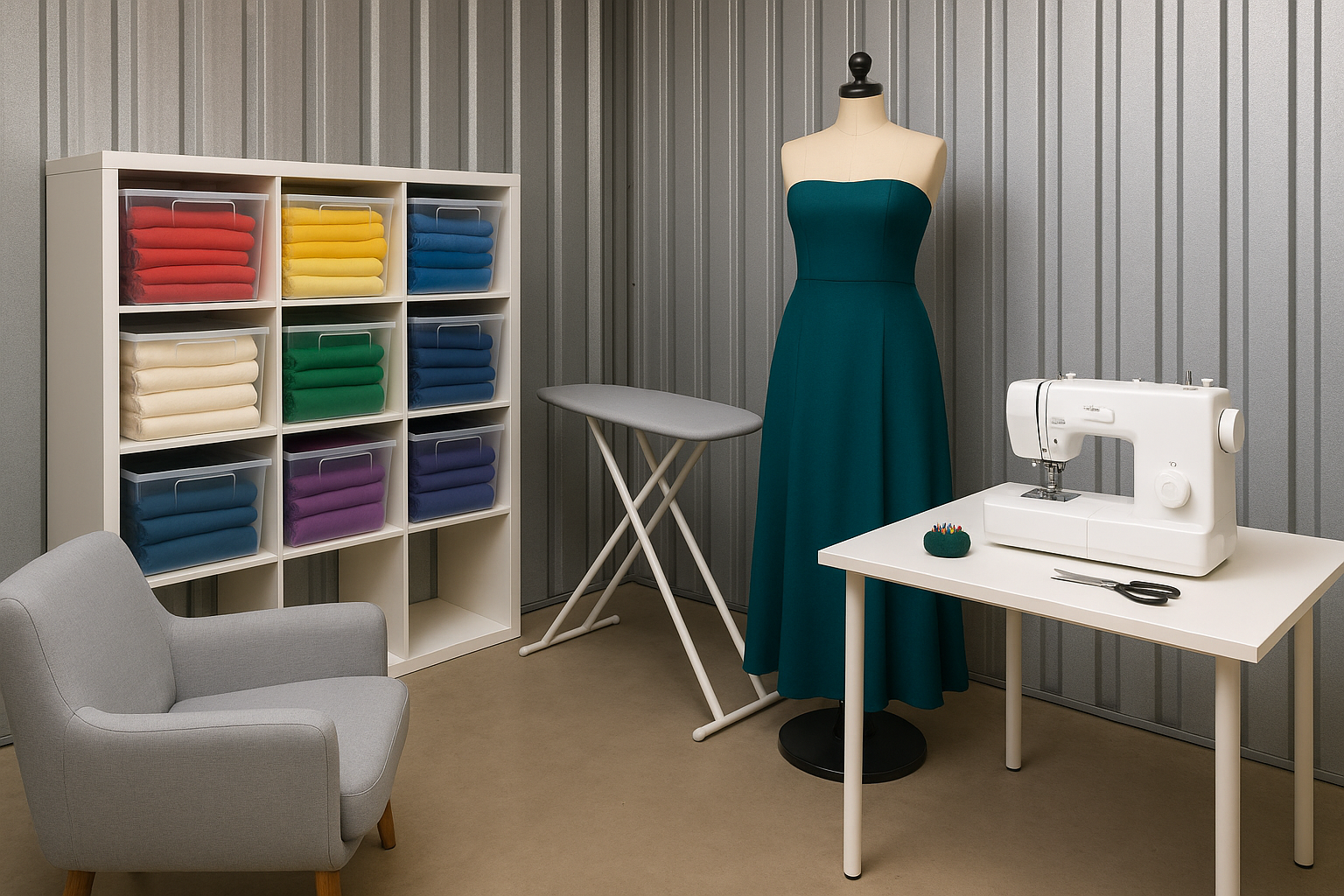
Sewing essentials, neatly organized in a storage unit — ready to inspire. Visual generated with AI tools.
If you want your fabric to stay clean, dry, soft and ready to use when you pull it back out, give it a space that’s as stable as your sewing room would be. Climate control does exactly that.
Conclusion
So if your fabric’s in a pile on the chair or stuffed in a plastic bag from a store that doesn’t even exist anymore, it’s okay. Really. You don’t need to organize everything in one weekend. Label one bin. Hang a line and clip up the prints that make you smile when you walk past them. That counts.
If you can reach what you need and you know where to find the fabric that’s been waiting patiently for its moment, that’s a win. And if, along the way, it starts to feel a little lighter in your brain too… even better.



Living Room Storage Ideas: 28 Ways to Reclaim Your Hosting Space
If a living room is where most of a household’s living happens, good storage should be the top priority for setting up or revamping the place. After all, think of how easier it would be to have people over when tidying up the place is just a matter of putting things in their right place (in a time when fewer and fewer people are entertaining friends at home(opens in new tab)). The trick is making room for all those wayward clothes, blankets, chargers and other small things that end up on (or, inexplicably, in) the sofa. Here are 28 living room storage ideas to get you started and make tidying up a quick affair.

25 Mudroom Storage Ideas (And Mistakes to Avoid)
When you come home with muddy boots, an armful of bags and a coat you can’t wait to take off, it’s nice to have somewhere to put it all. With a mudroom, you can leave the outdoor mess at the door instead of carrying it through the house. Traditionally, you’d set aside a separate room, but you can just as easily use a hallway, an entryway closet, a laundry-room corner or a stretch of wall near the entrance.

Is Your Home Office Worth the Rent? What Coworking and Self Storage Could Save You
Every square foot of your apartment comes with a price tag, and a home office claims more of them than most renters expect. It starts with a desk. Then come the second monitor, the printer, the filing cabinet and the overflow boxes. Before long, the corner you set aside for work has turned into a small room you are paying for every month.

Best U.S. Cities to Live Uncluttered: Plano, TX, Offers the Most Room to Breathe
Clutter is in our homes as much as in our heads. Both are shaped by where we live.

America’s Top Snowbird Destinations for 2026–2027: Florida Leads in Numbers, Texas Wins on Value
For Americans living in colder states, the approach of winter is reason enough to start looking south. Cold weather carries costs that go beyond the heating bill and shoveling snow. Seasonal affective disorder(opens in new tab) is far more prevalent in northern states, so a temporary move south isn’t simply an escape from the cold, but a chance to spend the hardest stretch of winter outdoors and in the sun.

How Much Does Halloween Really Cost in 2026? Plan Wisely to Avoid the Scare of Hidden Costs
Americans’ love for Halloween is almost frightening — this year alone, we are on our way to spending $13.5 billion, according to data from the National Retail Federation(opens in new tab). That breaks down to about $115 Halloween costs per person, a whopping 49% more than 10 years ago.
How to Store LEGOs: All the Fun, None of the Clutter
How to store LEGOs largely comes down to how your household uses them. If the bricks are part of everyday play, you need a setup that keeps them within easy reach and makes cleanup quick (for your feet’s sake, at least). Toy storage(opens in new tab) such as simple bins, playmats or containers that children can put away themselves may be enough. Larger or more serious collections usually need more organization, such as labelled drawers for loose pieces, trays for unfinished builds, shelves for completed models and separate storage for retired sets.

Cardboard Costume Guide: Tips and Ideas for a DIY Halloween
Whether for kids or adults, cardboard costume ideas often make the biggest splash once materialized, and that’s for a simple reason: doing a lot with a little is a universally impressive feat (especially in this economy). If you don’t have enough boxes you could temporarily repurpose, don’t worry! There are many places where you can find free moving boxes(opens in new tab), from stores and supermarkets to online groups and recycling drop-off spots. On the run? Try your luck at a self storage(opens in new tab) facility that sells moving supplies, often for cheap. This way, you can choose moving boxes of different shapes and sizes(opens in new tab), so you can make your costumes as complex as you want.

How to Celebrate Halloween: 9 Non-Spooky Ways To Enjoy It
As soon as October starts, it’s the official Halloween month. And while for many people it means it’s open season to get the scare of a lifetime, others, especially families with small children, might prefer to celebrate in a tamer way that’s both kid- and adult-friendly. While you’re likely to find more events where the spook factor is high, here’s how to celebrate Halloween in a not-so-scary way: