

Storing and winterizing an RV properly is the difference between an RV that holds its value and stays reliable for years and one that greets you in spring with cracked pipes and a dead battery. This guide covers where to store your RV between trips, how to winterize it before the first hard freeze, and what to check before your first trip of the season along with the basics of choosing and buying your first unit.
Whether you’re a young family dreaming of long, affordable summer trips or trying to make the most of your golden years, an RV opens up a different kind of travel. You’re not tied to plane tickets and pre-booked hotels. If you fall in love with a place, you stay longer. If it rains for three days straight and the campground turns into a mud pit, you drive somewhere better. You’re never stuck somewhere you don’t want to be.
RVing is also genuinely cheaper for families once you factor out accommodation costs. You’ll still pay to park at a campsite, but that’s a fraction of booking hotel rooms for a week. Plenty of spots along the way cost nothing at all. Cooking your own meals trims the budget further, and there’s something to be said for traveling with your own stuff around you, especially when kids are involved.
Not sure where you want to go this season? StorageCafe’s best RV destinations in the U.S. for 2026 breaks down the top picks by category: coast, desert, national parks, waterfront, and entertainment.
Want to give this lifestyle a try? Here’s what you need to know, including, most importantly, how to store your RV properly so it holds its value and stays ready to roll.
Buying an RV for the first time
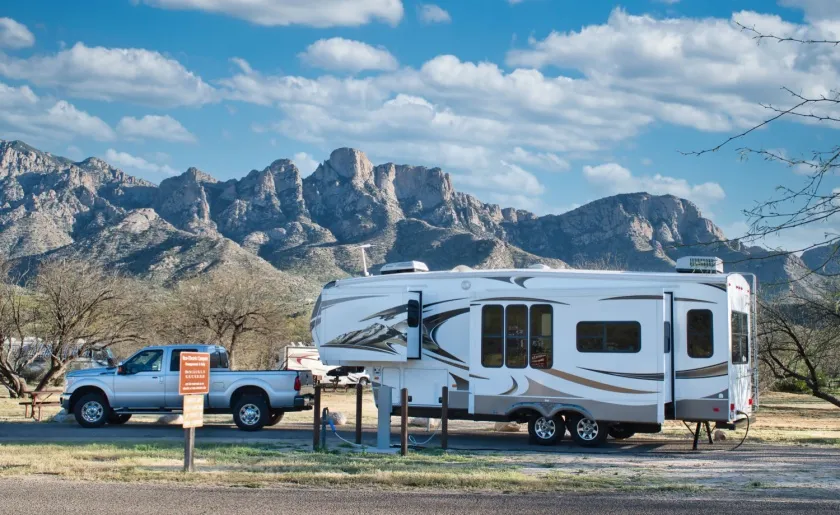
The three decisions that shape every other choice in RV ownership are vehicle type (motorhome vs. towable), size class, and new vs. used – and getting them right before you shop saves time and expensive mistakes.
A few things worth figuring out before you start shopping: the type and size of vehicle, which features you actually need, and whether to buy new or used.
Motorhome or towable?
There are two main types of RVs: ones you drive directly, called motorhomes, and ones that need to be towed (fifth wheelers and travel trailers).
Fifth wheelers and travel trailers don’t have their own engine, so they’re cheaper on average than motorhomes. The catch is that towing one requires a powerful truck or SUV. If you don’t already own a vehicle capable of the job, factor that purchase into the math — the savings narrow quickly.
A new motorhome can run $500,000 or more if you’re going top-of-the-line, but the average falls somewhere between $80,000 and $125,000. Buy used and you can typically cut those figures roughly in half. New fifth wheelers hover around $50,000, with decent used ones available for around $20,000, though you’ll still need a capable pickup, which adds at least another $30,000 new.
Many people find towables easier to drive than motorhomes, but that’s genuinely a personal preference. You should definitely try both before you decide. One practical edge motorhomes have: everyone in the vehicle has access to the kitchen, bathroom, and everything else while you’re moving. With a towable, the passengers are in the tow vehicle and have to stop to use any of the RV’s features.
Which size do you need?

RVs are divided into classes by size.
Class A motorhomes are the largest. They can sleep six to ten people and come loaded with amenities, but they’re difficult to maneuver and won’t fit in many campgrounds or standard parking areas. New ones can easily exceed $500,000.
Class B RVs, also called camper vans, are the smallest of the bunch. They’re built on a van chassis, which means they fit in a regular parking space and handle off-road or remote destinations reasonably well. The tradeoff is limited space. You’ll have a sink, toilet, and shower, plus room for a small kitchen, but not much else.
Class C RVs split the difference. Built on a half-truck frame, they offer more space than a camper van while still being significantly easier to drive than a Class A.
Tow-behind trailers and fifth wheelers are generally comparable in size to Class A and Class C motorhomes. Their main advantage: unhitch and leave the RV at the campsite while you drive the tow vehicle around freely.
Should you buy a new or used RV?
For most first-time buyers, a used RV is the better starting point: lower purchase price, cheaper insurance, and a lower-stakes way to test the lifestyle before committing to a new unit at full price.
A new RV does come with a full manufacturer’s warranty and the ability to customize features and finishes, and if those things matter to you the premium may be worth it. A used RV is substantially more affordable, cheaper to insure, and you can remodel the interior without worrying about tanking its value. The downside is that damage is hard to assess on a used unit. Problems might be hiding behind cabinets, paneling, and slideout walls.
If you’re new to all of this, it’s probably worth starting used. Give the lifestyle a real test before committing to a brand-new purchase.
Where should you store an RV when you’re not using it?
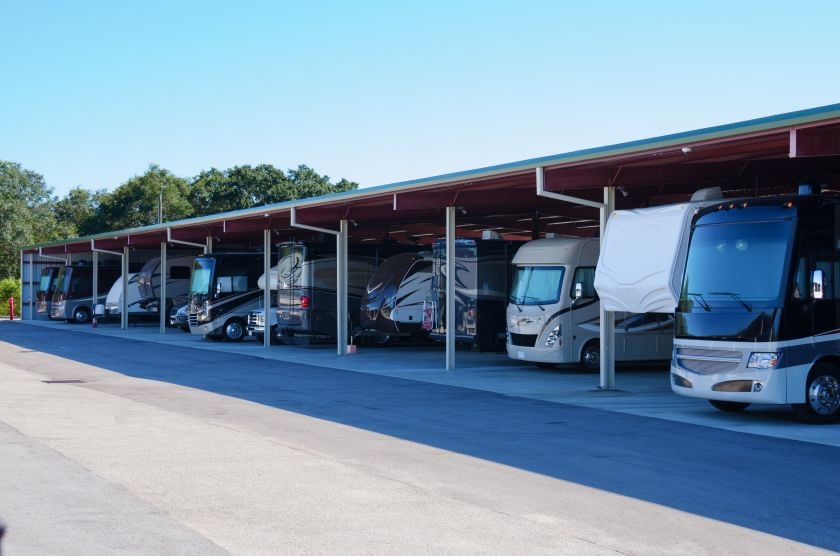
This is the question most beginner guides skim past, and it’s one of the most important decisions you’ll make as an owner. Where your RV sits between trips has a direct impact on how much it costs you over time — in repairs, in wear, and in resale value. RV owners have four main storage options: their own driveway or property, a self-storage facility, a campground or RV park, or a dealership storage program. Each comes with different tradeoffs on cost, convenience, and how well your RV holds up over time.
Can you store an RV in your driveway?
Parking at home sounds like the obvious solution until you look into it. Many HOAs prohibit RV storage in driveways outright, and plenty of municipalities have their own ordinances limiting how long an oversized vehicle can sit on a residential street or property. Check both before assuming you’re in the clear.
If home storage is allowed, your next decision is how to protect the vehicle. A tarp is the cheapest option but does the least. They trap moisture, abrade the finish in wind, and blow off. A purpose-built carport offers meaningfully better protection from sun and precipitation. A full covered parking structure is the best home-based option and the most expensive to build, but it pays off in reduced wear over years of storage.
The main advantage of home storage is obvious: the RV is right there when you want it. The main risk is exposure to UV, weather, and temperature swings. All do slow damage that adds up over time.
Self storage facilities
Self-storage facilities offer the most reliable combination of security and weather protection, with options ranging from open outdoor spaces to fully enclosed units. For current national average prices by storage type and unit size, see StorageCafe’s RV storage page.
One underused advantage of storage facilities: you can rent month-to-month. If you’re on a long trip and decide you’d rather stay in a vacation rental for a stretch, renting RV storage wherever you happen to be keeps the vehicle safe without locking you into a long-term commitment.
Campground and RV park long-term storage
Some campgrounds and RV parks offer discounted off-season rates for owners who want to store a vehicle on-site during months they’re not actively using it. This can be a reasonable middle ground between full-service storage and leaving the RV exposed at home.
Before committing to a campground storage arrangement, ask about security (is it a locked, gated area or just an open field?), whether utility hookups are available during storage, and whether you’re required to move the vehicle periodically. Policies vary widely. Some parks are well-suited for this; others are not set up for it at all.
Dealership storage programs
Some RV dealerships offer storage as a standalone service or bundled with seasonal maintenance packages. The appeal is convenience. Your RV is already at a facility that can service it before you pick it up in spring. Availability varies by region and dealer, so it’s worth asking when you’re shopping or when you bring the vehicle in for service.
BLM and public land
BLM land is not an RV storage solution, but it’s worth understanding what it does and doesn’t allow if you’re planning extended road trips through the western U.S. In much of the western United States, Bureau of Land Management land allows dispersed camping at no cost. The legal stay limit is typically 14 days in one location before you must move, which means you can’t leave an unattended RV parked on BLM land for months between trips. What it does offer is a scenic, free place to park between legs of an active trip when you’re actually out there using the vehicle.
How do you prepare an RV for long-term storage?
Preparing an RV for long-term storage doesn’t take too long, usually three to four hours, and should happen before the first hard freeze — typically in October or November depending on your climate. Most RV owners in northern states should begin winterization in October; owners in the Sun Belt can often wait until December, though coastal humidity still warrants the full process. The most critical steps are draining the entire water system, protecting the fuel, sealing the exterior, and securing the batteries.
Drain the entire water system
This is the step that prevents the most expensive damage. Winterizing the water system means draining the fresh water tank, the gray tank, the black tank, the water heater, and all supply lines, not just the main tank. Water left in any part of the plumbing will freeze, expand and crack pipes or fittings.
The two standard methods are compressed air (blown through the lines to push remaining water out) and RV-specific antifreeze. Do not use automotive antifreeze, which is toxic and shouldn’t go anywhere near a water system. Most RV owners use a combination of both.
If you own a Class A diesel pusher, your water heater is likely larger than the units in Class B or C rigs and has an additional bypass valve that needs to be set before you add antifreeze. Class B camper van owners often have the simplest winterization because the water systems are smaller and more accessible. If you’re not sure about your specific setup, your owner’s manual covers the steps, or a dealer service department can walk you through it the first time.
Prep the exterior
The two exterior priorities before storage are sealing every potential water entry point and protecting surfaces from UV damage.
Start by washing the whole vehicle. Grit and road film left on the surface can cause oxidation and staining over winter. Once it’s clean, do a thorough inspection. The highest-failure points are roof seams and slide-out seals. These are where water gets in. Press along every seam and check the slide-out edges carefully. For any cracks or gaps, use a silicone-based sealant. It handles temperature movement better than latex alternatives in outdoor applications. For larger damage, get professional help rather than hoping it holds. A small crack in October can be an expensive repair by April.
After sealing, apply a UV-protective wax to any fiberglass surfaces. Sun does slow, significant damage to fiberglass finishes during months of outdoor storage, and a quality wax coat is cheap insurance.
Clear out the interior
Remove all food — not just obvious perishables, but anything in pantry storage, the spice rack, or the back of a cabinet. Rodents and insects are genuinely the primary concern here, not spoilage. An RV sitting undisturbed for months is attractive habitat. Covering external vents and openings with mesh or foam plugs keeps the entry points closed.
Clean out the refrigerator, leave its door propped open slightly to prevent mold, and wipe down all cabinet surfaces.
Add fuel stabilizer (and biocide for diesel)
Add fuel stabilizer before your final drive to storage, not after parking. You want it circulating through the entire fuel system. If added to a parked tank, it doesn’t fully mix. One trip to the storage facility after adding stabilizer is enough.
If you have a diesel RV, diesel fuel is susceptible to algae and microbial growth during long storage, especially in humid conditions. A biocide additive (available at any RV or diesel supply shop) prevents this and is worth the few minutes it takes.
Manage the batteries and propane
For battery care, the right approach depends on how often you’ll visit your storage unit. If you plan to stop by monthly, running the engine for 15–20 minutes keeps the batteries charged and circulates the oil. If you won’t visit for several months, it’s better to disconnect the batteries and store them somewhere with temperature control — a garage or basement — connected to a trickle charger. A battery left sitting dead for a full winter develops sulfation damage that permanently reduces its capacity.
For propane, turn the tanks off at the valve before storage but leave them attached to the RV. Don’t transport or store propane tanks indoors.
What should you check when taking an RV out of storage?
Taking an RV out of storage requires about an hour of inspection — tires, roof seals, batteries, water system, propane connections, and registration — before the vehicle is genuinely road-ready.
Check tire pressure and look for sidewall cracking from UV exposure. Tires that spent winter outdoors can develop surface cracks even if the pressure looks fine. Inspect all roof seams and slide-out seals for winter damage. Reconnect batteries and test all 12-volt systems.
Flush the water system thoroughly before drinking from it. Let the lines run first, then sanitize the tank: mix one-quarter cup of household bleach per 15 gallons of tank capacity, fill the tank with fresh water, run the solution through every faucet until you smell bleach, then let it sit for several hours before draining and flushing with clean water until the bleach smell is gone. This takes more time than it sounds. Do it in advance, not when you’re ready to hit the road.
Check the propane system for leaks with a leak detector or soapy water on the connections before lighting anything. Finally, confirm your registration and insurance are current; it’s an easy thing to let lapse over winter and equally easy to check before you’re on the road.
Frequently Asked Questions
Can you store an RV in your driveway?
Yes, in some cases, but there are two things to check before assuming you can. First, your HOA’s rules, if you have one; many HOAs prohibit RV storage in driveways outright. Second, local municipal ordinances, which sometimes limit how long an oversized vehicle can sit on a residential street or property. If both allow it, home storage is the most convenient option, though you’ll still want to think about weather protection. A carport or covered structure will significantly reduce wear compared to leaving the RV fully exposed.
What type of RV storage offers the best protection?
Enclosed indoor storage offers the best protection for exterior surfaces, roof seals, and tires, but it’s the most expensive option. Covered outdoor storage is a strong middle ground — it blocks sun and precipitation without the full cost of an enclosed unit. Open outdoor storage is adequate in mild climates when the vehicle is properly prepped with UV wax and sealed seams. In climates with heavy snow load, significant temperature swings, or prolonged intense sun, indoor is worth the premium.
Do you need to winterize an RV even if it’s stored indoors?
Yes, if temperatures in your region drop below freezing. Indoor storage protects the exterior but doesn’t guarantee the interior stays above 32°F, especially in facilities that aren’t climate-controlled. Drain and protect the water system regardless of where the vehicle is stored. The freeze risk is inside the plumbing, not outside the vehicle.
How long can an RV sit in storage without being damaged?
A properly winterized and prepped RV can sit in storage for six to twelve months without significant risk. The three variables most likely to cause damage during storage are moisture left in the water system (which freezes and cracks pipes), batteries left to discharge completely (sulfation damage that permanently reduces capacity), and UV exposure on tires and exterior surfaces. Address all three during prep and a full winter in storage is routine.



Scary Good DIY Halloween Decorations That Won’t Haunt Your Wallet
A few floating candles in the hallway, a family of ghosts by the front door and a suspicious number of bats climbing up the bedroom wall can make October feel a whole lot spookier. While Halloween stores are full of tempting finds, some of the best DIY Halloween decorations can come from things you already have tucked away in drawers, closets or the recycling bin.

Suburban Giants and Urban Risers: Where America’s 100 Largest Metros Fall on the Self Storage Map
Self storage has long been a suburban story. Across America largest 100 metros, 59% of the inventory built over the past decade sits outside city cores, largely preserving the ratio of the total existing inventory.

Sweatshirt Storage Ideas Worth Keeping Up Your Sleeve
Sweatshirts are great until you realize how much room they take up. A few thick hoodies can fill a drawer fast, with lighter crewnecks getting squashed underneath or pushed somewhere you forget about. Good sweatshirt storage can make that pile much easier to manage without requiring a bigger closet.

Living Room Storage Ideas: 28 Ways to Reclaim Your Hosting Space
If a living room is where most of a household’s living happens, good storage should be the top priority for setting up or revamping the place. After all, think of how easier it would be to have people over when tidying up the place is just a matter of putting things in their right place (in a time when fewer and fewer people are entertaining friends at home(opens in new tab)). The trick is making room for all those wayward clothes, blankets, chargers and other small things that end up on (or, inexplicably, in) the sofa. Here are 28 living room storage ideas to get you started and make tidying up a quick affair.

25 Mudroom Storage Ideas (And Mistakes to Avoid)
When you come home with muddy boots, an armful of bags and a coat you can’t wait to take off, it’s nice to have somewhere to put it all. With a mudroom, you can leave the outdoor mess at the door instead of carrying it through the house. Traditionally, you’d set aside a separate room, but you can just as easily use a hallway, an entryway closet, a laundry-room corner or a stretch of wall near the entrance.

Is Your Home Office Worth the Rent? What Coworking and Self Storage Could Save You
Every square foot of your apartment comes with a price tag, and a home office claims more of them than most renters expect. It starts with a desk. Then come the second monitor, the printer, the filing cabinet and the overflow boxes. Before long, the corner you set aside for work has turned into a small room you are paying for every month.

Best U.S. Cities to Live Uncluttered: Plano, TX, Offers the Most Room to Breathe
Clutter is in our homes as much as in our heads. Both are shaped by where we live.

America’s Top Snowbird Destinations for 2026–2027: Florida Leads in Numbers, Texas Wins on Value
For Americans living in colder states, the approach of winter is reason enough to start looking south. Cold weather carries costs that go beyond the heating bill and shoveling snow. Seasonal affective disorder(opens in new tab) is far more prevalent in northern states, so a temporary move south isn’t simply an escape from the cold, but a chance to spend the hardest stretch of winter outdoors and in the sun.

How Much Does Halloween Really Cost in 2026? Plan Wisely to Avoid the Scare of Hidden Costs
Americans’ love for Halloween is almost frightening — this year alone, we are on our way to spending $13.5 billion, according to data from the National Retail Federation(opens in new tab). That breaks down to about $115 Halloween costs per person, a whopping 49% more than 10 years ago.