

If you’ve ever tried to figure out whether a storage quote was fair, you know the problem. You see a monthly rate, but you have no way to tell whether it’s a deal, a premium-level price, or right in line with the market — and pricing tools that give you real context are surprisingly hard to find.
StorageCafe’s Storage Unit Price Guide gets you straight to the point. It’s a dedicated resource designed specifically to show you what storage costs nationwide, as well as across your state and city. That way, the moment you start shopping you already know what a reasonable price looks like.
Why the price guide belongs in your storage search
Finding a unit is only half the job. Before you can tell whether a listing is a good deal, you need a sense of what storage actually costs — for your size, your amenities, and your market. That’s the gap the Storage Unit Price Guide fills, and it’s why it works best as a companion to your search. Consult it before you start searching (or even pull it up alongside the listings), and every rate you see comes with built-in context.
You’ll know whether a quote sits above or below the going rate in your area, how much the size you need typically runs, and what a fair price looks like before you ever reach out to a facility. Instead of guessing — or piecing together numbers from one facility’s site and a general listing here and there — you start informed.
What makes our price guide work
While standard price research leaves you to assemble the context yourself, StorageCafe’s Storage Unit Price Guide skips the process and takes a much different, more transparent approach. It draws on analysis of Yardi Matrix data spanning thousands of facilities nationwide and distills it into clear benchmarks — by size, by amenity, by city, and by state — so you start with the full picture rather than a single number.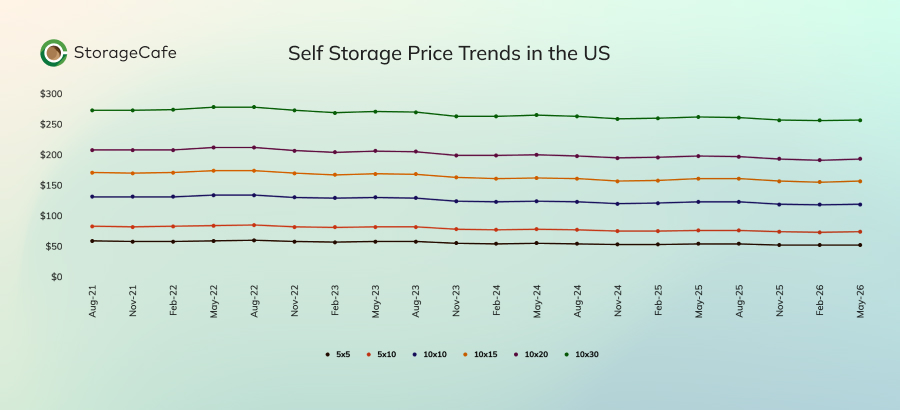
The graph even shows you the month-to-month evolution of rents at a national level, so you can see when prices are starting to dip or rise.
Scroll down, and you’ll even find a table that ranks major U.S. cities in terms of affordability. Enter the nearest major city to you, and you’ll see where you stand.
Compare by size, city, and state
The guide breaks pricing down in a way that makes the most sense for most renters. It establishes the national average street rate for a standard 10’×10’ non-climate-controlled unit — the industry’s most common type of unit — and maps how rates rise and fall from there across the most common sizes, from compact 5’×5’ lockers up to roomy 10’×30’ units.
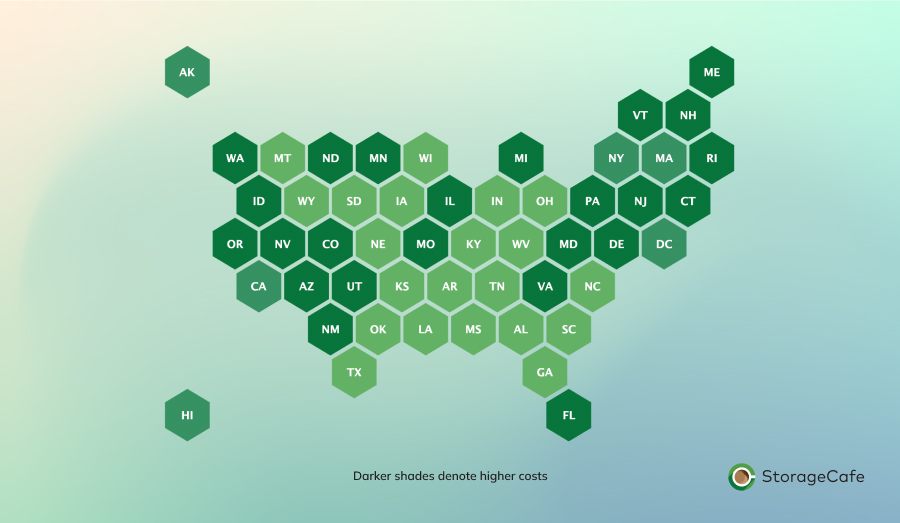
It also shows where your market lands: the upper half of an expensive state for storage units, the lower half of an affordable market, or somewhere in the middle. Whether you’re in a high-cost coastal metro or an affordable Midwest market, the guide cuts through the noise and gives you a clear picture of what storage costs and why.
And who knows? Maybe you’re just a 10-minute drive away from a sweet deal in a neighboring city or state — something that would take you hours to realize on your own, instead of just one minute using our storage unit price guide.
What to think about before you compare prices
Not all storage costs the same, and the right budget depends on a few factors worth considering before you start comparing facilities.
How to know which size unit I should pay for?
This is where a lot of renters get stuck — and where overpaying or underpreparing can both happen. Any unit size has an average rent, both at a city and a state-level. When you know that average rent, you can make an informed decision on whether to stick to that size or go for a smaller unit. The guide lays out the average rate for each size so you can match your needs to a realistic budget rather than guessing.
When is climate control worth it?
Climate-controlled units hold temperature and humidity steady, so they’re worth it if you’re storing delicate items like electronics, antiques, artwork and wood furniture, which need protection from swings in weather. That protection carries a premium over a standard unit of the same size.
So, when deciding whether or not to go for a climate-controlled unit, it’s important to weigh how much you really want to invest in storing delicate items long term. Once you know both averages for your area, weigh the upgrade against what you’re storing and your local climate. That comparison will point you toward the option that makes the most financial sense.
How does storage compare to your other costs?
A storage rate is easier to judge next to the expenses you already cover. The guide puts it in perspective — a 10’×10’ unit costs about what a daily premium-coffee habit runs over a month, and storage tends to run cheaper per square foot than apartment space. Seen that way, renting a slightly smaller home and offloading the overflow can pencil out in your favor.
What’s driving the price you’re seeing?
Local supply and demand, real estate costs, amenities like drive-up access and 24-hour entry, and even the season all push rates up or down. Knowing which factors are in play helps you tell a justified premium from an inflated one before you commit.
FAQs about StorageCafe’s Storage Unit Price Guide
Does the guide show current prices?
Yes. The benchmarks reflect current street rates based on Yardi Matrix data, updated to the most recent month available. Because rates shift with season and demand, it’s always wise to verify the live price in your specific market before reserving.
Where can I see prices for my city?
StorageCafe’s local listing pages show rates for facilities in your area, and each displays how your market compares to the national average. Enter your city, ZIP code, or address to see what storage costs near you.
Why do storage prices vary so much between cities?
Local supply, demand, and real estate costs are the main drivers. Right now, high-cost metros like San Francisco, Los Angeles, and New York City pair strong demand with expensive land, pushing rates up, while markets with ample inventory in the South and Midwest stay among the most affordable.
———————————————-
If you’re trying to budget for storage — for a move, a renovation, a downsizing, or just to reclaim space at home — our Storage Unit Price Guide is the fastest way to learn what you should expect to pay. Start with the national benchmarks, see how your market compares, then search by city or ZIP code to find current rates near you.


25 Mudroom Storage Ideas (And Mistakes to Avoid)
When you come home with muddy boots, an armful of bags and a coat you can’t wait to take off, it’s nice to have somewhere to put it all. With a mudroom, you can leave the outdoor mess at the door instead of carrying it through the house. Traditionally, you’d set aside a separate room, but you can just as easily use a hallway, an entryway closet, a laundry-room corner or a stretch of wall near the entrance.

Is Your Home Office Worth the Rent? What Coworking and Self Storage Could Save You
Every square foot of your apartment comes with a price tag, and a home office claims more of them than most renters expect. It starts with a desk. Then come the second monitor, the printer, the filing cabinet and the overflow boxes. Before long, the corner you set aside for work has turned into a small room you are paying for every month.

America’s Top Snowbird Destinations for 2026–2027: Florida Leads in Numbers, Texas Wins on Value
For Americans living in colder states, the approach of winter is reason enough to start looking south. Cold weather carries costs that go beyond the heating bill and shoveling snow. Seasonal affective disorder(opens in new tab) is far more prevalent in northern states, so a temporary move south isn’t simply an escape from the cold, but a chance to spend the hardest stretch of winter outdoors and in the sun.

How Much Does Halloween Really Cost in 2026? Plan Wisely to Avoid the Scare of Hidden Costs
Americans’ love for Halloween is almost frightening — this year alone, we are on our way to spending $13.5 billion, according to data from the National Retail Federation(opens in new tab). That breaks down to about $115 Halloween costs per person, a whopping 49% more than 10 years ago.

How to Store LEGOs: All the Fun, None of the Clutter
How to store LEGOs largely comes down to how your household uses them. If the bricks are part of everyday play, you need a setup that keeps them within easy reach and makes cleanup quick (for your feet’s sake, at least). Toy storage(opens in new tab) such as simple bins, playmats or containers that children can put away themselves may be enough. Larger or more serious collections usually need more organization, such as labelled drawers for loose pieces, trays for unfinished builds, shelves for completed models and separate storage for retired sets.

Cardboard Costume Guide: Tips and Ideas for a DIY Halloween
Whether for kids or adults, cardboard costume ideas often make the biggest splash once materialized, and that’s for a simple reason: doing a lot with a little is a universally impressive feat (especially in this economy). If you don’t have enough boxes you could temporarily repurpose, don’t worry! There are many places where you can find free moving boxes(opens in new tab), from stores and supermarkets to online groups and recycling drop-off spots. On the run? Try your luck at a self storage(opens in new tab) facility that sells moving supplies, often for cheap. This way, you can choose moving boxes of different shapes and sizes(opens in new tab), so you can make your costumes as complex as you want.

How to Celebrate Halloween: 9 Non-Spooky Ways To Enjoy It
As soon as October starts, it’s the official Halloween month. And while for many people it means it’s open season to get the scare of a lifetime, others, especially families with small children, might prefer to celebrate in a tamer way that’s both kid- and adult-friendly. While you’re likely to find more events where the spook factor is high, here’s how to celebrate Halloween in a not-so-scary way:

Motorcycle Storage Guide: How to Store Your Bike Safely
Motorcycles may be born to be wild, but eventually even the wild ones need somewhere to park. Whether riding season is winding down or your current living situation comes with plenty of square footage for you and less for your bike, motorcycle storage is one of those parts of ownership that doesn’t get as much airtime as the open road.

Halloween Decorating on a Budget (And Cheap Ideas for Everything Elsee)
Halloween has crept a long way from its eerie origins. While All Hallows’ Eve has transformed through the centuries, it wasn’t until the 1930s that trick-or-treating became a tradition in the U.S. and businesses began conjuring up mass-produced Halloween costumes. Now, Halloween is a monster-sized, billion-dollar industry, with a cauldron full of costumes and decorations ranging from the mainstream to the macabre. But is it all really worth your wallet? Maybe, but we’ll let you in on a little secret: You can keep your Halloween decorating on a budget and save on everything else, too. Take this plan and see it through!