
CA To WA Migration: Top Talent Is Moving To Washington — And Bringing Their Wallets

Key Takeaways:
- About 51K Californians — roughly 140 movers per day — moved to Washington state in 2023
- Most movers heading to Washington state are high-earning millennials
- In nine out of 10 top moving routes, Californians are heading to King County, anchored by Seattle, with Clark County being the only exception
- On three of the routes, Californians can save over 50% in homebuying expenses compared to their home state
- Renters get to pocket up to 44% in savings in monthly rents in Washington state compared to their origin counties
It’s no secret that Californians are leaving their home state, driven by soaring housing costs and a high overall cost of living. While Texas remains a top destination — often appealing to those looking to stretch their budgets — Washington state has become a key landing spot, especially among transplants with greater financial flexibility. In 2023 alone, more than 51,000 people made the leap from California to Washington — nearly 140 each day. That’s the equivalent of relocating the entire population of Palm Desert in just one year.
So, why are so many Californians choosing the Evergreen State? Unlike the clear-cut affordability draw of Texas, Arizona or Nevada, the appeal of Washington is more complex. In fact, housing in many parts of Washington is anything but cheap. Some popular relocation routes even lead to higher home prices than in California.
What Washington offers, however, is a powerful combination of economic opportunity and quality of life. The state boasts a thriving job market, especially in the tech sector, and unlike California’s steep 13% income tax, Washington levies no personal income tax at all. Add to that its strong infrastructure — Seattle ranks among the top U.S. cities for public transportation — and a statewide commitment to sustainability, and it’s easy to see why eco-conscious and career-driven Californians are making the move.
Young, high-earning professionals drive migration from California to Washington state
With a strong economy supported by tech, aerospace and clean energy, the Evergreen State is attracting professionals at the height of their careers. Based on data from the U.S. Census’s 5-Year American Community Survey (2019-2023), well-to-do millennials are the main age group making the move, accounting for nearly 35% of newcomers. These migrating millennials earn, on average, over $90,000 per year, significantly outpacing the national millennial average of $59,000.
Gen Zers come in second, with 28% of movers switching states. As they’re starting to graduate from college, many of them are in search of better jobs and a friendlier cost of living outside of California.
Gen Xers and baby boomers are leaving California at similar rates — over 10%. Both generations leaving the Golden State outearn the national average income for their age group. For baby boomers, this relocation means living in a more affordable state, where their dollar can stretch further.
While access to affordable housing may not be the main motivation for Californians moving to Washington, it’s still a meaningful outcome for many. More than a third (36%) of those making the move become homeowners shortly after arriving. That’s a significant share, especially considering that Washington’s housing market isn’t exactly a bargain. Still, when compared to the even steeper prices in many parts of California, relative affordability can open the door to homeownership, particularly in cities like Spokane, Tacoma or even parts of the Seattle metro.
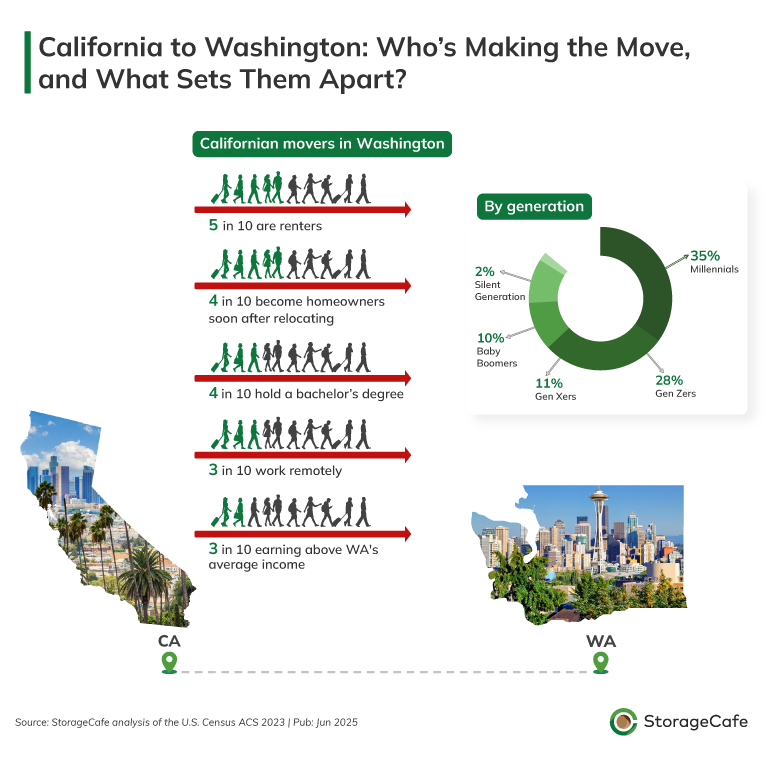
This shift is made more attainable by the profile of many of the movers themselves. Over 40% of California-to-Washington transplants hold a bachelor’s degree, and nearly 30% work remotely, giving them flexibility in where they live and the financial stability to enter competitive housing markets.
On average, these movers earn around $69,000 annually, while Washington residents overall earn slightly less, at just over $63,000 per year. This alignment in income levels suggests that many are relocating not necessarily for a pay bump, but for a better quality of life and improved cost-benefit balance, where homeownership becomes a realistic next step rather than a distant goal.
“While many popular moving routes reflect a clear search for improved affordability, the California-to-Washington migration trend suggests something different,” says Emilia Man, senior analyst with StorageCafe. “Movers on this route appear to be seeking balance. Seattle offers the urban, cosmopolitan lifestyle they’re accustomed to, but with a more favorable cost-to-income ratio. It’s a chance to maintain cultural vibrancy while making meaningful progress toward long-term goals like homeownership.”
Top destinations in Washington for California transplants
Although overall migration has slowed since its 2021 peak, Washington continues to stand out as a highly appealing relocation destination. Net migration between California and Washington remains positive, with the Evergreen State welcoming 150,000 new residents in net migration numbers from California over the past decade.
To better understand where these Californians are landing, we analyzed the 2023 U.S. Census American Community Survey and IPUMS microdata to map out the most popular migration routes from California to Washington. In addition to tracking population flows, we looked at key real estate and demographic metrics — including home prices, apartment rents and income levels. We also looked at self storage costs, as the service is widely used during transitional periods.
“We’ve seen considerable activity on the self storage front in Seattle recently, much of it tied to the significant influx of new residents who bring a lot of stuff — including hobby gear and seasonal items,” said Man. “What’s more, many of these newcomers are settling into apartments, which are often smaller than what they were used to back home. For example, 76% of newcomers from Los Angeles to Seattle are renters. In this context, self storage becomes an essential part of settling in — one that comes with lower costs than in California. In Seattle, a storage unit averages around $184 per month, compared to $257 in Los Angeles.”
King County unrivaled in attracting newcomers
King County, home to the Seattle metro area, is by far the most popular destination for Californians relocating to Washington. In fact, nine of the 10 busiest California-to-Washington routes lead directly to the Seattle metro, with nearly 23,000 Californians moving to King County in 2023 alone.
Seattle is widely considered a “second Silicon Valley,” thanks not only to tech and aerospace giants like Amazon, Microsoft and Boeing, but also to a strong local talent pipeline fueled by universities specializing in tech, health care and engineering.
Zooming in on the most popular moving routes from California to Washington, here are the strongest state-to-state matches drawing the most movers.
Los Angeles and San Diego Counties to King County
Among the most common relocation paths, moves from Los Angeles and San Diego to King County stand out. These routes are largely populated by high-earning millennials priced out of California’s competitive housing markets.
In most of the top 10 routes, the cost of housing in the destination county is lower than in the origin county. However, King County is an exception. In the busiest route — from Los Angeles to King County — the average home in King County costs slightly more than in Los Angeles, by 4%. Similarly, those relocating from San Diego to King County would pay about 2% more for a home in Washington.
Still, home prices are only part of the story. Many movers are renters eyeing eventual homeownership, and the income-to-housing cost ratio provides a fuller picture.
In King County, renters spend just 29% of their income on rent, compared to 40-41% in Los Angeles and San Diego. And while homeownership still exceeds the affordability threshold of 30%, buyers in King County are better positioned than in those California markets, where buyers would spend up to 88% of their income on a mortgage.
The numbers are especially promising for tech professionals. In the Seattle metro area, tech workers earn an average of $154,000 per year, compared to $125,000 in Los Angeles and $129,000 in San Diego. With over 162,000 people working in tech in Seattle, the city offers not just better salaries, but also more opportunity — more than double San Diego’s 58,000 tech workers.
While affordable housing is often a key driver of migration, Californians heading to Washington are motivated by more than just real estate costs. The majority of movers in the top 10 routes are high-earning millennials looking for a better cost-to-income balance, strong career opportunities and a lifestyle that mirrors the cultural vibrancy of California — without the price tag.
Santa Clara County to King County
Santa Clara County — anchored by the San Jose metro area — sent over 2,700 residents to King County in 2023 alone. These Californians essentially traded one tech hub for another, but with a major financial advantage: Homebuyers in King County pay about 41% less than they would in Santa Clara County.
With 62% of these newcomers being renters, lower rental costs likely played a key role in the decision to move. Apartment living is significantly more affordable in their new Washington home — renters pay roughly 30% less per month in King County compared to Santa Clara County, helping them access a more comfortable lifestyle for less.
Alameda County to King County
About 1,800 Californians left Alameda County and its county seat, Oakland, for King County. Seattle, with its thriving tech scene, offers comparable job opportunities to the Bay Area but with a more affordable cost of living, particularly when it comes to housing. More than half of these movers are millennials in the prime of their careers, and they out-earn the average King County resident by nearly $15,000 annually.
Homes in King County are also about 23% less expensive than in Alameda County, allowing roughly one-third of newcomers to purchase a home shortly after relocating. Renters benefit as well, saving around 12% on their monthly housing costs compared to what they’d pay back in California.
San Francisco County to King County
San Francisco County is another key source of Californians relocating to King County, with nearly 1,600 people making the move in 2023. Millennials make up two-thirds of these movers, and an impressive 88% hold a bachelor’s degree — a strong indicator that they’re targeting high-paying job opportunities in the Seattle area.
Their income reflects that ambition: The average income for this group is around $146,000, the highest among the top 10 California-to-Washington migration routes and well above King County’s average of $85,000.
Despite their strong earnings, affordability still matters. Home prices in King County are about 41% lower than in San Francisco County, and roughly one in four of these newcomers became homeowners within their first year of moving.
San Mateo County to King County
Nearly 1,500 people moved from San Mateo County to King County, WA, in 2023. Redwood City, San Mateo’s county seat and a key hub in Silicon Valley, boasts 255 sunny days a year, a fact behind its proud slogan: “Climate Best by Government Test.”
Yet many are trading that famously mild, sunny climate for King County’s cooler, cloudier weather, where rain falls nearly half the year and sunshine is far less predictable. So why make the switch? For many, the answer lies in affordability, lifestyle and long-term opportunity. These transplants are high earners, with average incomes topping $100,000 a year, a distinction shared by only four of the busiest California-to-Washington migration routes. And King County makes the dream of homeownership a lot more attainable, with homes here 46% less expensive than in San Mateo County.
San Diego County to Kitsap County
This is one of the two routes where Gen Zers make up the majority of movers. As they’re either in college or transitioning to their professional lives, their earnings are much lower compared to their millennial counterparts on other routes. Their income stands at only $39K/year, so, naturally, most of them tend to still rent once they settle in and around Port Orchard, Kitsap County. Here, the average apartment is 20% cheaper compared to the Californian rent in their county of origin.
Orange County to King County
Orange County to King County is the other moving route dominated by Gen Zers. This time, with more than half of them already having earned their bachelor’s degree, their income is higher, at a little over $58K/year. As they’re still building their career, most of them are renters. This move allows them to pay 13% less when renting in King County. A small percentage of them, about 22%, became homeowners shortly after relocating, banking on an 11% price difference in King County’s favor.
LA County to Clark County
Clark County, with its main urban area, Vancouver, is the only popular WA relocation destination for Californians outside of the Seattle area. Those taking up this route make over $91,000 annually, far exceeding the average income in Clark County — by over $30,000. Thus, they also claim the highest share of homeowners among the top 10 routes. An impressive 56% of them purchased a home within months after arriving in their new home state, incentivized by prices that are 38% less expensive than back in LA County. Even renters have it better in Clark County, managing to pay 12% less on rent.
Santa Clara County to Clark County, the most advantageous route for homebuyers
In roughly 70% of the 210 California-to-Washington migration routes, movers are able to save on the cost of buying a home in their destination county. Many Californians relocating to Washington are coming from high-priced markets in the San Francisco and San Jose metro areas, where housing is particularly tight.
The most financially advantageous route for homebuyers is from Santa Clara County and its county seat San Jose to Clark County. Homes at the destination are about 65% less expensive, making ownership far more accessible for newcomers. As a result, 62% of movers along this route purchased a home shortly after relocating to the Vancouver area. This corridor is largely favored by Gen Xers and baby boomers, suggesting a preference among older adults, some retired or nearing retirement, for quieter, more affordable communities.
Another route with significant savings is from San Diego County to Spokane County, where home prices are 53% lower on average. However, this path is more popular with younger Gen Zers at the start of their careers, many of whom have modest incomes. As a result, only 27% of these newcomers manage to buy a home soon after relocating.
Other notable routes with high savings potential include Los Angeles County to Spokane County and San Mateo County to King County, both of which offer sizable reductions in housing costs for those seeking to transition from California’s expensive real estate markets.
Savings on rents start at around 40% for some of the CA-to-WA moving routes
About 55% of Californians relocating to Washington state are renters, and, for many, it’s a financially smart move. On 17 of the most common migration routes, monthly rent savings exceed 10%, making the switch especially appealing for those not yet ready to buy.
Those who relocate from San Diego County to Spokane County get the best deal rent-wise, as they pay a massive 44% less per month. Thus, many postpone homeownership, with almost half of the movers preferring the renter lifestyle at least during their first year in Washington state. Trading the San Jose area for Clark County and Vancouver will also result in rents that are 41% less expensive — something that ultimately makes the job of saving for a down payment a lot easier. Other renter-friendly moves include LA County to Spokane County and San Diego County to Skagit County.
Robust demand fuels faster self storage growth in Washington
Moving, homebuying and post-move remodeling remain key drivers of self storage demand — and Seattle is no exception. This pattern is clearly reflected in Google search trends, with interest in self storage across Seattle climbing steadily, especially during the summer months, when relocations and home transitions typically surge.
As demand stays elevated, particularly in the Seattle metro area, storage continues to serve as a critical resource for helping newcomers settle in with greater ease. While both California and Washington cities currently fall below the national average in terms of available storage space, Washington has experienced more robust construction activity in recent years — likely a direct response to ongoing inbound migration.
King County, the top destination for Californians relocating to Washington, expanded its self storage inventory by 31% over the past decade. The average cost to rent a unit there is currently $181 per month, reflecting steady demand in a tight housing market. Other counties experiencing high volumes of incoming Californians have expanded their storage capacity even more dramatically. Clark County, home to Vancouver, saw a 73% increase in self storage space, while Pierce County grew its inventory by 42%. This surge in construction suggests local markets are responding to migration-driven demand, especially as new residents rent apartments, transition into homes and navigate renovations.
Self Storage Trends in Washington’s Top Destination Counties for California Movers
| County | Total Self Storage Inventory (sq. ft.) | Self Storage Inventory Growth (2013-2023) | Monthly Self Storage Rate |
|---|---|---|---|
| King County, WA | 13,743,134 | 31% | $181 |
| Pierce County, WA | 7,426,701 | 42% | $142 |
| Clark County, WA | 4,157,660 | 73% | $138 |
| Spokane County, WA | 5,831,026 | 41% | $123 |
| Snohomish County, WA | 5,648,588 | 27% | $176 |
Californians are heading to Washington in search of more than just lower taxes or cheaper homes. They’re finding career opportunities, lifestyle upgrades and, in many cases, significant savings, whether they’re renting or buying. With flexible work arrangements, solid incomes and growing infrastructure in key Washington counties, this West Coast migration trend is here to stay.
Check out the most popular California-to-Washington moving routes and other key metrics:
Featured expert opinion
Susan Curran, Director of the UW’s Center for Studies in Demography & Ecology and UW Associate Vice Provost for Research in the Office of Research 
- What are the main factors attracting Californians to Washington?
The primary conditions associated with Washington attracting Californians is: no state income tax, job growth, relatively cheaper housing market (but not by much) and quality of life conditions.
2. Are there any local challenges associated with this migration trend – such as effects on housing supply, job market, or infrastructure?
Yes, housing supply is challenged by in migration, but the job market is not. Recent IRA investments in light rail and rail along the western portion of the state have helped to ease some infrastructure burden. Planning for the particular needs across the age groups of migrants has proven challenging, such as planning for assisted living facilities or schools.
3. How do you expect the California-to-Washington migration route to evolve in the coming years?
I expect that it will continue at the same pace, given that the climate challenges in California will make some portions of the state increasingly unlivable.
Methodology
This analysis was done by StorageCafe, an online platform that provides storage unit listings across the nation.
For this report, we investigated the most recent California-to-Washington moving data provided by the U.S. Census American Community Survey 5-Year Estimates Public Use Microdata Sample, 2023.
We identified 26 popular moving routes leading from California to Washington and ranked them based on individual move-ins by county. Additional data on home and rent values, generational demographics, homeownership or rental status, educational attainment, remote work status and per capita income were also sourced from the U.S. Census’s American Community Survey (2023 data).
To assess cost savings for homebuyers and renters, we calculated both the numerical and percentage differences in home and rent prices between California and Washington counties.
Unemployment statistics were sourced from the U.S. Bureau of Labor Statistics, reflecting data for February 2025.
Data on self storage — using internal data through April 2025 for inventory and May 2025 for rents — came from our sister division Yardi Matrix, a business development and asset management tool for brokers, sponsors, banks and equity sources underwriting investments in the multifamily, office, industrial and self storage sectors.
Fair use and distribution
This study serves as a resource for the general public on issues of common interest and should not be regarded as investment advice. The data is true to the best of our knowledge but may change if amendments to it are made. We agree to the distribution of this content but we do require a mention in return for attribution purposes.


25 Mudroom Storage Ideas (And Mistakes to Avoid)
When you come home with muddy boots, an armful of bags and a coat you can’t wait to take off, it’s nice to have somewhere to put it all. With a mudroom, you can leave the outdoor mess at the door instead of carrying it through the house. Traditionally, you’d set aside a separate room, but you can just as easily use a hallway, an entryway closet, a laundry-room corner or a stretch of wall near the entrance.

Is Your Home Office Worth the Rent? What Coworking and Self Storage Could Save You
Every square foot of your apartment comes with a price tag, and a home office claims more of them than most renters expect. It starts with a desk. Then come the second monitor, the printer, the filing cabinet and the overflow boxes. Before long, the corner you set aside for work has turned into a small room you are paying for every month.
America’s Top Snowbird Destinations for 2026–2027: Florida Leads in Numbers, Texas Wins on Value
For Americans living in colder states, the approach of winter is reason enough to start looking south. Cold weather carries costs that go beyond the heating bill and shoveling snow. Seasonal affective disorder(opens in new tab) is far more prevalent in northern states, so a temporary move south isn’t simply an escape from the cold, but a chance to spend the hardest stretch of winter outdoors and in the sun.

How Much Does Halloween Really Cost in 2026? Plan Wisely to Avoid the Scare of Hidden Costs
Americans’ love for Halloween is almost frightening — this year alone, we are on our way to spending $13.5 billion, according to data from the National Retail Federation(opens in new tab). That breaks down to about $115 Halloween costs per person, a whopping 49% more than 10 years ago.

How to Store LEGOs: All the Fun, None of the Clutter
How to store LEGOs largely comes down to how your household uses them. If the bricks are part of everyday play, you need a setup that keeps them within easy reach and makes cleanup quick (for your feet’s sake, at least). Toy storage(opens in new tab) such as simple bins, playmats or containers that children can put away themselves may be enough. Larger or more serious collections usually need more organization, such as labelled drawers for loose pieces, trays for unfinished builds, shelves for completed models and separate storage for retired sets.

Cardboard Costume Guide: Tips and Ideas for a DIY Halloween
Whether for kids or adults, cardboard costume ideas often make the biggest splash once materialized, and that’s for a simple reason: doing a lot with a little is a universally impressive feat (especially in this economy). If you don’t have enough boxes you could temporarily repurpose, don’t worry! There are many places where you can find free moving boxes(opens in new tab), from stores and supermarkets to online groups and recycling drop-off spots. On the run? Try your luck at a self storage(opens in new tab) facility that sells moving supplies, often for cheap. This way, you can choose moving boxes of different shapes and sizes(opens in new tab), so you can make your costumes as complex as you want.

How to Celebrate Halloween: 9 Non-Spooky Ways To Enjoy It
As soon as October starts, it’s the official Halloween month. And while for many people it means it’s open season to get the scare of a lifetime, others, especially families with small children, might prefer to celebrate in a tamer way that’s both kid- and adult-friendly. While you’re likely to find more events where the spook factor is high, here’s how to celebrate Halloween in a not-so-scary way:

Motorcycle Storage Guide: How to Store Your Bike Safely
Motorcycles may be born to be wild, but eventually even the wild ones need somewhere to park. Whether riding season is winding down or your current living situation comes with plenty of square footage for you and less for your bike, motorcycle storage is one of those parts of ownership that doesn’t get as much airtime as the open road.

Halloween Decorating on a Budget (And Cheap Ideas for Everything Elsee)
Halloween has crept a long way from its eerie origins. While All Hallows’ Eve has transformed through the centuries, it wasn’t until the 1930s that trick-or-treating became a tradition in the U.S. and businesses began conjuring up mass-produced Halloween costumes. Now, Halloween is a monster-sized, billion-dollar industry, with a cauldron full of costumes and decorations ranging from the mainstream to the macabre. But is it all really worth your wallet? Maybe, but we’ll let you in on a little secret: You can keep your Halloween decorating on a budget and save on everything else, too. Take this plan and see it through!