


Key Takeaways
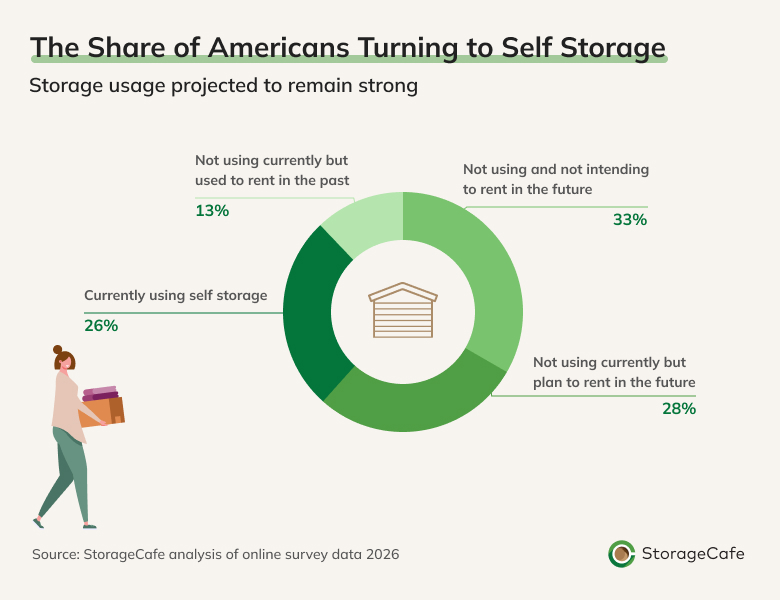
- 1 in 4 Americans currently uses self storage, with another 28% planning to rent a unit in the future
- Gen Z is the most space-starved, clutter-overwhelmed generation, with future intent (32%) more than double their current usage (13%)
- More than half of renters choose climate-controlled units above all other types
- Self storage searches rose 23% in 2025 across the 150 largest U.S. cities — more than triple the previous year’s growth
- Affordable pricing tops the list of features Americans look for in a storage unit
- More than a third of Americans feel overwhelmed by clutter at home, with clothing being the biggest culprit
About one in four Americans is already using self storage and just as many are actively searching for a unit online right now. Across the 150 largest U.S. cities, self storage searches rose 23% year-over-year in 2025 — nearly triple the growth recorded the previous year, up from around 8% in 2024.
Extra space has evolved from a convenience into an increasingly important part of household planning for a growing share of the population. What’s driving the shift? A housing market that remains challenging, homes that are becoming more compact, and lifestyles that require greater flexibility.
Current housing conditions have made moving more difficult for many Americans. Mortgage rates averaged 6.6% throughout 2025, giving homeowners with lower existing rates a strong incentive to stay put — even when their space no longer fully suits their needs. Buyers entering the market face a different challenge: New construction is delivering less square footage at higher prices, a trend some analysts have called housing shrinkflation(opens in new tab).
Gen Z is navigating these pressures from another angle. Homeownership, long regarded as a generational milestone, can feel increasingly distant when saving for a down payment competes with rent, student debt, and everyday living expenses. Whether renting or preparing to buy, many young adults are building full lives in more compact spaces.
Remote and hybrid work have added another layer to the equation. For a growing number of Americans, a home office has become a practical requirement, meaning every corner devoted to work leaves less room for storage(opens in new tab) and other household needs.
1 in 4 Americans uses self storage — and even more are getting ready to
Self storage has become a fixture of American life, with 26% of survey respondents currently renting a unit. Another 28% plan to use self storage in the future, meaning more Americans are on their way in than are already there.
Homeowners are out front at 29% current usage, with 36% planning to rent a unit down the line. Renters sit at 21% today and only 15% plan to use storage in the future. The gap between current and future intent likely comes down to budget: renters who aren’t using storage now are less likely to see it in their plans, while homeowners are running out of space and know it. Renters are watching their budget, homeowners are watching their closet space disappear.
Gen X tops the charts for storage intent, while Gen Z is already planning ahead
Gen X is the generation most likely to currently use self storage, with 35% renting a unit — a reflection of a generation famously known as the “sandwich generation(opens in new tab),” squeezed between aging parents and growing kids, with homes that were never quite big enough to hold it all. It’s no coincidence: 1 in 5 Gen X buyers purchased a multigenerational home in 2025, the highest of any generation — and more people under one roof inevitably means more belongings competing for the same space.
Boomers follow closely at 32%, many navigating the transition out of family-sized homes and into smaller, more manageable spaces.
Gen Z is just getting started. Only 13% currently rent a unit — the lowest of any generation — but 32% plan to in the future, nearly 1 in 3. As this generation ages into the housing market and confronts the same affordability walls as the Millennials before them, self storage is already on their radar as part of the plan.
The 10’x10’ is America’s go-to unit — but Gen Z and Boomers are pulling in opposite directions
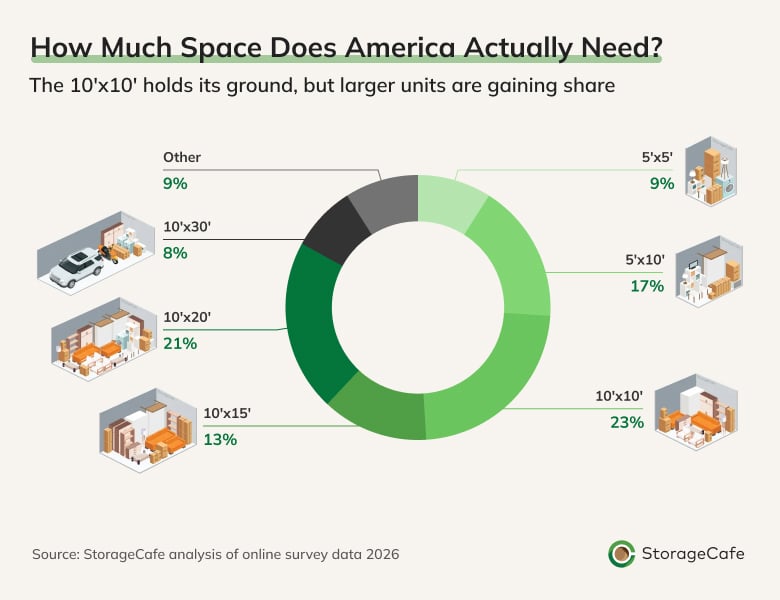
The 10’x10’ unit(opens in new tab) holds its ground, appearing in 23% of responses. Renters skew toward compact units — a 5’x10’ unit(opens in new tab) appears in 27% of renter responses and a 5’x5(opens in new tab)’ in 16% — while homeowners gravitate toward larger spaces, a 10’x20′ showing up in 25% of homeowner responses and a 10’x30’(opens in new tab) in 10%.
Gen X and Boomers are the power users of larger units, with a 10’x20′(opens in new tab) appearing in 27% and 28% of their responses respectively — consistent with Gen X managing multigenerational households and Boomers downsizing out of family-sized homes. Gen X also shows a 6% interest for 10’x30′ units, matching the sheer volume of what managing two households at once can generate.
Among all generations, the 10’x20′ features most heavily in Silent Generation responses, at 45%. For a generation largely past the accumulation phase and consolidating decades of belongings into one place, the larger unit isn’t a choice so much as a necessity.
Running out of room: Top Reasons people use self storage
Space is the crux of it. The single biggest reason Americans turn to self storage is simply not having enough room at home — appearing in 34% of homeowner responses and 31% of renter responses. Homeowners accumulate more over time, and with more people in the household and new homes shrinking while prices keep climbing, even a house stops being enough.
Moving is the second most common trigger, highlighted by 20% of homeowner responses and 30% of renter responses. Whether people are relocating across town or across the country, a move often creates a mismatch between what they own and what their new home can accommodate. That makes self storage especially relevant in today’s climate of affordability-driven migration(opens in new tab), as households leave higher-cost areas in search of more manageable housing and living expenses.
New Yorkers, for example, are increasingly heading to North Carolina, while Californians are relocating to Florida. For many, the transition does not lead directly to homeownership. They may rent first while exploring a new city, adjusting to a new job, or deciding where to settle for the longer term. During that period, they are often living in smaller spaces and may not have room for everything they brought with them.
Storage can therefore become part of the financial calculation behind a move. A more compact apartment in Florida or North Carolina may cost less than a comparable home in New York or California, but it may also offer less room. At an average of $132 per month in Jacksonville and $116 in Raleigh, a storage unit can offer a more affordable way to keep belongings nearby than moving immediately into a larger home.
What’s inside America’s storage units?
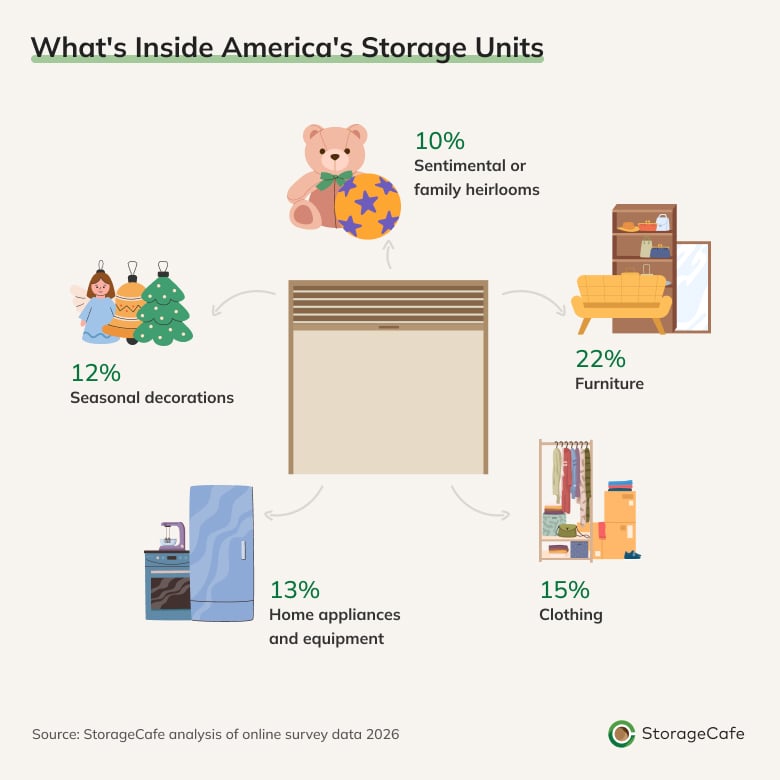
Furniture ranks first among stored categories at 22% — the natural result of living in less square footage than your belongings demand, against a backdrop of homes that are slowly losing space.
Clothing comes in second at 15% of responses, with studio and one-bedroom dwellers accounting for the highest share at 21% — compared to just 7% of those in four-bedroom homes. When your closet is the size of a cupboard, a storage unit becomes the overflow wardrobe.
Beyond the practical, sentimental items and family heirlooms account for 10% of stored categories — rising to 12% among renters, who may lack the attic or basement space homeowners rely on for safekeeping.
Seasonal decorations were chosen in 12% of responses, with Gen X leading at 16%. Sporting and hobby gear rounds out the picture at 9%, as Americans invest more in pursuits that come with equipment.
Climate control is the preferred choice — but not the only one
54% of current storage users opt for climate-controlled units(opens in new tab) — consistent across generations and property types — suggesting Americans broadly value protecting their belongings from temperature and humidity swings.
Non-climate-controlled units also remain widely used at 31%, particularly among those storing hardier items like tools or seasonal gear that can withstand more variable conditions.
Vehicle storage(opens in new tab) — whether for a car, RV or boat — still has its place, particularly among older generations.
Gen X skews toward the weekend warrior end of the spectrum, claiming 13% of responses for vehicle storage. Boats, motorcycles and classic cars that need somewhere to live between seasons. As they are edging into their golden years, silver boats and prized rides aren’t things they want just sitting exposed in a driveway. In fact, Gen X leads all generations in recreational boat purchases(opens in new tab). The storage industry is keeping that momentum going and making splashes alongside, with supply nearly doubling(opens in new tab) to meet the wave.
Boomers, on the other hand, are keeping their adventures closer to the ground and are focusing more on hitting the open road alongside their RVs, as vehicle storage makes the list in 8%. With Baby Boomers accounting for 52% of all RV owners in the U.S. in 2023(opens in new tab) and 11.2 million households owning an RV(opens in new tab) — a number projected to grow by nearly 10 million more within five years — the demand for vehicle storage isn’t going anywhere. An RV sitting in a driveway is a neighbor complaint waiting to happen, and most HOAs and urban lots don’t give you a choice. The storage facility solves a problem the driveway can’t, at a price point that makes more financial sense than the alternatives.
More than 1 in 4 Americans visit their storage weekly
Most users visit their unit at least once a month, but a notable 28% are there every single week. The most frequent visitors by far are four-person households, with 52% making weekly trips (almost double the overall average) treating their unit less like a vault and more like an extension of the home they’re actively cycling through.
Gen X keeps those roll-up doors busy, with 36% stopping by every week. For a group storing more, managing more and retrieving more, the weekly visits write themselves. Many are deep in the sandwich generation years, balancing aging parents and adult children at the same time, which often means storing more than one household’s worth of items at once. Nearly 3 in 4 sandwich generation caregivers(opens in new tab) say the demands of caring for two generations consume as much time and energy as a full-time job. With close to 24 hours a week(opens in new tab) going toward coordinating care across generations, little room is left for figuring out where everything goes. The storage unit absorbs the decision until there’s bandwidth to make it.
Renters visit more frequently than homeowners (36% weekly versus 25%). With renters moving 3.7 times more than homeowners(opens in new tab) across the largest U.S. cities, there’s a rhythm to the cycling in and out and the weekly visit numbers follow it closely.
Price and location matter most — and the rest aren’t far behind
When it comes to picking a facility, affordable pricing paves the way, named in 28% of responses. In a climate where housing costs keep rising and household budgets keep tightening, a storage unit that breaks the bank defeats the purpose.
Location runs close behind at 17% of responses, with proximity to home or work a consistent concern across generations. A storage unit you can’t easily get to is one you’ll eventually stop using.
Security and climate control follow at 10% each, reflecting a renter base that’s storing things that matter to them — heirlooms, business inventory and a lifetime’s worth of seasonal gear. 24/7 access appears in 13% of responses, with renters more likely than homeowners to prioritize it (16% vs 11%). For people living in smaller spaces, the storage unit has morphed from a last resort to a natural transition of how they manage daily life.
One number worth watching: digital convenience (online booking, app access) shows up in 9% of Millennial responses, the highest of any generation. The industry is already catching up, with mobile booking and app-based access fast becoming standard rather than a bonus feature. As Millennials become the dominant storage demographic, a clunky rental process may be all it takes to lose them to a competitor.
Remote work is reshaping the home, and the storage unit along with it
Hybrid workers are the most likely to be active storage users right now at 34%, compared to 28% of fully remote workers and 24% of those working entirely on-site. They are also the least likely to rule out storage entirely — only 19% say they have no intention of renting a unit, compared to 24% of fully remote workers and 23% of those on-site.
The past usage numbers add another layer. Fully remote workers have the lowest rate of having used storage before — just 8%, compared to 11% for hybrid workers and 14% for those on-site. Combined with their 40% intent to use storage in the future, it suggests a group that hasn’t yet made the move but is heading in that direction. Hybrid workers, by contrast, appear to have already crossed that threshold — leading on current usage and sitting closer to on-site workers on future plans.
On-site workers have the most storage history, hybrid workers are the most active right now, and fully remote workers are the ones most likely to get there next.
Clutter is on the rise, and Americans are looking for solutions
More than a third of survey respondents always or often feel overwhelmed by clutter(opens in new tab) at home and another 29% feel it sometimes, and only about 1 in 5 Americans say they never feel overwhelmed by clutter at home. The feeling hits hardest among five-person households, where 37% say they always feel overwhelmed. Gen Z reports the highest rates of frequent clutter stress at 47%, followed by Millennials at 40%.
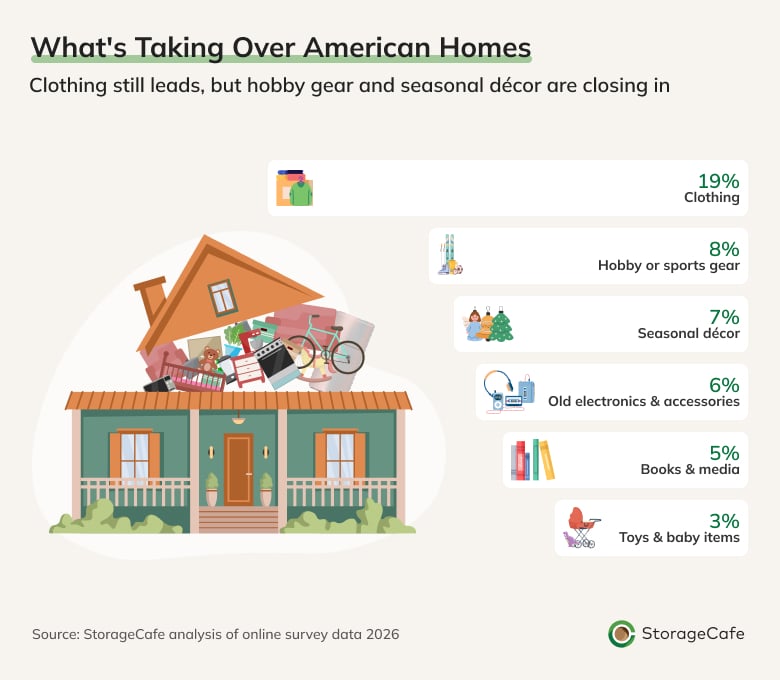
Clothing is the most commonly named source of clutter, appearing in 28% of renter responses and 28% of Gen Z responses. It’s part of a broader trend: the average American home contains close to 300,000 items(opens in new tab) — more possessions per household than any society in recorded history.
As lives expand, hobbies grow and households evolve, belongings have a way of outpacing the space available to store them. Clothing is usually the first thing to run out of room.
Research and mental health experts increasingly treat clutter as a psychological issue(opens in new tab), not just a practical one. Somewhere between a full closet and an impossible choice, the storage unit has become the answer to where you go when there’s no room left.
Nixon memorabilia, cremation urns and cosplay armor: a look at the stranger side of self storage
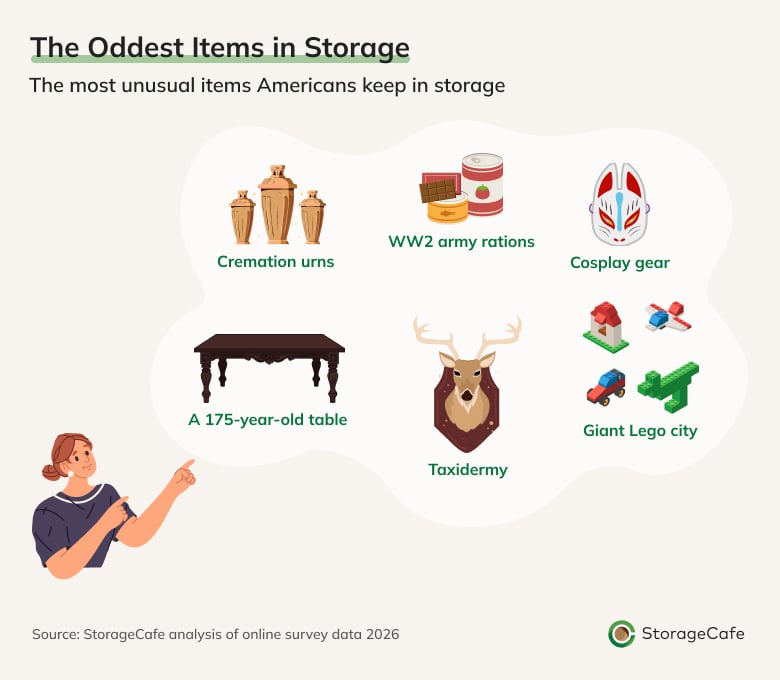
Self storage is mostly mundane. Mostly, but not always. While most Americans are stashing furniture and holiday décor(opens in new tab) behind their roll-up doors, a brave few have turned their units into something altogether more interesting.
Take the person storing WW2 army rations. Whether that’s emergency preparedness or a very niche collection, we have questions. Then there’s the Richard Nixon election campaign collectibles (every single campaign, apparently) which raise the bar for political dedication considerably. And somewhere out there, a 175-year-old family heirloom table is sitting in a climate-controlled unit — honestly, the safest place for it.
Cremation urns make another appearance this year — multiple respondents, in fact — suggesting that self storage has become a legitimate solution for one of life’s more delicate logistical challenges. Taxidermy also checks in, which we’ll leave without further comment. So does scuba diving equipment(opens in new tab), because apparently some people have an entire underwater life that needs somewhere to live above ground.
On the more wholesome end of the spectrum, stuffed animals(opens in new tab) and sentimental toys made a surprising appearance — including one respondent storing their daughter’s Labubu collection. Given that some editions have sold for over $150,000, this might actually be the smartest financial decision in this entire survey. A giant LEGO city banned from the living room by a spouse has also found refuge in storage — because some battles aren’t worth fighting.
And then there’s the cosplay gear(opens in new tab). As cosplay culture continues to grow, so does the sheer volume of what it requires — elaborate costumes, props, armor sets and accessories that no apartment closet was ever designed to accommodate. Turns out you can’t just fold up a full Nazgûl costume and slide it under the bed. Storage units have taken on a new role as the backstage of America’s cosplay community, keeping the magic intact between conventions.
Rounding things out: over a thousand ink pens, three motorcycles and a car someone has been meaning to restore for years. We believe in them.
Where self storage demand is surging — and why
Self storage interest is on the rise across the nation and accelerating in specific pockets. The largest year-over-year jumps in searches are concentrated in mid-sized Southern and Sun Belt cities, where population growth and housing pressure are outpacing available supply.
Memphis, TN(opens in new tab) leads with an 181% jump — the highest in the dataset. One of the drivers is xAI’s Colossus supercomputer facility(opens in new tab), the world’s largest, which has drawn nearly 3K workers and is pulling tech companies like Nvidia and Dell into what the city is now calling the “Digital Delta.” At $87 a month for a storage unit and apartments averaging 892 square feet, Memphis is one of the most affordable landing pads for relocating tech workers in the country. For workers arriving from San Francisco or Austin with a full apartment’s worth of belongings, that price gap is what makes renting a unit an easy decision.
Port St. Lucie, FL(opens in new tab) at +175% is a different kind of story, one that is built almost entirely on arrivals. As one of Florida’s fastest-growing migration hotspots, it has been drawing residents from pricier South Florida counties and from northern states — driver license exchanges in early 2026 showed new residents from New York up 16% and from New Jersey up 25%. People arriving from high-cost metros tend to leave a paper trail of belongings.
Chesapeake, VA and Virginia Beach, VA(opens in new tab) are military towns first, and the storage numbers follow from that. Both cities sit inside Hampton Roads, home to the world’s largest naval station(opens in new tab). Naval Station Norfolk alone employs 46K active-duty military and 21K civilian personnel, with Joint Expeditionary Base Little Creek-Fort Story adding another 18K service members. Virginia Beach’s storage per capita figure of 11.17 square feet is one of the highest in the dataset, nearly double Chesapeake’s 7.13, reflecting a region where storage has become a permanent feature of how people live. Military households move on orders, not timelines, and Hampton Roads has been absorbing that demand for decades. With that many households rotating in and out on military orders, a 127% to 170% jump in searches fits the pattern.
North Las Vegas, NV(opens in new tab) rounds out the top five at +138%. With only 4.9 square feet of storage per capita (among the tightest markets in the dataset) the city’s infrastructure hasn’t kept pace with its growth. North Las Vegas has been one of the fastest-growing cities in Nevada(opens in new tab) for years, drawing residents priced out of the broader Las Vegas Valley, and major developments like the 18K acre Apex Industrial Park are accelerating that further — projected to generate 73K jobs and $7 billion(opens in new tab) in investment at full buildout, alongside a $91 million land purchase for a 1,500-home community that ranked among the largest single land deals in Southern Nevada in the past decade.
The Sunshine State makes its presence felt throughout — Jacksonville(opens in new tab), Cape Coral(opens in new tab), Fort Lauderdale(opens in new tab) and Orlando (opens in new tab)all posting strong gains too, pointing to a broader storage boom fueled by the state’s continued population surge.
While self storage is generally accessible in the top markets for extra space, there are traditionally pricey urban hubs where low supply keeps rates elevated. Boston(opens in new tab), Los Angeles(opens in new tab) and San Francisco(opens in new tab) all average $249 per month — with search interest climbing and low inventory rates.
Washington, DC(opens in new tab) shows a similar pattern. While the city is largely undersupplied at just 2.17 square feet of storage per resident, one of the lowest in the country – search interest saw a 77% year-over-year surge. In Honolulu(opens in new tab), where the average street rate hits $300 a month — the highest in the dataset — searches jumped 124%. In cities where space is this scarce, demand doesn’t respond to price. It just keeps climbing.
Self Storage Demand Trends and Availability in Major Cities Across the US
| City | State | Y-o-Y Change (2025 vs. 2024) | Searches per 1,000 Residents (2025) | Self Storage Per Capita (sq. ft.) | Avg. Street Rate ($) |
|---|---|---|---|---|---|
| Memphis | TN | 181% | 27.0 | 8.3 | 87 |
| Port St. Lucie | FL | 175% | 31.4 | 6.4 | 157 |
| Chesapeake | VA | 170% | 53.0 | 7.1 | 113 |
| North Las Vegas | NV | 138% | 26.2 | 4.9 | 129 |
| Virginia Beach | VA | 127% | 26.6 | 11.2 | 123 |
| Honolulu | HI | 124% | 31.7 | 3.3 | 300 |
| Saint Louis | MO | 124% | 19.4 | 4.7 | 122 |
| Baltimore | MD | 117% | 29.0 | 3.8 | 127 |
| Cape Coral | FL | 106% | 53.1 | 8.7 | 150 |
| Kansas City | MO | 103% | 33.1 | 3.8 | 119 |
| New Orleans | LA | 101% | 52.0 | 4.6 | 137 |
| Providence | RI | 90% | 29.9 | 1.8 | 144 |
| Akron | OH | 90% | 30.2 | 5.2 | 100 |
| Irvine | CA | 89% | 34.7 | 5.3 | 184 |
| Tempe | AZ | 89% | 77.0 | 4.2 | 121 |
| Moreno Valley | CA | 88% | 51.3 | 4.3 | 145 |
| Augusta | GA | 88% | 54.4 | 9.1 | 92 |
| Chandler | AZ | 86% | 39.1 | 4.9 | 116 |
| Ontario | CA | 85% | 29.0 | 2.4 | 138 |
| Fremont | CA | 85% | 31.7 | 3.4 | 175 |
| Gilbert | AZ | 85% | 26.6 | 3.9 | 118 |
| Louisville | KY | 82% | 32.1 | 7.6 | 108 |
| Lexington | KY | 82% | 41.4 | 8.3 | 144 |
| Norfolk | VA | 82% | 32.6 | 5.5 | 124 |
| Winston Salem | NC | 82% | 52.7 | 8.2 | 104 |
| Oxnard | CA | 81% | 43.3 | 5.3 | 164 |
| Aurora | CO | 81% | 19.6 | 4.1 | 121 |
| Aurora | IL | 81% | 19.6 | 2.8 | 109 |
| Des Moines | IA | 80% | 41.4 | 4.9 | 101 |
| Oklahoma City | OK | 79% | 58.0 | 9.2 | 85 |
| Washington | DC | 77% | 2.0 | 2.2 | 180 |
| Shreveport | LA | 76% | 49.0 | 12.4 | 96 |
| McKinney | TX | 75% | 65.1 | 8.4 | 121 |
| Little Rock | AR | 73% | 18.4 | 13.4 | 110 |
| Fort Lauderdale | FL | 70% | 76.7 | 3.8 | 147 |
| Newport News | VA | 59% | 18.1 | 6.6 | 123 |
| Modesto | CA | 54% | 41.5 | 6.8 | 126 |
| Frisco | TX | 52% | 40.3 | 3.8 | 127 |
| Oakland | CA | 51% | 30.9 | 2.6 | 196 |
| Houston | TX | 51% | 27.2 | 7.0 | 123 |
| Amarillo | TX | 51% | 66.0 | 14.8 | 84 |
| Peoria | AZ | 50% | 18.5 | 4.6 | 106 |
| Newark | NJ | 50% | 19.2 | 1.0 | 125 |
| Jersey City | NJ | 50% | 36.9 | 1.3 | 184 |
| Chattanooga | TN | 50% | 47.4 | 8.2 | 93 |
| Anaheim | CA | 50% | 21.2 | 1.5 | 184 |
| Santa Ana | CA | 49% | 23.2 | 1.7 | 198 |
| Stockton | CA | 49% | 34.1 | 7.0 | 117 |
| Wichita | KS | 48% | 41.7 | 7.1 | 110 |
| Huntsville | AL | 48% | 1.9 | 13.6 | 93 |
| Knoxville | TN | 48% | 85.0 | 10.0 | 130 |
| Tallahassee | FL | 48% | 82.1 | 11.7 | 137 |
| Chula Vista | CA | 47% | 40.0 | 3.8 | 182 |
| Charlotte | NC | 47% | 22.9 | 7.4 | 121 |
| San Francisco | CA | 47% | 25.2 | 2.0 | 249 |
| Spokane | WA | 47% | 32.2 | 7.3 | 131 |
| Scottsdale | AZ | 47% | 45.3 | 9.2 | 188 |
| Boston | MA | 46% | 25.1 | 0.7 | 249 |
| Fontana | CA | 46% | 26.6 | 3.4 | 140 |
| Overland Park | KS | 46% | 28.5 | 3.2 | 126 |
| Indianapolis | IN | 46% | 19.5 | 7.1 | 98 |
| Reno | NV | 46% | 100.4 | 14.6 | 131 |
| Columbus | OH | 46% | 6.5 | 4.5 | 103 |
| Columbus | GA | 46% | 6.5 | 11.4 | 101 |
| Irving | TX | 45% | 20.0 | 7.5 | 107 |
| Arlington | TX | 45% | 16.5 | 6.2 | 102 |
| Arlington | VA | 45% | 16.5 | 1.2 | 256 |
| Denver | CO | 45% | 44.1 | 3.5 | 134 |
| Long Beach | CA | 45% | 45.2 | 2.0 | 203 |
| Salt Lake City | UT | 44% | 85.2 | 3.8 | 131 |
| Huntington Beach | CA | 43% | 38.6 | 2.4 | 211 |
| Jacksonville | FL | 42% | 17.2 | 10.5 | 132 |
| Orlando | FL | 40% | 81.8 | 7.1 | 127 |
| Raleigh | NC | 38% | 12.7 | 7.6 | 116 |
| Colorado Springs | CO | 35% | 52.5 | 11.6 | 111 |
| Richmond | VA | 34% | 28.0 | 6.0 | 129 |
| Grand Prairie | TX | 31% | 19.5 | 3.3 | 111 |
| Toledo | OH | 29% | 10.0 | 4.8 | 105 |
| Glendale | AZ | 28% | 14.1 | 3.2 | 108 |
| Glendale | CA | 28% | 14.1 | 2.1 | 280 |
| Birmingham | AL | 26% | 15.1 | 7.7 | 120 |
| Riverside | CA | 23% | 52.3 | 5.7 | 138 |
| Henderson | NV | 23% | 41.8 | 6.6 | 135 |
| Hialeah | FL | 22% | 11.7 | 2.3 | 179 |
| Pittsburgh | PA | 22% | 30.9 | 3.7 | 135 |
| Rochester | NY | 22% | 63.8 | 3.7 | 145 |
| Tulsa | OK | 22% | 39.8 | 9.2 | 103 |
| Fayetteville | NC | 22% | 63.7 | 12.6 | 104 |
| Fort Worth | TX | 21% | 14.6 | 6.6 | 103 |
| Minneapolis | MN | 21% | 32.1 | 2.1 | 128 |
| Yonkers | NY | 21% | 41.5 | 2.1 | 201 |
| Nashville | TN | 21% | 24.4 | 7.1 | 147 |
| Bakersfield | CA | 21% | 32.8 | 10.0 | 101 |
| Sacramento | CA | 21% | 33.6 | 5.1 | 142 |
| Cleveland | OH | 21% | 23.9 | 2.2 | 120 |
| Atlanta | GA | 20% | 34.3 | 4.7 | 148 |
| Mesa | AZ | 20% | 33.8 | 6.1 | 108 |
| Brownsville | TX | 20% | 20.3 | 5.4 | 110 |
| Chicago | IL | 18% | 11.7 | 3.5 | 142 |
| Cincinnati | OH | 18% | 25.6 | 4.3 | 100 |
| San Antonio | TX | 16% | 22.0 | 9.6 | 118 |
| Dallas | TX | 16% | 20.4 | 5.2 | 133 |
| Los Angeles | CA | 16% | 15.1 | 2.1 | 249 |
| Tucson | AZ | 16% | 33.1 | 9.1 | 104 |
| Montgomery | AL | 15% | 32.3 | 15.1 | 81 |
| Lincoln | NE | 12% | 19.0 | 7.0 | 128 |
| Buffalo | NY | 11% | 22.7 | 1.8 | 138 |
| Plano | TX | 9% | 19.5 | 5.4 | 118 |
| Phoenix | AZ | 8% | 12.8 | 5.6 | 120 |
| Worcester | MA | 7% | 9.2 | 3.3 | 145 |
| Milwaukee | WI | 4% | 19.2 | 3.8 | 110 |
| Philadelphia | PA | 2% | 19.9 | 3.4 | 145 |
| Greensboro | NC | 2% | 13.8 | 11.2 | 95 |
| Santa Clarita | CA | 2% | 18.5 | 4.4 | 189 |
| Grand Rapids | MI | 2% | 37.8 | 3.9 | 113 |
| Detroit | MI | 2% | 9.2 | 1.0 | 147 |
| Fort Wayne | IN | 0% | 27.3 | 7.5 | 104 |
| El Paso | TX | 0% | 19.7 | 6.5 | 115 |
| Lubbock | TX | 0% | 44.0 | 17.6 | 105 |
| Portland | OR | 0% | 46.4 | 4.5 | 146 |
| Fresno | CA | 0% | 16.0 | 7.1 | 130 |
| St. Paul | MN | 0% | 0.3 | 3.3 | 158 |
| Boise City | ID | 0% | 0.0 | 12.3 | 117 |
| Spring Valley | NV | 0% | 32.8 | 0.7 | 138 |
| Sunrise Manor | NV | 0% | 0.0 | 12.0 | 127 |
| Tacoma | WA | 0% | 89.6 | 5.1 | 144 |
| Sioux Falls | SD | 0% | 43.7 | 8.0 | 110 |
| Laredo | TX | 0% | 22.3 | 6.9 | 151 |
| Madison | WI | 0% | 48.5 | 4.5 | 135 |
| New York City | NY | -1% | 5.4 | 2.5 | 209 |
| Omaha | NE | -1% | 28.4 | 7.5 | 100 |
| Anchorage | AK | -1% | 41.1 | 6.4 | 226 |
| San Diego | CA | -1% | 24.6 | 4.2 | 179 |
| Corpus Christi | TX | -1% | 35.9 | 11.7 | 115 |
| Seattle | WA | -2% | 40.9 | 4.3 | 174 |
| Albuquerque | NM | -2% | 30.9 | 7.6 | 120 |
| Austin | TX | -3% | 39.5 | 7.9 | 134 |
| Tampa | FL | -4% | 44.3 | 7.3 | 132 |
| Paradise | NV | -4% | 3.9 | 0.7 | 126 |
| Garland | TX | -5% | 11.5 | 4.1 | 110 |
| Las Vegas | NV | -11% | 41.9 | 8.2 | 126 |
| Durham | NC | -13% | 14.7 | 9.7 | 114 |
| Enterprise | NV | -13% | 3.1 | 1.0 | 62 |
| San Bernardino | CA | -17% | 32.6 | 3.4 | 105 |
| Miami | FL | -20% | 56.8 | 4.0 | 180 |
| San Jose | CA | -33% | 21.0 | 3.9 | 184 |
| St. Petersburg | FL | -33% | 0.2 | 5.8 | 155 |
| Vancouver | WA | -35% | 17.4 | 8.5 | 134 |
| Baton Rouge | LA | -37% | 63.1 | 11.3 | 121 |
| Mobile | AL | -40% | 51.9 | 11.4 | 99 |
Expert opinions
To learn more about recent trends shaping the self storage sector, we talked to an expert in the field.
Doug Ressler, Business Intelligence Manager at Yardi Matrix
Affordability came up as the top feature respondents look for in a storage facility, cited in 29% of feature selections. Is pricing pressure on consumers changing how the industry operates?
Yes, and I would argue that the 29% result is part of a broader shift that has been underway since the post-pandemic storage boom ended. According to recent Yardi Matrix research, the industry is facing a combination of:
- Weak housing turnover
- Slower migration
- Softer consumer spending
- Elevated supply in many markets
- Negative year-over-year advertised rent growth nationally
National advertised self storage rates declined 1.6% year-over-year in July 2026, marking the seventh consecutive month of annual declines. The Matrix Self Storage National Report for August 2026 also notes that demand remains stagnant even as new supply is beginning to slow.
Historically, storage customers prioritized location, security, climate control and convenience. Those factors still matter, but when affordability becomes the most-selected feature, it suggests many consumers are now treating storage as a discretionary expense that must compete with other household costs.
This reflects broader consumer behavior in two key ways. First, higher housing costs have caused rent and mortgage payments to consume a larger share of household budgets, leaving consumers with less money available for ancillary services like storage. Second, while tenancy has grown longer, turnover has slowed — Yardi notes that occupancy improvements have been driven more by fewer move-outs than by stronger move-ins, meaning customers stay longer but are more price sensitive when leasing new units.

More than a third of Americans feel overwhelmed by clutter always or often. Is self storage becoming more of a mental health and lifestyle solution than a purely practical one?
While self storage remains fundamentally tied to life events such as moving, downsizing, divorce, inheritance and business needs, the industry is increasingly serving a psychological and lifestyle function as well. The statistic that more than one-third of Americans feel overwhelmed by clutter suggests storage is evolving from a simple “extra space” product into a way for consumers to reduce stress, regain control of their living environment, and improve quality of life.
There are three key reasons why this shift is occurring. First, homes are being asked to do more. Since the pandemic, homes have become offices, gyms, classrooms, entertainment spaces and storage areas all at once. As people spend more time at home, clutter becomes more noticeable and more disruptive, meaning the decision to rent a storage unit is often less about possessing too many items and more about creating a more functional living environment.
Second, consumers increasingly associate clutter with stress. Many Americans now describe clutter in emotional rather than practical terms — as overwhelming, stressful, anxiety-inducing and distracting. As a result, storage facilities effectively sell peace of mind alongside square footage. The customer’s purchase is not just a 10’x10′ unit, it is a cleaner home, better organization, less daily stress and more usable living space. From a marketing perspective, that is a fundamentally different value proposition.
Third, affordability pressures are making storage a substitute for housing upgrades. Rather than buying a larger home, renting a bigger apartment or adding a garage, many consumers are turning to storage as a more accessible and affordable alternative — a trend that ties directly back to the broader affordability pressures reshaping the industry.
Renters use storage very differently than homeowners. Is the industry adapting its offerings to serve each group better?
Absolutely. One of the most important shifts occurring in self storage is that renters and homeowners increasingly represent two distinct customer segments with different needs, usage patterns and price sensitivities. The industry historically built facilities around a “one-size-fits-all” model, but operators are becoming much more deliberate about tailoring products and services to each group.
For renters, self storage often functions as a substitute for additional square footage. Many renters face smaller apartments, rising housing costs, limited closets and storage areas, frequent moves, and roommate transitions. Storage allows them to effectively increase their usable living space without upgrading to a larger apartment. As affordability pressures have intensified, operators are increasingly targeting renters with smaller units like 5’x5’s and 5’x10’s, lower entry pricing, month-to-month leases, online rentals and mobile access, and facilities located near dense multifamily neighborhoods.
With remote and hybrid work now a fixture for many Americans, how is that reshaping demand for storage?
Remote and hybrid work have created one of the most underappreciated demand drivers for self storage over the past several years. Before 2020, storage demand was largely tied to traditional life events such as moving, marriage, downsizing or relocation. Today, many households use storage to help adapt their living space to new work and lifestyle needs.
One of the biggest changes is that a spare bedroom is no longer viewed as storage space. For many households, that room has become a dedicated office, a hybrid office and guest room or a shared workspace for multiple family members. Items that once lived in a spare bedroom, basement or corner of the house often get relocated to storage instead. In that sense, self storage is helping households reconfigure their homes without physically expanding them — a family might spend $150 a month on storage rather than undertake a costly remodel or move into a larger home.
Remote work has also accelerated migration into lower-cost markets, but affordability pressures remain significant. Many renters and homeowners are choosing smaller floorplans, townhomes, condos and higher-density housing. As square footage becomes more expensive, storage serves as a relatively inexpensive extension of the home.
Methodology
This analysis was conducted by StorageCafe, a nationwide online platform providing self storage unit listings.
Our findings are based on a survey of 1,430 respondents across the United States, conducted between November 2025 and June 2026 via rentcafe.com(opens in new tab) and storagecafe.com.
Self storage search data was sourced from Google Ads, using annual averages of city-specific keyword searches for 150 major U.S. cities in 2024 and 2025.
Self storage street rate and availability data was obtained from Yardi Matrix(opens in new tab), StorageCafe’s sister division and a business development and asset management tool for brokers, sponsors, banks and equity sources underwriting investments in the multifamily, office, industrial and self storage sectors.
Fair use and distribution
This study serves as a resource for the general public on issues of common interest and should not be regarded as investment advice. The data is true to the best of our knowledge but may change if amendments to it are made. We agree to the distribution of this content but we do require a mention in return for attribution purposes.

Living Room Storage Ideas: 28 Ways to Reclaim Your Hosting Space
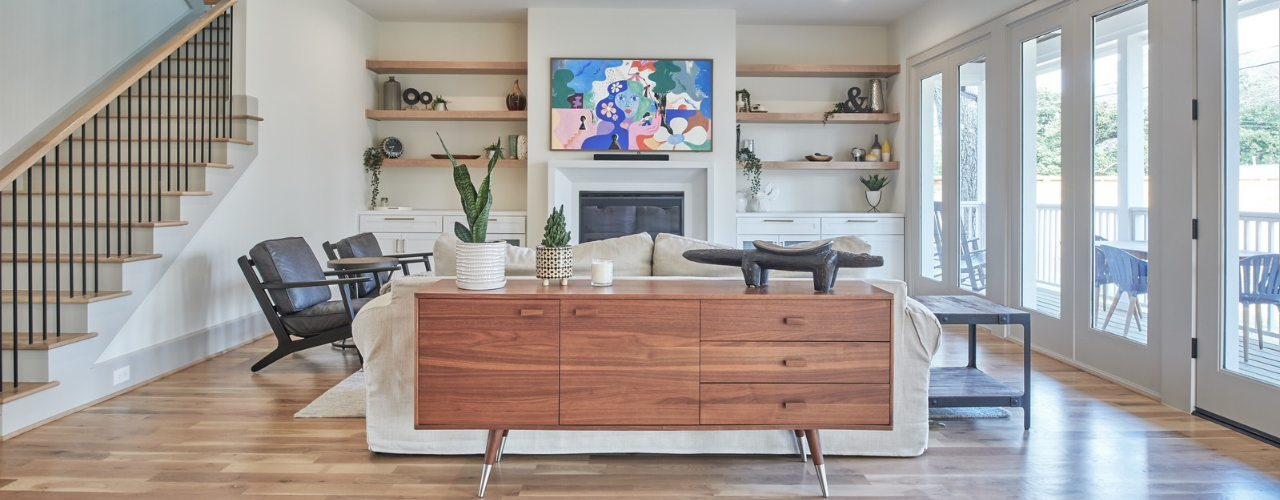
If a living room is where most of a household’s living happens, good storage should be the top priority for setting up or revamping the place. After all, think of how easier it would be to have people over when tidying up the place is just a matter of putting things in their right place (in a time when fewer and fewer people are entertaining friends at home(opens in new tab)). The trick is making room for all those wayward clothes, blankets, chargers and other small things that end up on (or, inexplicably, in) the sofa. Here are 28 living room storage ideas to get you started and make tidying up a quick affair.
25 Mudroom Storage Ideas (And Mistakes to Avoid)
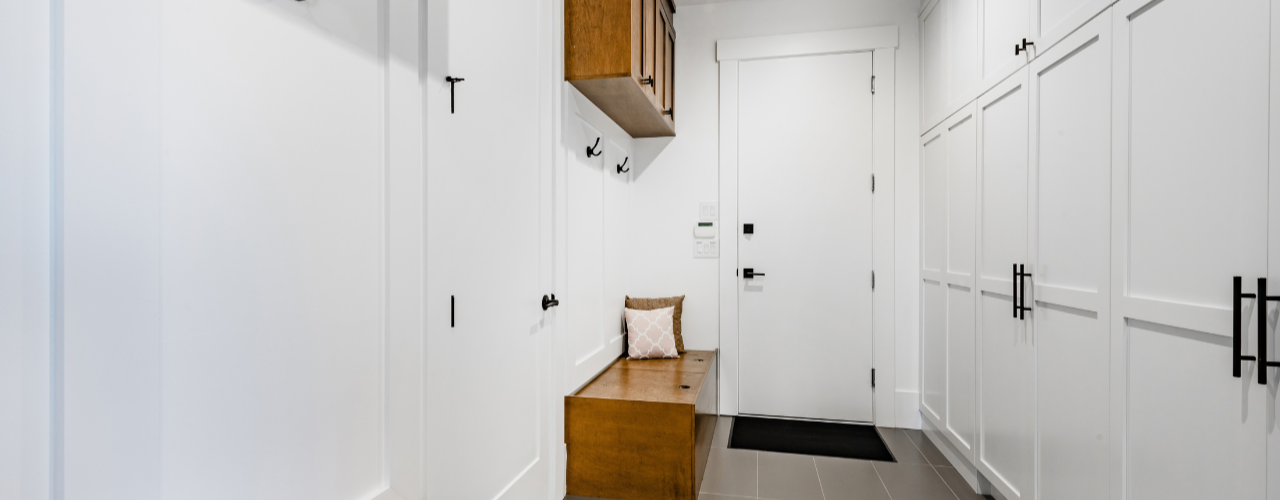
When you come home with muddy boots, an armful of bags and a coat you can’t wait to take off, it’s nice to have somewhere to put it all. With a mudroom, you can leave the outdoor mess at the door instead of carrying it through the house. Traditionally, you’d set aside a separate room, but you can just as easily use a hallway, an entryway closet, a laundry-room corner or a stretch of wall near the entrance.
Is Your Home Office Worth the Rent? What Coworking and Self Storage Could Save You
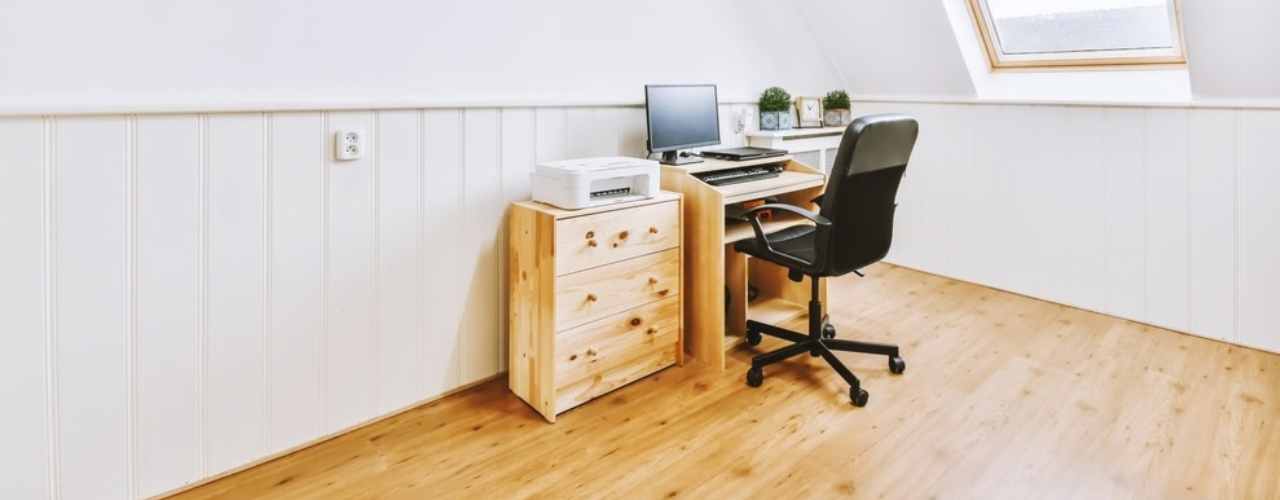
Every square foot of your apartment comes with a price tag, and a home office claims more of them than most renters expect. It starts with a desk. Then come the second monitor, the printer, the filing cabinet and the overflow boxes. Before long, the corner you set aside for work has turned into a small room you are paying for every month.

Best U.S. Cities to Live Uncluttered: Plano, TX, Offers the Most Room to Breathe
Clutter is in our homes as much as in our heads. Both are shaped by where we live.

America’s Top Snowbird Destinations for 2026–2027: Florida Leads in Numbers, Texas Wins on Value
For Americans living in colder states, the approach of winter is reason enough to start looking south. Cold weather carries costs that go beyond the heating bill and shoveling snow. Seasonal affective disorder(opens in new tab) is far more prevalent in northern states, so a temporary move south isn’t simply an escape from the cold, but a chance to spend the hardest stretch of winter outdoors and in the sun.

How Much Does Halloween Really Cost in 2026? Plan Wisely to Avoid the Scare of Hidden Costs
Americans’ love for Halloween is almost frightening — this year alone, we are on our way to spending $13.5 billion, according to data from the National Retail Federation(opens in new tab). That breaks down to about $115 Halloween costs per person, a whopping 49% more than 10 years ago.
How to Store LEGOs: All the Fun, None of the Clutter
How to store LEGOs largely comes down to how your household uses them. If the bricks are part of everyday play, you need a setup that keeps them within easy reach and makes cleanup quick (for your feet’s sake, at least). Toy storage(opens in new tab) such as simple bins, playmats or containers that children can put away themselves may be enough. Larger or more serious collections usually need more organization, such as labelled drawers for loose pieces, trays for unfinished builds, shelves for completed models and separate storage for retired sets.

Cardboard Costume Guide: Tips and Ideas for a DIY Halloween
Whether for kids or adults, cardboard costume ideas often make the biggest splash once materialized, and that’s for a simple reason: doing a lot with a little is a universally impressive feat (especially in this economy). If you don’t have enough boxes you could temporarily repurpose, don’t worry! There are many places where you can find free moving boxes(opens in new tab), from stores and supermarkets to online groups and recycling drop-off spots. On the run? Try your luck at a self storage(opens in new tab) facility that sells moving supplies, often for cheap. This way, you can choose moving boxes of different shapes and sizes(opens in new tab), so you can make your costumes as complex as you want.

How to Celebrate Halloween: 9 Non-Spooky Ways To Enjoy It
As soon as October starts, it’s the official Halloween month. And while for many people it means it’s open season to get the scare of a lifetime, others, especially families with small children, might prefer to celebrate in a tamer way that’s both kid- and adult-friendly. While you’re likely to find more events where the spook factor is high, here’s how to celebrate Halloween in a not-so-scary way: