

Starting fresh is always exciting, but before you really get to enjoy your new home, there are a few things to take care of. Less appealing, maybe, but critical for a happy new beginning.
As big fans of organizing, we’ve put together the ultimate moving checklist: a complete, step-by-step guide covering everything you need to do before, during, and after your move — from hiring movers and setting a budget to packing strategies, moving day logistics, and unpacking. Whether you’re relocating to a different state or just swapping neighborhoods, this checklist has you covered.
Moving is not the easiest feat. It requires careful planning and solid task coordination, and having it all thought out beforehand can make the difference between a hectic process and a genuinely hassle-free move. Read our advice, check the (virtual) boxes below, and moving will start to feel like the adventure it really is — one you can actually embrace and enjoy.
How to plan a move: First steps you need to take
First things first: you need a planner to jot down the details of the move – whether a simple word doc on your smartphone, a Google doc, or a printable planner. Think of this list as a command center which will help you stay on top of things, making sure you’ve completed all the steps and there’s nothing you overlooked.
Save the date
The next step while planning your move is to decide on the date of the move. Seasonality affects the costs, especially if you’re hiring professional movers. Many people choose to move during weekends and during summer months, so, due to high demand, most moving companies also have higher rates in these time slots.
Choosing a weekday and an off-season month (November through March) for your move will usually translate into lower moving costs. However, there are other factors to consider, like the weather, which is generally less “moving-friendly” during autumn and winter for most parts of the country. Then there’s the traffic, which might be busier during weekdays than during weekends.
Hiring a moving company vs. a DIY move
Hiring a moving company saves you a lot of stress and trouble, particularly for a long-distance move. Relying on professional movers will let you eliminate a few steps of the moving checklist as they’ll take care of things like the following:
- Supplying packing materials and packing your stuff for transportation, including furniture disassembly when needed.
- Truck loading, transporting your belongings to the new location, and unloading everything.
- Keeping on schedule with the move, obtaining moving permits if needed.
It’s often a good idea to book the moving company about two or even three months in advance. This way, you can be sure that the company you prefer is available on your moving day. Postponing this step for a month or less prior to the moving day means your choice of movers will be limited. Make sure you ask for quotes from at least three moving companies before booking one.
Hiring professional movers, however, can be more expensive than going with a DIY move. If you decide to take care of the move yourself, make sure you include everything when calculating the costs of your move, including:
- The time you take off work
- The cost of the rental truck
- The cost of fuel
- Cost of moving supplies
- The cost of lodging and food along the way
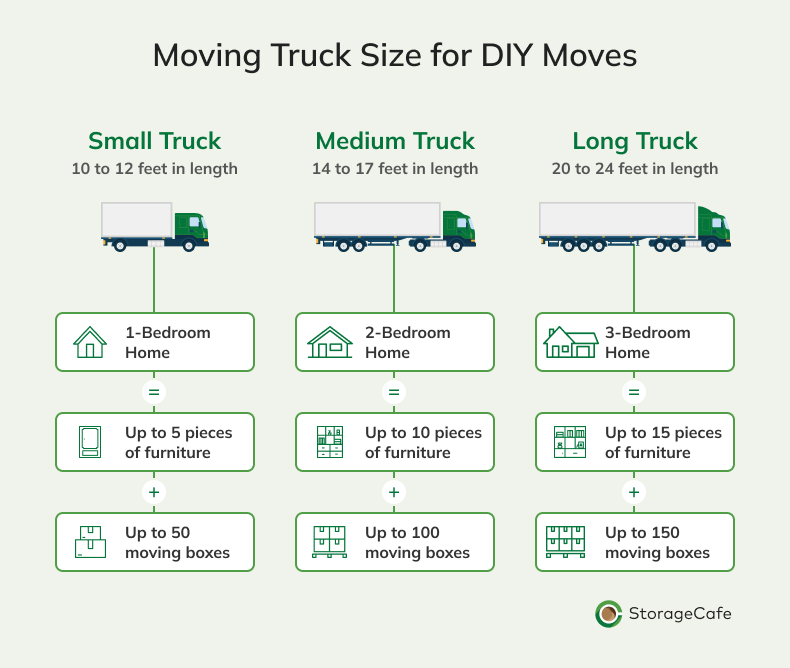
It’s also important to consider the right moving truck size for your needs as this might help you save some money. A truck that’s too small means you’re squashing your belongings together and you risk damaging them. Renting a moving truck that’s too big, on the other hand, is a waste of money. Here’s how to choose the right truck size for your needs:
- A 10 to 12 ft. truck is suitable when moving a small apartment and can hold around five pieces of furniture and up to 50 moving boxes.
- A 14 to 17 ft. moving truck is normally enough for a 2-bedroom home, and you can load it with about 10 pieces of large furniture and up to 100 moving boxes.
- A 20 to 24 ft. moving truck works for a 3-bedroom home and you can fit inside around 15 pieces of furniture and up to 150 moving boxes.
Moving permit – do you need one or not?
You might need a moving permit, depending on the place you’re moving to. The moving permit offers you the right to temporarily park large vehicles such as the moving truck in a certain location during specific times of the day. This type of permit is required particularly in big cities such as New York City, Chicago and Boston – however, regardless of where you move to, you should contact the local administration and ask about whether such a permit is required. If you’re hiring a moving company, they usually deal with the permit themselves.
Services to cancel, transfer and arrange
Contact your utility and service providers to learn details about how and when to cancel or transfer all those services and utilities. You don’t want to pay an extra month at your old address for not canceling a service on time, nor do you want to move to your new home and lack some essential services. Here are the utility and service providers you should contact in both locations – your old home and the new one:
- Water
- Electricity
- Gas
- Cable
- Internet
- Phone/cell phone
- Garbage collection
Change your USPS address
Changing your USPS address before moving saves you missing bills, notifications, deliveries, and other important documents sent by mail.
Changing the address is pretty simple and straightforward: go to the dedicated USPS web page and follow the instructions. You will have to list your contact information – full name, phone number and email – and to fill in the old address and the new one. Also, you have to choose the date when USPS should start forwarding your mail to your new address. The date you enter must not be more than 30 days prior to the moment when you’re filling out the form, or more than 3 months after.
Drawing a budget
Moving is definitely expensive and it’s important that you put together a detailed budget – it will help you, on one hand, to understand how much money you actually need and, therefore, to start saving ahead of time. On the other hand, it will help you keep those costs under control. Here are the things you should factor into your budget when planning your move:
- Cost of hiring a moving company – make sure you learn what’s included and what’s not included in the price quote. Some companies include things like moving supplies, packing, and unpacking services in their price quote, while others do not. While you might be attracted by a lower price, also be sure that you understand exactly what services that price will get you. Also, ask for quotes from several moving companies before hiring one.
- Cost of renting a moving truck if you prefer a DIY move, plus cost of fuel for the truck.
- Moving supplies costs – different types of boxes, tape, plastic and bubble wrap, markers, labels, and so on.
- Equipment rental – you might need a dolly to load up heavy items, or other electrical tools to disassemble your furniture.
- Insurance costs – you might want to get extra insurance for your belongings, on top of what the moving company or the truck rental company is offering. If you are planning to move valuable items — for example, artwork, antiques, musical instruments and expensive furniture — extra insurance is highly recommended.
- Moving permit
- Fuel, lodging, food and parking costs in case you’re driving your own car to your new home. These costs add up quickly in the case of long-distance moves.
Also keep in mind:
- Vehicle shipping costs if you decide to ship your cars.
- Cleaning costs for both your old and new homes.
- Cost of taking time off work to organize and complete your move.
- Storage unit costs(opens in new tab), as you’ll most likely need to store some of your items before and after the move, as you pack up your old home and until the new home is ready.
- Childcare and/or pet care costs on moving day.
- Setting up utilities at your new home – some companies require fees for setting up services such as Internet, cable, and so on.
- Remodeling costs – that really depends on the situation, but, even if the new home doesn’t need a lot of work, you might still want to paint some walls, improve the backyard and so on. It’s smart to set aside some money for such small projects.
- Furniture and appliances updates – your existing furniture and appliances might not fit into your new home, and you might have to buy new items.
To help you understand all the ramifications and the importance of calculating a detailed budget, we came up with an example for one of the country’s most popular moving routes, California to Texas(opens in new tab), or, more precisely, San Francisco to Austin.
We calculated the budget for moving an average sized home (2-3 bedrooms) based on the categories of expenses listed above. Both types of moves were considered – hiring a moving company or DIYing the move. We obtained price estimates from several companies for each expense in the budget where it applies. We did not include remodeling costs and furniture and appliances updates, as they are not necessarily a part of the moving process, and usually vary widely, depending on the situation.
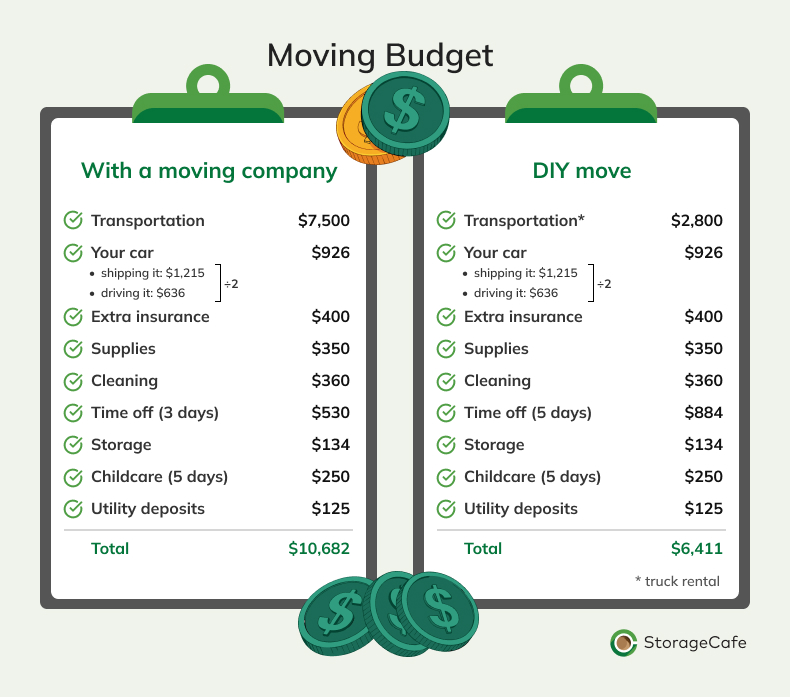
Based on our calculations, a DIY move is indeed more affordable – relocating this way from San Francisco, California, to Austin, Texas, including all the associated expenses, results in an overall cost of around $6,400. If you’re hiring a moving company, you should expect to pay a little over $10,000, but, on the other hand, there’s a lot less work involved in the process.
This calculation is obviously just an example, but it clearly shows why it’s important to put everything in your budget: costs do add up quickly, even for apparently small things like paying a babysitter.
How to declutter before your move
Decluttering(opens in new tab) is one of the most important steps of a successful, stress-free move. Besides distance, the quantity of stuff you are transporting from one home to the other is the most important indicator of how expensive that move is going to be. By taking the time to declutter thoroughly, you are making your move simpler and less expensive.
Here’s how to tackle your home’s decluttering:
Start early on – two months before the moving date is a good moment to begin the decluttering process. This way, by the time you start packing, your belongings will already be sorted out.
Start decluttering from the outside in – this means starting with auxiliary spaces such as the garage, basement, attic, garden shed, and so on. These spaces are usually the most cluttered in a home, as people tend to banish the items they no longer need and use there, whether they are furniture, electronics, appliances, toys and books, clothes, and so on.
Once you have cleared up those spaces, it’s time to start decluttering indoors.
Go through your closets with a critical eye and let go of all the items you haven’t worn in a while. A year is a commonly used timeframe when deciding whether you should keep a certain piece of clothing or let it go – if you haven’t worn it for an entire year, you probably don’t need it.
Keep only one of the same type of items – if, for example, you have two lawnmowers that do the same job, or two kitchen blenders, keep the one you like most and give up on the other.
Make sure your furniture and appliances fit into your new home. Keep to hand detailed measurements of the sizes of the rooms and the widths of door frames in your future home. Then, for each item, check whether you’ll be able to get it into its new room and if it will fit properly in there. It’s a waste of time, money, and effort to move stuff you won’t be able to use.
Find creative ways to deal with your sentimental items, from children’s drawings to ancient t-shirts or boxes with old pictures and magazines. Instead of packing up all that stuff, maybe you could take pictures of the most significant items or use them in collages or other artsy projects. This way, you’ll manage to enjoy their sentimental value even more, without having to transfer so much stuff.
Use the things you like instead of saving them for an undefined future – many of us tend to “save” stuff that we love, such as a nice bedding set, tableware, and so on. Well, what better time to use your favorite items than when moving into a new home? Leave your old, tattered items behind and enjoy the new ones.
What do you do with the things you no longer need?
Now that you finished decluttering your home, you’re left with an appreciable amount of personal and household possessions you have to deal with. There are several ways to get rid of the things you no longer need:
- Donate the clothes to charitable organizations such as Goodwill or Salvation Army. Both organizations are easily accessible throughout the country and have excellent track records with their charitable work. If you have shoes to donate, consider Soles4Souls, an initiative helping people in developing countries to launch their own businesses selling donated shoes and clothing, and it’s also distributing shoes and clothing to people in need in the US and worldwide.
- Donate the books you no longer need to local libraries or to organizations such as Reader to Reader, or check the book donation map of America to find the nearest organization that accepts such items.
- Donate furniture(opens in new tab), appliances and electronics to Habitat for Humanity ReStore, where your items get a new life instead of ending up in a landfill.
You could also:
- Organize a garage sale.
- List your items for sale online, whether it’s Craigslist, Facebook Marketplace, or other similar websites.
- Ask family and friends whether they want some of the stuff you no longer need.
- Recycle the items that are not suitable to be sold or donated. Contact your local waste management company or local authorities to find out how you can dispose correctly of bulkier items like furniture, appliances, and so on.
How to pack for a move
Actual packing can start a few weeks prior to moving day, as it’s a laborious task that usually takes much longer than people estimate. Of course, if you want an early start on packing, you should begin with items you don’t use on daily basis, such as winter clothing if you’re moving in the middle of the summer, for example. There are different packing strategies, so pick the one that suits your needs best:
Following the logic of the Marie Kondo decluttering method, you can pack your home by category: clothes, books, papers, miscellaneous items and sentimental items. This approach works best when you have only a few days left for packing, as it provides an easy-to-follow plan and allows you to declutter as you pack, if you haven’t yet had the chance. By packing all the clothing in your home in one go, it’s easy to spot and discard the items you no longer need – and the same is true for each category of belongings.
Packing by room is another strategy that allows you to start the process ahead of time. You can pack first the areas of your home you don’t use so often — for example, basement, attic and garage — followed by guest bedrooms, the dining room and the living room. Pack the kitchen, bathrooms, and the bedrooms used by family members last, as you need and use those spaces the most.
Find the packing method that works the best for your family. If, for example, you have small children, maybe the best course of action could be to ask a friend or family member to babysit during the weekend prior to the move and do the bulk of the packing then. On the other hand, if your children are teenagers, ask them to pack their own bedrooms how they see fit, while you deal with the rest of the home.
Supplies you need for packing up your home
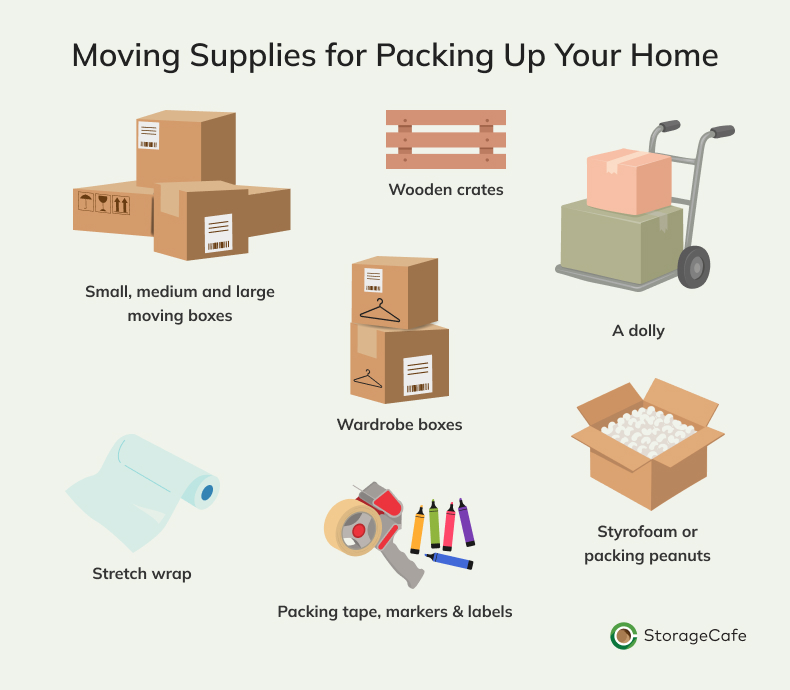
You’ll need an assortment of boxes, plus other supplies, to help you pack everything safely and orderly. Here are the packing supplies you must have by the time you start packing:
- Small, medium and large moving boxes
- Wardrobe boxes
- Wooden crates for heavy items
- Packing tape
- Styrofoam and/or packing peanuts for protecting fragile items. Alternatively, you can use old newspapers, sheets, towels, and so on.
- Stretch wrap
- Markers and labels
- A dolly for moving heavy items. If you’re using a moving company, they will have one. If you’re renting a moving truck, ask the company about also renting a tow dolly. Otherwise, you could purchase a simple, inexpensive one that still gets the job done.
The number of moving boxes(opens in new tab) you need depends, obviously, on the number of bedrooms you have and the size of your household. Here’s how to approximate how many boxes you need for your home:
- Calculate approx. 5 small boxes, 5 medium and 5 large boxes for each bedroom, plus a couple of wardrobe boxes if needed. Wardrobe boxes allow you to pack hanging clothes without wrinkling them. One wardrobe box generally holds approx. 20 inches of closet space, so, if your hanging closet is 40 inches in length, you need two wardrobe boxes.
- For a family-sized kitchen, you need about 10 small boxes, 6 medium boxes and another 6 large boxes. You should also get a few dish barrel boxes that allow you to transport your breakable items (glasses, mugs, plates, and so on) safely.
- Packing the average living room requires up to 5 small boxes, around 4 medium boxes, and another 3-4 large boxes.
How to efficiently pack your kitchen
The kitchen is, understandably, one of the most difficult rooms to pack. On the one hand, it contains a lot of stuff and, on the other, you need to use it until moving day. Here are some simple rules that will make packing your kitchen a lot easier:
- Check out your fridge, freezer and pantry and try to eat all the food you have before moving, instead of buying more food or ordering take out.
- Use sturdy boxes for breakable and fragile items, such as china, mugs, cups and small appliances.
- Set aside the essential items you need to use until the last moment: a few dishes, cutlery, cups, a toaster, your coffee maker, dish soap and some kitchen towels. Pack those only on moving day, in one box, and label the box properly, to make sure you find your kitchen essentials easily in your new home.
- Empty and defrost your fridge and freezer the day before moving day. Wash them thoroughly inside and out and allow the interior to dry off completely before closing the doors in order to avoid musty smells. Then, tape the doors shut to prevent potential damages during transportation.
If you’re left with a supply of unperishable foods that you don’t want to take with you, contact a local soup kitchen or other charitable organization and donate that food.
Things to remember while packing
- Don’t overstuff the moving boxes, as they might tear apart during transportation.
- The heavier the moving boxes are, the more complicated the move is, particularly if it’s a DIY move. Favor small and medium boxes over large and extra-large ones as much as possible.
- Use sturdy boxes or wooden crates for heavy items like books or tableware.
- Protect electronics and appliances with bubble wrap, packing peanuts, old newspapers or other soft, protective materials.
- Use stretch wrap to protect your furniture from scratches, and use corner protectors, particularly for expensive furniture that you can’t disassemble for moving.
- It’s a lot easier to move flatpack furniture if you disassemble it.
- Label all your boxes. Buy colored markers and assign colors for each room – red for living room, green for kitchen and so on. If you’re planning to stick labels on your boxes, make sure they are good quality and don’t peel off during transportation.
- Be detailed when labeling the boxes – don’t simply write “kitchen” on a box but also add a small inventory of what the box actually contains. For example, “kitchen cups and mugs.” That will help a lot when unpacking.
Use self storage to store packed items until moving day – and after
Starting to pack ahead of time makes moving easier to manage – however, it doesn’t make a lot of sense to keep your already packed stuff, be it furniture, appliances, or clothing, inside your current home. Instead, rent a self storage unit located close to your future home and take your packed items there. In case of long-distance moves, it’s important to know that many self storage facilities accept deliveries, which means you can ship some of your things close to your future home prior to moving day.
If your new home is not yet move-in ready, you can store all your stuff until you are done with all the remodeling work. Here’s how to decide what size of storage unit you need:
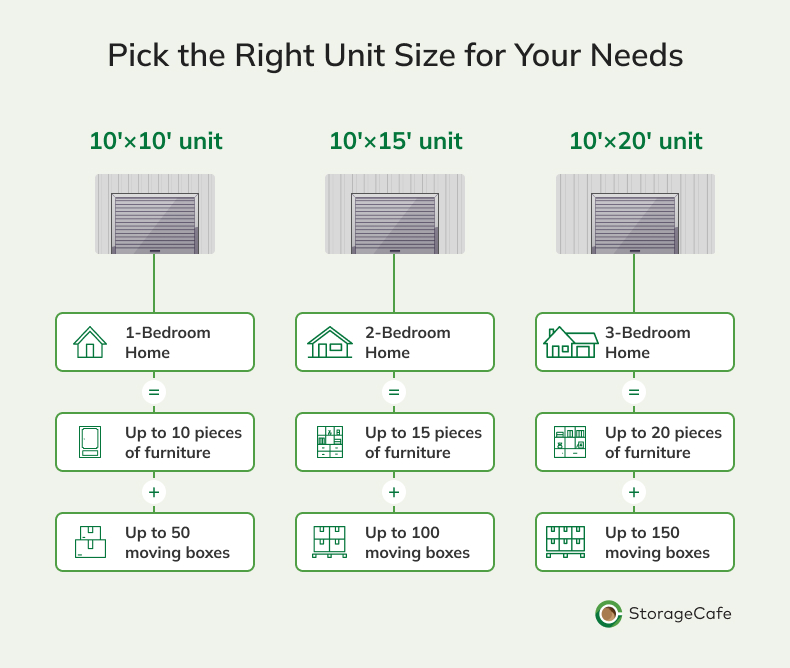
- A 10×10 unit(opens in new tab) is enough to store the belongings from a studio apartment or from a small one-bedroom apartment.
- A 10×15 storage unit(opens in new tab) can hold the furniture and the other belongings from a regular 2- or 3-bedroom house or apartment.
- The 10×20 storage unit(opens in new tab) is about the size of a one-car garage, and you can fit into it the entire contents of a fairly large home (3+ bedrooms).
Things to keep for personal transportation
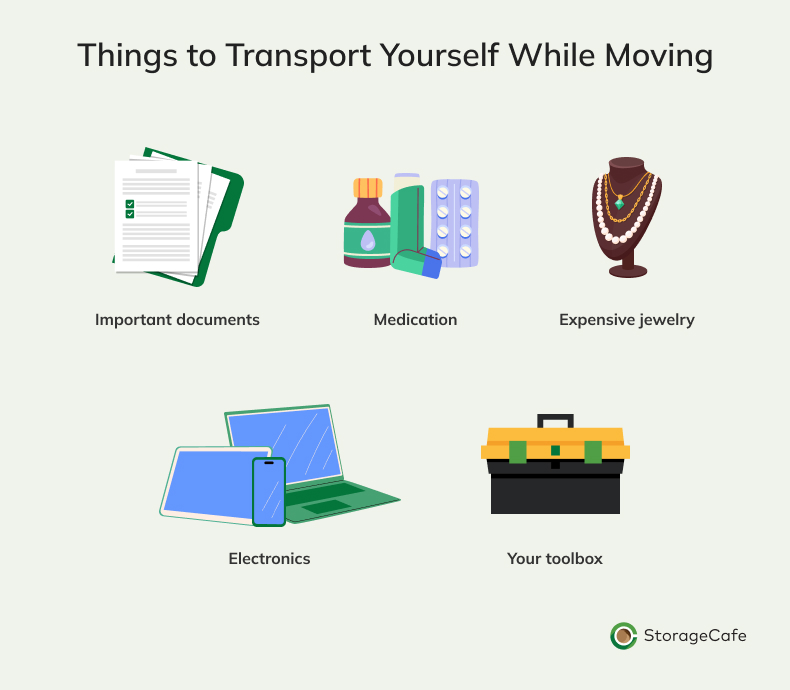
There are a few categories of items you shouldn’t pack in the moving truck, for safety reasons, as you don’t want them to be damaged or lost. Here’s a list of the things to keep for personal transportation:
- Important documents – passports, birth and marriage certificates, insurance policies, medical documents.
- Medication and health-related devices you or your family might use.
- Electronics such as laptops or tablets.
- Expensive items like jewelry and such
- Your toolbox – you’ll need it a lot during moving day, so keep it close.
Pack a moving day basket with snacks and other necessities
Put together a basket with sandwiches, snacks, fruit and water for moving day – you probably won’t have the time to stop for a proper meal, but you will need some sustenance during such a busy day. Add some paper towels and wet wipes, and chargers for the phones and tablets you will be using on that day. Make sure that family members who take medication daily have that medication on hand.
Also, put some cleaning supplies together – sponges and rags, floor and surface cleaners, kitchen and bathroom spray cleaners, a broom set and a mop – and put them all in a bucket. Make sure the bucket is easily accessible when you reach your new home. You might have to do a bit of extra cleaning before unloading the furniture and appliances.
Pack a first-night kit for your new home
You’ll be exhausted after moving day, so it’s smart to have an easily accessible “first-night kit” for your family. Here’s what it should contain:
- Bedding, towels and pajamas for all your family members.
- Personal care products such as soap, shampoo and toothpaste.
- Your children’s favorite toy or book.
- Food, dishes and beds for your pets, if you have any.
Moving day – how to make sure it runs smoothly
- Try to take at least a couple of days off work to deal with all the unpacking and with setting up your new home. Even if you move during the weekend, it’s going to be challenging to have your home in relative order by Monday. Plus, you might have to be at home during a weekday if companies need to drop by and install Internet or cable TV.
- You want to start moving day as early as possible, so it’s a good idea to load the moving truck the night before. If you’re using a moving company, ask them whether it’s possible to follow this schedule – many moving companies will agree with your request.
- Load the truck in the reverse order of how you want it unloaded – if you want to unpack the kitchen first, then make sure that the kitchen stuff is loaded inside the moving truck last.
- Arrange for childcare and/or pet care for moving day. It’s going to be stressful and busy, and little ones running around your house will only add to all that.
- Search for food delivery services close to your new home and have some food delivered by the time you finish unloading the moving truck. Make sure to order extra, so you’ll have something to eat the next morning, until you manage to go grocery shopping.
Unpacking – how to approach it efficiently
You’re home. But it’s not home yet with all those boxes crowding your space. It’s time to find a place for all those things you own. Unpacking should follow the same method that you chose for packing – whether you packed by category or by room, you should unpack the same way. However, there are some general rules to follow that will make unpacking a bit easier:
- Get the big items inside first, such as furniture and appliances, and take them to their respective rooms before bringing in the boxes full of stuff. It’s a lot easier this way than trying to maneuver bulky and heavy items while the floor is covered with various boxes.
- Pay attention to the box labels and make sure the movers – or the family and friends helping you to move – understand where each box must go.
- Once the truck is unloaded and everything is inside, get the “first-night kit” you assembled and make the beds for everyone – you will have even less energy by the time night falls, so it’s better to have the beds ready as soon as possible.
- Retrieve your box with kitchen essentials and make the kitchen as functional as possible for the time being – make sure you have some plates and cutlery to eat with, and that you are able to prepare a cup of coffee or tea.
- If you have small children, quickly childproof the house – make sure the doors close properly and that they can’t get out without you noticing. Also, keep a close eye on them during the night, until you get the chance to childproof the home completely.
- Consider keeping pets inside a crate for the first night – this will give them a chance to get over the excitement of the move and will allow you to identify pet-related dangers that might exist in your new home.
- Locate the fuse box and water valve in case something goes wrong and you need to shut off water or electricity.
- Introduce yourself to your neighbors – it’s easier and less awkward to meet your neighbors during moving day.
- If you still have time and energy left, start unpacking the boxes – however, if you’re very tired, leave everything for the next morning, enjoy your moving day pizza, and have some rest.
Moving Resources
Moving checklist timeline: What to do and when
What should I do 30 days before moving?
- Book your moving company or moving truck.
- Change your USPS address.
- Contact utility and service providers and start the process of closing out the services at your old address and setting them up at the new one.
- Notify your landlord if you’re renting and find out when you can have your security deposit reimbursed.
- Start decluttering your home and sell or donate the stuff you no longer need or want.
- Contact your family doctor and have your and your family’s medical records transferred.
- Contact your insurance company about canceling your home insurance policy – or transferring it to your new address, if possible.
- Send cancellation or transfer notices to service providers.
What should I do 3 weeks before moving?
- Start packing your non-essential items.
- Rent a self storage unit close to your new home and start storing your stuff as you pack it.
- Check out the new home and determine if you want to do some small remodeling projects before you move. If you do want that, get to work immediately.
- Perform a deep clean of your new home, if necessary. If it’s a long-distance move, contact a cleaning company to perform this service.
What should I do 2 weeks before moving?
- Make a list of the packing supplies that you need and obtain them – you can buy all the supplies, or you can search for people or businesses donating cardboard boxes in your area.
- Have your car serviced, particularly if you plan a long-distance move and you want to drive to your destination.
- Contact your family and friends to ask for their help on moving day if you’re planning a DIY move.
- Plan your meals so you finish all the food in the house before moving day.
What should I do 10 days before moving?
- It’s time to start packing the bulk of your stuff. Pack strategically, and make sure the last items you pack are the ones you use on daily basis.
- Pay any remaining bills you might have with local businesses.
- Return any books, DVDs and games you got from your local library.
- Arrange for childcare and/or pet care during moving day.
What should I do the day before moving day?
- Defrost and clean your fridge and freezer and prepare them for moving.
- Make sure your toolbox is complete and up to the task.
- Prepare sandwiches and snacks for moving day.
- Have essential kitchen items and cleaning supplies packed and ready to go.
- Pack first-night kits for your entire family.
- Load the moving truck the night before moving day, if possible.
Moving FAQs: All you need to know to help your move easier
Start saving money for the move a few months in advance. Take plenty of time with decluttering – sell, donate and recycle all the stuff you don’t need. Start packing at least a couple of weeks before moving day – or even sooner, if you’re moving a big home. Rent a self storage unit close to your new home and store items there as you pack them, to streamline your move.
How much does moving cost?
The cost of moving is determined by distance and the volume of stuff you are moving. Ask for quotes from a few moving companies or truck rental companies to find out how much moving will cost in your case. For example, moving an average home from California to Texas, a popular relocation route nowadays, costs around $7,000. Relocating from New York to Florida will cost you up to $6,000, while swapping Illinois for Indiana requires a budget of around $4,000. These are just the basic moving costs, without added expenses such as cleaning services, time off work, remodeling work, food and accommodation along the way, and so on.
Is it better to hire movers or move yourself?
It depends a lot on the circumstances. A local move, especially when it’s an apartment or a smaller home, can be done without hiring professionals. However, long-distance moves are more challenging, and you might be better off hiring a moving company. Renting a moving truck is another option – however, you have to be comfortable with driving a huge truck perhaps a thousand miles or more.
How much do you tip movers?
It’s customary to tip your movers, to show appreciation for their effort and for taking care of your stuff. A $40-$50 tip per person is appropriate for a full-day move, one that lasts around 8 hours. In the case of a less complicated move, when movers are helping you for half a day, you can tip about $20 per person. Another way to calculate is to count how many hours they worked and to offer a $4-$6 tip per person and per hour.
What are the best months to move?
The most popular months for moving are May to September, when the weather is nice and while children are out of school. However, the popular months are also the most expensive, and you might save money if you move off-season: November to March.
What should you not pack when moving?
Don’t pack anything that’s damaged, tattered, not functioning properly, or that you haven’t used in a while and probably won’t use again. Go through all your papers, documents and magazines to see what’s important and should be packed and moved and what you can throw away. Also, don’t pack anything that’s flammable or explosive, like paint thinners, full gas cannisters, and so on.
What will professional movers not move?
Professional movers don’t move hazardous materials – paint and paint thinners, aerosol cans, batteries, and anything containing flammable or explosive substances. Most moving companies will hand you a list ahead of time with the items they won’t move.
If you have to move items that are fragile, extra heavy or very expensive – such as pianos, antique furniture, art collections, and so on – book a moving company that specifically states that they are equipped to move such objects.
How do I start decluttering to move?
Start by decluttering the spaces you use the least during your daily activities, such as the attic, the garage and the basement. Move to the inside areas or your home and declutter all your closets, drawers and shelves. Next, you can proceed to sorting the big pieces of furniture and the appliances and decide what to pack and move to your new home and what you’ll leave behind.
Is self storage worth using when moving?
Self storage(opens in new tab) is very helpful while moving. Rent a self storage unit close to your new home and store your stuff in there as you pack it – this way, by the time moving day comes, the work is half done. Also, if your new home is not exactly move-in ready, you can keep the bulk of your belongings in storage until you’re done with the remodeling work.
When it comes to self storage costs(opens in new tab), the service is generally affordable so it won’t eat up too much of your moving budget. A standard 10×10 storage unit stands at about $120, according to Yardi Matrix. Rates will vary a lot depending on location. For example, a 10×10 self storage unit in San Francisco(opens in new tab) rents for a little over $300 per month, while the street rate for same type of storage unit in Austin, Texas(opens in new tab), is around $120.
What should I put in storage when moving?
Put your belongings in storage as you pack them, starting, obviously, with the ones that you need the least for the moment. If, for example, you’re moving during the summer, pack and store your winter-related clothing and gear. Then, pack the rooms you use the least – the guest bedrooms, or the dining room – and put everything in storage until moving day. Also, you can keep the bulk of your belongings in storage if there’s still remodeling or cleaning work to be done at your new home.
When should you start packing to move?
You should start packing about two weeks prior to moving day, on average, but it really depends on the size of the home you are packing. If you’re living on your own in a small one-bedroom apartment, you can easily finish packing in a day or two. However, packing a 3+ bedroom home will take a lot longer, so give yourself enough time. Count at least two full weekends for decluttering, prior to packing, and a few more days for actually packing and preparing everything for the move.
What should you move first when moving?
Pack first the things you need the least during your daily activities – out of season clothing and gear, your extra towels and bedding, books, fine China, artwork pieces, decorative items, and so on.
What should I pack last when moving?
The items you should pack last are the ones you use all the time – toiletry items, everyday clothing and shoes, medication, your children’s favorite toys and books, and pet paraphernalia. Your toolbox and house cleaning supplies should be the last items to go into your moving truck or your car, as you’ll probably need them as soon as you reach your destination.
How do I pack bulky objects?
Bulky, heavy objects, and those with irregular shapes, are a bit more difficult to pack. If those items are too big to go in a box, you can wrap them in plastic or bubble wrap for the move. Protect the corners and the edges of the items with pieces of sturdy cardboard, to avoid damage from transportation.
How do you move in one day?
Moving in one day is doable if you have the bulk of the packing already done – in fact, most people moving locally allocate one day to the actual process of transferring their belongings from point A to point B. However, if your belongings are not ready for transportation, it’s going to be a rather impossible mission. If you find yourself in this situation, ask for help from family and friends, start as early as possible, and start packing your most important possessions first, to make sure you have the time to move them.
How do you move in two days?
That’s a difficult task, and you should really allocate more time for moving. However, there are some strategies that can help you expedite the move if you only have two days to get the job done:
- Pack your essentials first.
- Go room by room when packing.
- Wrap your drawers in plastic wrap with all the contents inside.
- Put plastic bags over your clothes hangers and move them altogether. This will save some time with both packing and unpacking clothes.
- Pack clothing and other lightweight items in large plastic bags instead of boxes, as this takes less time.
- Use moving boxes for fragile and breakable items, and wrap them in clothes, towels, and so on, saving both time and money.
How do you move in one week?
Moving in one week is less than ideal, but if you act quickly and decisively, you might be able to pull it off. Here’s what you need to do:
- Get enough moving supplies so you don’t have to make multiple trips to the store.
- Enlist the help of friends and family.
- Take a couple of days to declutter – it will pay off, as you’ll have fewer items to pack and transport.
- Try to stay as organized as possible, but you might have to cut some corners. If you don’t have the time to carefully pack and label each box, you’ll have to deal with it when you unpack.
- Try to hire professional movers, although it might be difficult to find available ones at short notice.
What is the luckiest day to move to a new house?
There are different superstitions concerning when to move and when not to move to a new home. A common superstition says you shouldn’t move on Friday and Saturday – well, that’s a shame, seeing as most people favor weekends for moving. Also, it’s considered unlucky to move during a rainy day – that’s a totally understandable superstition. Thursday is considered the luckiest day for moving.
Top moving companies for long distance moves
More than 30 million Americans are moving annually, according to the US Census, resulting in a flourishing moving industry with about 8,500 moving companies and an annual revenue of around $20 billion(opens in new tab). Customers therefore have plenty of choices when searching for a moving company – here are the major players on the market:
- United Van Lines(opens in new tab) has a nationwide network of 400+ agents across 46 states and has been in the moving business for nearly a century. They handle long-distance, local, and international moves.
- North American Van Lines(opens in new tab) is one of the country’s top-rated long-distance movers, consistently ranking among the best in independent surveys. Founded in 1933, the company operates through a network of agents across all 50 states and internationally, offering full-service household and corporate moves, packing and unpacking, auto transport, and short- and long-term storage solutions.
- Atlas Van Lines(opens in new tab) is one of the largest interstate carrier in the country, with more than 200 agents in the U.S. and around 500 agents globally across over 140 countries. They offer a wide array of services, from long-distance and local moves to military transfers, moving special items, and corporate relocations.
- Mayflower(opens in new tab) has been in the moving business since 1927 and operates through a network of more than 200 agents across the United States. They offer local, long-distance, and international moving — including service to more than 150 countries — plus additional services like car transportation, full-service packing and unpacking, and multiple insurance options for your belongings while in transit.
- Allied(opens in new tab) The company operates through a network of 400+ agents across all 50 states, with a global reach spanning more than 130 countries. It handles long-distance and international moving for households and businesses, and offers both virtual in-home surveys for cost estimates and a container-based option called Allied Express for smaller moves.
- PODS(opens in new tab) is an innovative moving and storage company that gives you maximum flexibility: a portable container is delivered to your door, you fill it on your own timeline, and PODS either transports it to your new address or stores it at one of their facilities until you’re ready.
Top self storage operators
The self storage industry is on a growing path(opens in new tab) in the US – new supply projected to go online in 2026 alone amounts to over 55 million square feet, and there are over 47,000 storage facilities throughout the country, from small, independent businesses to large providers. In other words, customers have a wide array of options when it comes to renting self storage(opens in new tab) – a much needed service for people on the move.
Here are the biggest self storage companies in the country:
- Public Storage(opens in new tab) has more than 3,500 locations in 40 of the country’s states and territories, and it’s best represented in Texas, California and Florida.
- Extra Space Storage(opens in new tab) owns and/or operates about 4,200 storage facilities containing more than one million storage units in 43 states.
- CubeSmart(opens in new tab) owns or manages over 1,500 facilities throughout the country. Its most active markets are New York, Texas and Florida.
- National Storage Affiliates(opens in new tab) operates more than 1,000 storage facilities located in 37 states and territories, totaling more than 69 million square feet of rentable storage space.
Home organizing methods – quick roundup
Now you have moved into your new home, you should make the most of this fresh start and adopt a home organizing philosophy that suits your preferences and your lifestyle. Having a method based on which you organize everything makes it easier to keep your home tidy and uncluttered and reduces cleaning time. Here are some of the most popular home organizing methods – pick the one that’s right for you and your family:
- The KonMari method, popularized by professional organizer Marie Kondo, is centered around the idea that our belongings must “spark joy” for us. Consequently, we should ditch all the stuff we don’t use and enjoy on a daily basis. Marie Kondo also offers plenty of advice on how to organize your closets, drawers and cabinets(opens in new tab), so that you have easy access to everything and no clutter around the house.
- The Home Edit way of organizing your home emphasizes an orderly aesthetic – you learn to organize everything using bins, containers, baskets, labels, and so on. But, more than that, it’s about making sure that your well-organized belongings are also pleasing to the eye: color coding your books on shelves, or your clothes in the closet, for example.
- Outer Order, Inner Calm method from Gretchen Rubin comes with very practical, easy to apply clutter-clearing suggestions, turning what might initially look like a huge amount of work into smaller, manageable tasks.
- The minimalist method preached by Joshua Becker advices us to pare down our possessions and to keep only the bare minimum. Obviously, keeping your home tidy and uncluttered under such circumstances is a piece of cake. Also, minimalism teaches us to stop spending money on stuff we don’t absolutely need – so it’s friendly to our bank accounts too.
- The Alejandra Costello method helps you identify the things that hold you back when it comes to clutter, whether it’s not knowing how to begin, procrastination, a genuine lack of space, and so on. Then, you get to organize your home based on your situation.
Happy Moving and Enjoy your New Home!


25 Mudroom Storage Ideas (And Mistakes to Avoid)
When you come home with muddy boots, an armful of bags and a coat you can’t wait to take off, it’s nice to have somewhere to put it all. With a mudroom, you can leave the outdoor mess at the door instead of carrying it through the house. Traditionally, you’d set aside a separate room, but you can just as easily use a hallway, an entryway closet, a laundry-room corner or a stretch of wall near the entrance.
Is Your Home Office Worth the Rent? What Coworking and Self Storage Could Save You
Every square foot of your apartment comes with a price tag, and a home office claims more of them than most renters expect. It starts with a desk. Then come the second monitor, the printer, the filing cabinet and the overflow boxes. Before long, the corner you set aside for work has turned into a small room you are paying for every month.

Best U.S. Cities to Live Uncluttered: Plano, TX, Offers the Most Room to Breathe
Clutter is in our homes as much as in our heads. Both are shaped by where we live.

America’s Top Snowbird Destinations for 2026–2027: Florida Leads in Numbers, Texas Wins on Value
For Americans living in colder states, the approach of winter is reason enough to start looking south. Cold weather carries costs that go beyond the heating bill and shoveling snow. Seasonal affective disorder(opens in new tab) is far more prevalent in northern states, so a temporary move south isn’t simply an escape from the cold, but a chance to spend the hardest stretch of winter outdoors and in the sun.

How Much Does Halloween Really Cost in 2026? Plan Wisely to Avoid the Scare of Hidden Costs
Americans’ love for Halloween is almost frightening — this year alone, we are on our way to spending $13.5 billion, according to data from the National Retail Federation(opens in new tab). That breaks down to about $115 Halloween costs per person, a whopping 49% more than 10 years ago.
How to Store LEGOs: All the Fun, None of the Clutter
How to store LEGOs largely comes down to how your household uses them. If the bricks are part of everyday play, you need a setup that keeps them within easy reach and makes cleanup quick (for your feet’s sake, at least). Toy storage(opens in new tab) such as simple bins, playmats or containers that children can put away themselves may be enough. Larger or more serious collections usually need more organization, such as labelled drawers for loose pieces, trays for unfinished builds, shelves for completed models and separate storage for retired sets.

Cardboard Costume Guide: Tips and Ideas for a DIY Halloween
Whether for kids or adults, cardboard costume ideas often make the biggest splash once materialized, and that’s for a simple reason: doing a lot with a little is a universally impressive feat (especially in this economy). If you don’t have enough boxes you could temporarily repurpose, don’t worry! There are many places where you can find free moving boxes(opens in new tab), from stores and supermarkets to online groups and recycling drop-off spots. On the run? Try your luck at a self storage(opens in new tab) facility that sells moving supplies, often for cheap. This way, you can choose moving boxes of different shapes and sizes(opens in new tab), so you can make your costumes as complex as you want.

How to Celebrate Halloween: 9 Non-Spooky Ways To Enjoy It
As soon as October starts, it’s the official Halloween month. And while for many people it means it’s open season to get the scare of a lifetime, others, especially families with small children, might prefer to celebrate in a tamer way that’s both kid- and adult-friendly. While you’re likely to find more events where the spook factor is high, here’s how to celebrate Halloween in a not-so-scary way:

Motorcycle Storage Guide: How to Store Your Bike Safely
Motorcycles may be born to be wild, but eventually even the wild ones need somewhere to park. Whether riding season is winding down or your current living situation comes with plenty of square footage for you and less for your bike, motorcycle storage is one of those parts of ownership that doesn’t get as much airtime as the open road.